
Key takeaways
- Bethesda Game Studios has made no official announcements regarding remakes of the first two Fallout games, leaving a significant gap for players nostalgic for the original isometric RPG experience.
- The community response to Fallout: Bakersfield has been overwhelmingly positive, with commenters describing it as potentially “the best Fallout in over a decade” and “the sickest Fallout project” ever attempted.
- Despite the project’s non-commercial status and voluntary donation model, Fallout: Bakersfield carries significant legal risk.
- The original Fallout, released in 1997, sold approximately 600,000 units, establishing the franchise’s foundation.
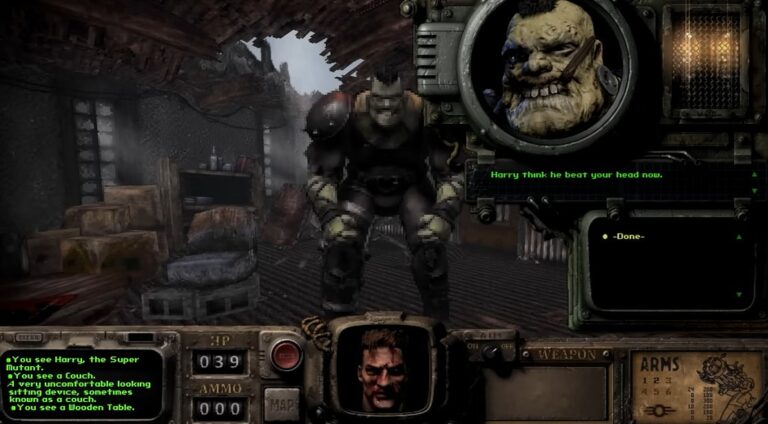
A fan-made total conversion mod called Fallout: Bakersfield has resurfaced with a major 4-minute trailer in July 2025, confirming its continuation after a three-year development silence and revealing that the project is currently 60% complete with an estimated 2027 release date. Built on the GZDoom engine as a first-person “boomer shooter” reimagining of the original 1997 Fallout’s Necropolis area, the non-commercial mod represents one of the most ambitious fan projects in the franchise’s history. Developer Alexander Berezin stated the primary goal is “transferring the original atmosphere to the first-person mode,” blending classic Fallout aesthetics with Doom-style 2.5D sprite visuals across Windows, macOS, and Linux platforms.
A Project Two Years Away From Completion
Alexander “Red888guns” Berezin, working alongside Denis Berezin, confirmed in recent communications that Fallout: Bakersfield stands at the 60% completion mark, with the remaining 40% estimated to require approximately two years of continued development. The July 2025 trailer itself contained a deliberate narrative arc, flickering between release date placeholders reading “2025,” “202?,” and briefly “2027,” suggesting the latter represents the developers’ internal target despite their public reluctance to commit officially to any timeline.
Progress breakdowns reveal uneven development across different asset categories. World and tile construction has reached 80% completion, positioning the game’s environments as the most advanced component. Weapon implementation trails significantly behind at 50%, while creature design lags furthest at only 30%, indicating that the final two years will likely focus heavily on populating the world with hostile entities and expanding the player’s arsenal. The developers accept only voluntary donations via the Boosty platform and explicitly reject commercial payments, maintaining the project’s non-commercial status while funding ongoing work.
Why Bakersfield Fills a Franchise Void
Bethesda Game Studios has made no official announcements regarding remakes of the first two Fallout games, leaving a significant gap for players nostalgic for the original isometric RPG experience. Fallout: Bakersfield addresses this absence by recontextualizing the Necropolis—the ghoul-infested vault city from the 1997 original—as a first-person shooter environment, offering longtime fans a fundamentally new way to experience a classic location.
The mod’s ambition extends beyond simple visual conversion. By adopting the GZDoom engine and Doom WAD file structure, the project taps into a proven modding ecosystem while creating something entirely distinct from both the original turn-based RPG and modern Bethesda-developed Fallout titles. This technical approach allows the developers to preserve the gritty, brown, pre-rendered aesthetic of the original game while translating it into an action-oriented first-person perspective, a transformation that has generated substantial community enthusiasm.
Community Reception and Industry Significance
The community response to Fallout: Bakersfield has been overwhelmingly positive, with commenters describing it as potentially “the best Fallout in over a decade” and “the sickest Fallout project” ever attempted. This enthusiasm reflects broader frustration within the fanbase regarding the lack of official recognition for the franchise’s foundational entries, combined with admiration for the technical ambition demonstrated by the development team.
Fallout: Bakersfield exists within an emerging scene of GZDoom-based Fallout mods that reimagine the classic RPG as fast-paced first-person shooters. This trend mirrors the broader “boomer shooter” resurgence in the indie market, exemplified by successful titles like Selaco, Dusk, and Ultrakill, which leverage classic engines to create modern games with retro sensibilities. The mod’s positioning within this larger movement suggests it will appeal not only to Fallout purists but also to the growing audience for mechanically straightforward, visually distinctive shooters.
The Necropolis Connection and Television Timing
The mod’s title references Bakersfield, California, the pre-war name for the city of Necropolis, which houses Vault 12—the vault whose door was left permanently open, creating the ghoul population that defines the location. This geographical and lore-based specificity gained additional relevance when Cooper Howard, the protagonist of Amazon Prime’s Fallout television series, explicitly mentioned Bakersfield in Season 1, teasing that future seasons may explore Necropolis and Vault 12 more deeply.
The alignment between Fallout: Bakersfield’s setting and the television series’ narrative trajectory suggests the mod will benefit from renewed mainstream interest in the franchise. As the TV adaptation introduces broader audiences to Fallout lore and aesthetics, a playable recreation of one of the series’ most iconic locations could capture the attention of both longtime fans and newer viewers seeking deeper engagement with the universe.
The Legal Shadow Over Development
Despite the project’s non-commercial status and voluntary donation model, Fallout: Bakersfield carries significant legal risk. Bethesda Softworks, owned by Microsoft, maintains a well-documented history of vigorously protecting its intellectual property, and no guarantee exists that the project will receive official clearance or remain unmolested as it approaches completion. The developers’ reluctance to announce a firm release date may reflect awareness of this uncertainty.
The 2027 timeline remains contingent on the project avoiding cease-and-desist orders or legal intervention during its final development phase. This precariousness adds an unspoken tension to the project’s narrative—the closer Fallout: Bakersfield comes to release, the greater the likelihood it will attract corporate attention that could derail years of volunteer labor.
Franchise Scale and the Original’s Absence
The original Fallout, released in 1997, sold approximately 600,000 units, establishing the franchise’s foundation. Since then, the Fallout series has grown into a commercial juggernaut, accumulating over 55 million copies sold as of 2020, with Fallout 4 alone reaching 35 million copies sold by July 2026. This explosive growth underscores the franchise’s mainstream dominance while simultaneously highlighting the conspicuous absence of official remakes for the original entries.
Bakersfield’s existence as a fan project represents an implicit acknowledgment that the commercial Fallout machine has moved far beyond its isometric roots. The mod serves as both a love letter to the franchise’s heritage and a practical solution to Bethesda’s apparent disinterest in officially revisiting the original games, making it an invaluable artifact for preservation and reimagining of classic game design.
What Players Should Monitor
The remainder of 2025 and all of 2026 will determine whether Fallout: Bakersfield maintains development momentum without legal interference. The mod’s progress reports, trailer releases, and any official communications from the development team should signal whether the 2027 target remains viable or whether the project faces unexpected obstacles.
Fallout: Bakersfield represents a rare convergence of fan passion, technical ambition, and franchise nostalgia at a moment when the broader Fallout universe is experiencing cultural prominence. Whether it reaches completion in 2027 or faces legal termination beforehand, the project has already demonstrated that the appetite for reimagined classic games remains robust, and that fan-led preservation efforts continue to fill gaps left by commercial publishers.
