
Key takeaways
- Beyond policy announcements, Sony showcased a formidable PS4 launch and near-launch lineup designed to demonstrate technical capability and broad appeal.
- The contrast between Sony and Microsoft proved decisive. While Microsoft championed digital-first strategy and cloud gaming potential, consumers interpreted the Xbox One’s approach as anti-consumer and anti-ownership.
- Yet Sony’s E3 2013 victory contained a subtle caveat that would shape the generation differently than the rhetoric suggested.
- A less-discussed but equally significant element of Sony’s E3 2013 strategy involved its embrace of independent developers.
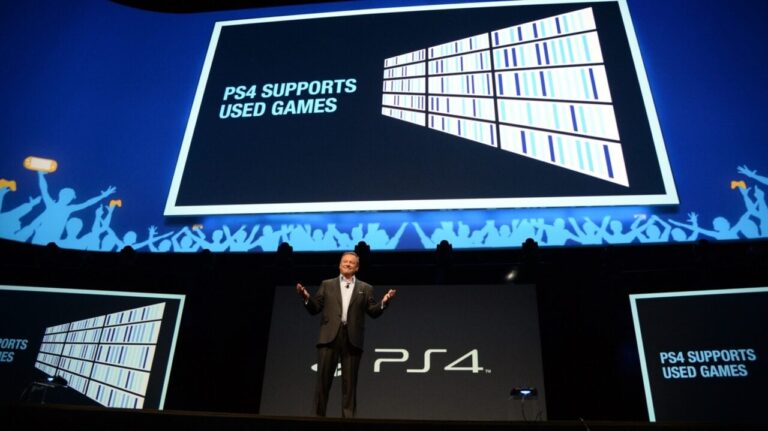
On June 10, 2013, at the Los Angeles Memorial Sports Arena, Sony Computer Entertainment America CEO Jack Tretton announced the PlayStation 4 would cost $399—$100 less than Microsoft’s Xbox One—and would impose no restrictions on lending, trading, reselling, or playing disc-based games offline. This single announcement, delivered with thunderous applause, became the defining moment of E3 2013 and fundamentally shifted the console generation’s narrative in Sony’s favor. Nearly a decade later, the promise of unrestricted physical game ownership has aged in ways neither Sony nor the industry anticipated.
The $399 Gambit That Changed Everything
Jack Tretton’s commitment was unequivocal and direct: “The PlayStation 4 will support lending, trading, reselling, and indeed playing your games on your console in pretty much the same way as we have been since they came on floppy discs. No DRM, no restrictions, no online requirements, and no authentication.” This statement arrived at a critical moment when Microsoft had just announced the Xbox One with mandatory online connectivity, always-on requirements, and severe restrictions on game sharing and resale. Sony seized the opening with surgical precision, positioning the PS4 as the consumer-friendly alternative.
The price advantage compounded the message. At $399 versus Xbox One’s $499, Sony undercut its rival by $100 while offering a more permissive stance on physical media ownership. This dual strategy—aggressive pricing paired with gamer-centric policy—created what industry analysts described as a PR knockout blow. Microsoft’s own restrictive stance had handed Sony the perfect opportunity, and the company capitalized on it with clarity and confidence that resonated across gaming communities worldwide.
The Game Lineup That Promised Next-Gen Dominance
Beyond policy announcements, Sony showcased a formidable PS4 launch and near-launch lineup designed to demonstrate technical capability and broad appeal. Guerrilla Games’ *Killzone: Shadow Fall* arrived as a launch title in November 2013, while Sucker Punch Productions’ *inFAMOUS: Second Son* followed in 2014. Evolution Studios’ *Driveclub*, Ready at Dawn’s *The Order: 1886*, and Avalanche Studios’ *Mad Max* rounded out the exclusive showcase, each promising to leverage the PS4’s hardware advantages over aging PS3 technology.
Sony also secured major third-party commitments, with Square Enix’s *Final Fantasy XV* and *Kingdom Hearts 3* anchoring the JRPG space. Simultaneously, the company reaffirmed its commitment to the PS3 with Naughty Dog’s *The Last of Us*, released just four days after the E3 announcement on June 14, 2013, and Quantic Dream’s *Beyond: Two Souls*, launching that November. This dual-generation strategy signaled confidence in both the present and future of PlayStation hardware, reassuring players invested in the current ecosystem while building excitement for what came next.
Microsoft’s Misstep and the Industry’s Recalibration
The contrast between Sony and Microsoft proved decisive. While Microsoft championed digital-first strategy and cloud gaming potential, consumers interpreted the Xbox One’s approach as anti-consumer and anti-ownership. The always-online requirement, mandatory Kinect bundling at $499, and restrictions on physical game trading created a perfect storm of negative sentiment. Sony’s E3 2013 presentation directly exploited these vulnerabilities, framing PlayStation as the platform for gamers who valued ownership rights and offline play.
Industry observers noted that Sony’s one-two combination—price advantage plus DRM-free policy—fundamentally altered the generation’s trajectory. Pre-order numbers surged in PlayStation’s favor, and the narrative shifted irreversibly. Microsoft eventually backpedaled on its restrictive policies in July 2013, removing online-check requirements and restoring game-sharing capabilities, but the damage was done. Sony had already secured the mindshare and loyalty of millions of consumers who felt heard and respected by the company’s positioning.
The Monetization Layer Nobody Discussed
Yet Sony’s E3 2013 victory contained a subtle caveat that would shape the generation differently than the rhetoric suggested. While disc-based games remained unrestricted and offline-playable, Sony announced that PS4 online multiplayer would require a paid PlayStation Plus subscription. This represented a new monetization layer absent from the PS3 era, introducing a recurring revenue model that would become standard across both PlayStation and Xbox ecosystems.
The PS Plus requirement received far less scrutiny than Microsoft’s DRM policies, partly because it addressed a narrower use case—online play only—rather than all gameplay. Players could still own, trade, and play their physical games offline without subscription. However, this compromise would generate billions in recurring revenue for Sony across the PS4 generation, fundamentally altering the economics of console gaming even as the company proclaimed freedom and openness.
Redemption from the PS3’s Troubled Launch
Sony’s E3 2013 triumph stood in sharp contrast to one of gaming’s most infamous press conferences: E3 2006, where the company unveiled the PlayStation 3 at a staggering $599 with weak game announcements and a dismissive tone toward consumers. That event became synonymous with corporate arrogance and misjudgment, setting the PS3 on a difficult path toward market recovery. E3 2013 represented a complete reversal—humble pricing, consumer-friendly policies, and a robust game lineup signaled that Sony had learned from its previous generation’s mistakes.
The seven-year gap between these events framed E3 2013 as a redemption arc. Analysts explicitly compared the two conferences, noting that Sony had transformed from the company that alienated consumers to the company that championed their rights. This narrative shift proved as valuable as any policy announcement, rebuilding trust and positioning PlayStation as the platform for players rather than for corporate interests.
The Indie Renaissance That Changed Platform Strategy
A less-discussed but equally significant element of Sony’s E3 2013 strategy involved its embrace of independent developers. The company invited indie game makers to showcase titles, emphasizing an open platform with no DRM and minimal barriers to development. This contrasted sharply with Microsoft’s perceived closed ecosystem and attracted developers who felt Microsoft’s approach prioritized corporate control over creative freedom.
Sony’s indie commitment would prove prescient, as independent games became increasingly central to the PS4’s identity and success. By positioning PlayStation as the platform where small studios could thrive alongside AAA publishers, Sony created an ecosystem that appealed to both hardcore players seeking experimental titles and mainstream audiences seeking blockbuster experiences. This strategic openness extended beyond policy into cultural positioning.
What Physical Games Actually Became
A decade later, the physical game landscape has transformed in ways that complicate Sony’s 2013 messaging. While disc-based games remain unrestricted and tradeable, digital distribution has become the dominant format across PlayStation, Xbox, and Nintendo platforms. Game file sizes have exploded, frequently requiring multi-gigabyte day-one patches that necessitate internet connectivity even for offline play. The “play your games offline” promise, while technically valid, has become increasingly hollow as games demand updates and connectivity features.
Additionally, Sony’s own behavior has drifted from the 2013 stance. The company has emphasized digital-only releases, discontinued physical media from some studios, and pushed subscription services like PlayStation Plus Extra and Premium—which bundle digital game access with online multiplayer. The freedom to trade and resell physical games remains, but the percentage of players exercising that freedom has declined dramatically as digital became the path of least resistance.
The Legacy That Shaped a Generation
Sony’s E3 2013 moment remains historically significant not because it preserved physical gaming as a dominant format—it did not—but because it fundamentally established consumer trust during a critical industry transition. By positioning PlayStation as the pro-consumer alternative when Microsoft stumbled, Sony secured generational loyalty that translated into sales dominance throughout the PS4’s lifecycle. The PS4 outsold Xbox One by a margin of roughly 2-to-1, a gap directly traceable to E3 2013’s messaging and the trust it generated.
The policy announcements made by Jack Tretton on June 10, 2013, proved durable in their technical implementation. Players could and did trade, lend, and resell PS4 physical games throughout the generation. However, the broader promise—that physical games would remain central to gaming culture—aged differently than the rhetoric suggested. The victory was real, but the world it was meant to preserve was already transforming in ways that neither Sony nor its audience fully anticipated at that triumphant moment.
