
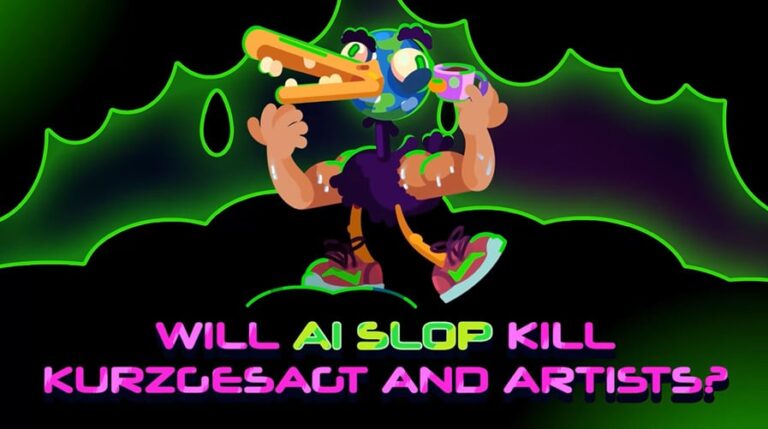
Key takeaways
- YouTube's AI detection system incorrectly penalized the educational science channel Kurzgesagt, flagging their handcrafted animations as artificial content.
- The channel's distinctive Corporate Memphis visual style, now ubiquitous in AI training data, triggered false positives in YouTube's detection algorithms.
- The incident highlights YouTube's struggle to balance AI investment with content moderation, catching legitimate creators alongside actual low-effort AI slop.
- Kurzgesagt ironically explored similar AI-generated content problems in videos produced just last year.
Kurzgesagt, the German science education channel that has defined accessible learning through animation since 2013, faced a stunning reversal when YouTube’s automated systems penalized one of their uploads. The video in question explored microscopic superpredators—a topic fitting their catalog of curiosities spanning from cosmic phenomena to biological oddities. YouTube’s detection algorithms identified the content as artificially generated material and took action from the platform level, degrading the video’s visibility and triggering what the creators called “every creator’s worst nightmare.”
The Incident
What Happened
The channel confirmed the incident through a public statement, revealing that their contact at YouTube determined the penalization was not a mistake in moderation judgment but rather an error in algorithmic classification. The detection system had wrongly categorized their handcrafted, human-produced video as AI-generated slop—a growing category of low-effort content that has become a platform management concern. Kurzgesagt stated: “YouTube’s automatic AI detection tools wrongly think that our very much human-made videos are AI Slop.”
YouTube’s Acknowledgment
The channel’s assessment was direct. Their contacts at YouTube acknowledged the fundamental nature of the error—not a moderation decision made by human staff, but a systematic failure in detection algorithms. The statement continued: “It started to choke our channel. Our contacts at YouTube were amazingly helpful and transparent with us, and hopefully the bug is fixed for now.”
How View Decline Became Detection
The first warning signs arrived subtly. Kurzgesagt noticed peculiar fluctuations across their recent uploads, a pattern they initially dismissed as typical variance in audience engagement. The performance of their second-most-recent video dipped noticeably, but when the microscopic superpredators video posted, the channel experienced some of the worst numbers in their history.
Rather than accept the decline as organic, the creators investigated their analytics carefully. The data pattern suggested something mechanical—not an audience loss or content rejection, but systematic suppression. When they reached out to YouTube for clarification, the platform confirmed their suspicion: the algorithm had downranked the content as a penalty for suspected AI generation.

The Visual Style Problem
Corporate Memphis and AI Training
Understanding how this detection failure occurred requires examining Kurzgesagt’s distinctive aesthetic. The channel built its identity through minimalist illustrations in a style often described as “Corporate Memphis”—a design language characterized by simple shapes, playful characters, and a flattened color palette. This approach became ubiquitous across digital media, spawning countless imitators and, critically, becoming deeply embedded in AI training datasets.
When Original Art Triggers Suspicion
The irony is layered: Kurzgesagt’s artistic contribution to visual communication has become so pervasive that the very style they pioneered now triggers suspicion when they deploy it. Modern AI text-to-image generators and video synthesis tools absorbed this aesthetic pattern during training. When YouTube’s detection system encounters animations matching these patterns, the algorithm flags them as potentially synthetic—not recognizing that original human artists creating in established styles differ fundamentally from algorithmic imitations.
YouTube’s Contradictory Position
Google operates with fundamentally conflicting objectives. The corporation continues aggressive investment in artificial intelligence capabilities while simultaneously deploying detection and suppression systems intended to prevent AI-generated material from degrading platform quality. This contradiction shapes YouTube’s current policy landscape.
Last year, YouTube introduced updated detection measures and provided users with tools to flag channels flooding the platform with low-effort AI content. These initiatives responded to a real problem: algorithmic generation enabled creators to produce vast volumes of derivative, exploitative, or misleading material with minimal effort. However, the detection infrastructure built to address this problem lacks the nuance required for accurate classification.
Most AI detection tools remain notoriously inadequate. These systems struggle to distinguish between original work in established styles and synthetic replication. A human animator applying the Corporate Memphis aesthetic produces visually similar results to an AI model trained on the same style—but the distinction between these cases matters enormously for platform integrity and creator accountability.
The Broader Pattern of Creator Suppression
Kurzgesagt’s experience was not isolated. Since YouTube implemented these stricter detection measures, multiple other channels have come forward reporting algorithmic suppression they attributed to the same flawed detection system. The pattern suggests the penalties are not surgical corrections targeting actual AI slop, but blanket suppressions catching legitimate creators alongside their intended targets.
The consequences extend beyond individual channel performance. If detection errors suppress quality educational and entertainment content while failing to meaningfully reduce problematic AI material, the platform’s overall information environment deteriorates. Viewers seeking reliable information face degraded access to vetted sources, while low-effort synthetic content may persist undetected.
A Channel That Predicted Its Own Problem
The additional layer of irony crystallized when examining Kurzgesagt’s content history. The channel tackled the very problem affecting them just last year, producing educational material exploring how artificially generated content could exploit, overwhelm, and diminish the usefulness of the internet. They examined this issue with the same rigor and clarity they brought to every other scientific topic.
That investigation could not have anticipated that the platform’s response to the problem would misfire so directly against their own work. Yet the scenario demonstrates a core challenge in content moderation at scale: systems designed to solve complex problems often create new ones.
What Happens Next
Kurzgesagt committed to reuploading the suppressed video with modifications intended to improve overall quality and reduce the likelihood of repeated penalties. The specific alterations were not detailed, but the approach acknowledges both the detection system’s sensitivity and the need for creators to adapt their output to algorithmic expectations.
The broader question remains unresolved: how can YouTube simultaneously promote AI development while preventing its misuse? The platform’s current approach—detection systems that struggle with accuracy—may prove insufficient for navigating this tension. The Kurzgesagt incident illustrates that even when mistakes are identified and creators can reach supportive contacts within YouTube, the damage to visibility and audience reach has already occurred.
Frequently Asked Questions
What video did Kurzgesagt have penalized?
A video exploring microscopic superpredators was flagged by YouTube's AI detection system as artificially generated content, when it was actually created by hand.
Why did YouTube's detection system misidentify the video?
Kurzgesagt's distinctive minimalist animation style, known as Corporate Memphis, has become ubiquitous in AI training data, causing the algorithm to mistake original work for synthetic content.
How did YouTube respond once the error was identified?
YouTube's internal contacts acknowledged the error was a bug in the detection system rather than a moderation mistake, and the channel reported the underlying issue appeared to be resolved.
