
Key takeaways
- Niu Lai, made for $200, generated $4 million at the Chinese box office—a return of 20,000 times its budget, making it one of the most profitable films ever.
- The animated feature's success came from authentic imperfection and zero marketing budget, with theaters creating hand-drawn promotional materials that generated organic word-of-mouth.
- The film's handcrafted quality gained appeal precisely when AI-generated content dominates entertainment, demonstrating audience appetite for recognizable human artistry over algorithmic optimization.
- Niu Lai's viral ascent challenges industry assumptions about profitability, showing that technical polish and celebrity talent are not prerequisites for blockbuster success.
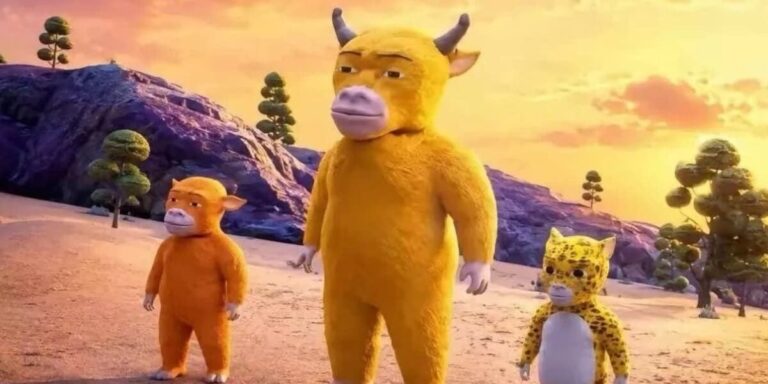
Niu Lai, a Chinese animated feature roughly translated as “Here Comes The Cow,” has emerged as one of the most profitable films ever made—a distinction that seems impossible given its $200 production budget and the film’s early reception as a global internet laughingstock.
From Viral Meme to Box Office Phenomenon
The Origin Story
The film was created by a mother and son duo, Xin Yumeng and Sun Lifang, who produced the entire project with virtually no financial backing. The story follows a timid calf separated from his family, who must discover his courage to overcome obstacles and find his way home—a classic underdog narrative undermined by production values that recall Rapsittie Kids, a film infamous for its technical inadequacy.
When Niu Lai first arrived in cinemas, it sold only 300 tickets. This meager initial performance, however, represented an immediate profit for its creators. The film had no marketing budget, leaving theaters to hand-draw their own promotional materials to support its limited run. These homemade posters, combined with the film’s rough computer-generated imagery and humble distribution, created the perfect conditions for virality.
The Global Spread
What began as local curiosity exploded into a worldwide phenomenon. International audiences discovered the film through pirated recordings and bootleg copies circulating online, transforming the scrappy project into meme material. The very qualities intended as shortcomings—the rudimentary animation, the lack of professional marketing, the pure amateurism of the entire production—became its greatest assets in capturing public attention.
The Profitability Record
Numbers That Defy Convention
Within a week of becoming a viral sensation, Niu Lai had generated approximately four million in revenue at Chinese box offices. This represents a return on investment of 20,000 times the original budget. To contextualize this achievement: the film’s budget equaled the cost of two standard editions of Grand Theft Auto VI. Its box office haul places it among the most profitable motion pictures ever released, even surpassing the recent dark horse hit Obsession.
The economics of this success invert every standard assumption about filmmaking. Larger budgets typically correlate with larger grosses, yet Niu Lai broke through the noise of major studio releases and franchise tentpoles on an investment that could be covered by a single birthday dinner.
Marketing Without Expense
The absence of a traditional marketing budget became an advantage rather than a limitation. Cinemas that showcased the film responded to its minimal promotion by creating hand-drawn posters and promotional materials of their own. This grassroots approach generated authentic word-of-mouth in an era when manufactured social media campaigns often fail to generate genuine enthusiasm. The film’s impoverishment became its selling point.

The Craftsmanship Argument
Niu Lai occupies an unusual cultural moment. The film is undeniably rough, its animation crude by professional standards, its technical execution far from polished. Yet its success arrives at a time when artificial intelligence increasingly mediates the creation of visual content, producing algorithmically generated imagery that lacks the intentionality of human creation.
In this context, Niu Lai’s handcrafted imperfection becomes a statement. The film was created by specific people with limited resources, not generated by neural networks optimizing for engagement metrics. Its ugliness, as raw as it is, carries the imprint of deliberate artistic choice. In an entertainment landscape saturated with content optimized by machine learning, the presence of recognizable human fingerprints on a creative work may carry unexpected appeal.
What Niu Lai Reveals About Audience Appetite
The film’s viral ascent challenges several assumptions about modern entertainment consumption. Audiences theoretically overwhelmed with content choices gravitated toward this particular project specifically because its technical inadequacy made it memorable. The film’s success was not driven by celebrity talent, visual spectacle, or sophisticated storytelling, but by its very refusal to compete on those terms.
The movie demonstrates that novelty and authenticity can outweigh production value in capturing attention. While most content creators pursue greater technical polish, higher budgets, and more sophisticated marketing, Niu Lai succeeded by being genuinely different—not through calculated eccentricity but through honest constraint. The filmmakers did not aim for a certain aesthetic; they created the best film they could manage with $200.
Implications for the Entertainment Industry
Niu Lai’s extraordinary profitability raises questions about how the entertainment industry evaluates risk and potential returns. The film arrived amid Hollywood’s ongoing struggle to predict audience preferences and chase viral trends. Its success illustrates that profitable entertainment does not require astronomical budgets, established franchises, or star power. A film made by two people with minimal resources outperformed projects representing hundreds of millions in investment.
The movie has become rare in a way that may not persist. As the entertainment industry attempts to replicate Niu Lai’s success, the very qualities that made it appealing—its authentic imperfection, its genuine amateurism, its unpolished earnestness—will become impossible to recreate deliberately. Planned imperfection is a contradiction in terms. The film’s moment of cultural resonance may represent something that cannot be commodified or mass-produced, which paradoxically may make it all the more valuable in the current moment.
Frequently Asked Questions
Who made Niu Lai and what was its budget?
The film was created by mother-and-son duo Xin Yumeng and Sun Lifang with a production budget of $200.
How much box office revenue did Niu Lai generate?
The film generated approximately four million in revenue at Chinese box offices, representing a return on investment of 20,000 times its original budget.
Why did the film become viral despite its low production value?
The film's viral success stemmed from its authentic imperfection, lack of traditional marketing, and hand-drawn promotional materials created by cinemas, which generated organic word-of-mouth in an era of algorithmic content dominance.
