
Key takeaways
- Valve's 2007 Portal prequel F-Stop, cancelled after negative playtester feedback, has leaked as a 99% complete game accessible to the public.
- The experimental camera-mechanics puzzle game was one of five prototypes created during Valve's 2007 Directed Design Experiments, with elements later integrated into Portal 2.
- Three separate data leaks combined to create the playable version: a Steam depot breach with assets, plus source code and map data released through the Valve Cut Content Discord.
- F-Stop's emergence reveals how cancelled prototypes inform later released titles and offers historians direct evidence of Valve's internal design philosophy.
The video game world has gained access to a piece of lost interactive history. F-Stop, Valve’s abandoned Portal prequel from 2007, has surfaced online in a state that players can actually experience. Thanks to a convergence of data leaks and community effort, the experimental game that never reached publication now exists in a playable form that is nearly feature-complete.
An Experiment in Perspective
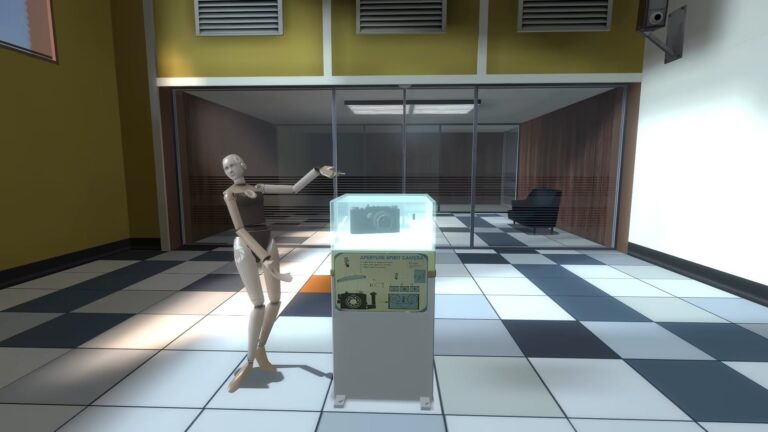
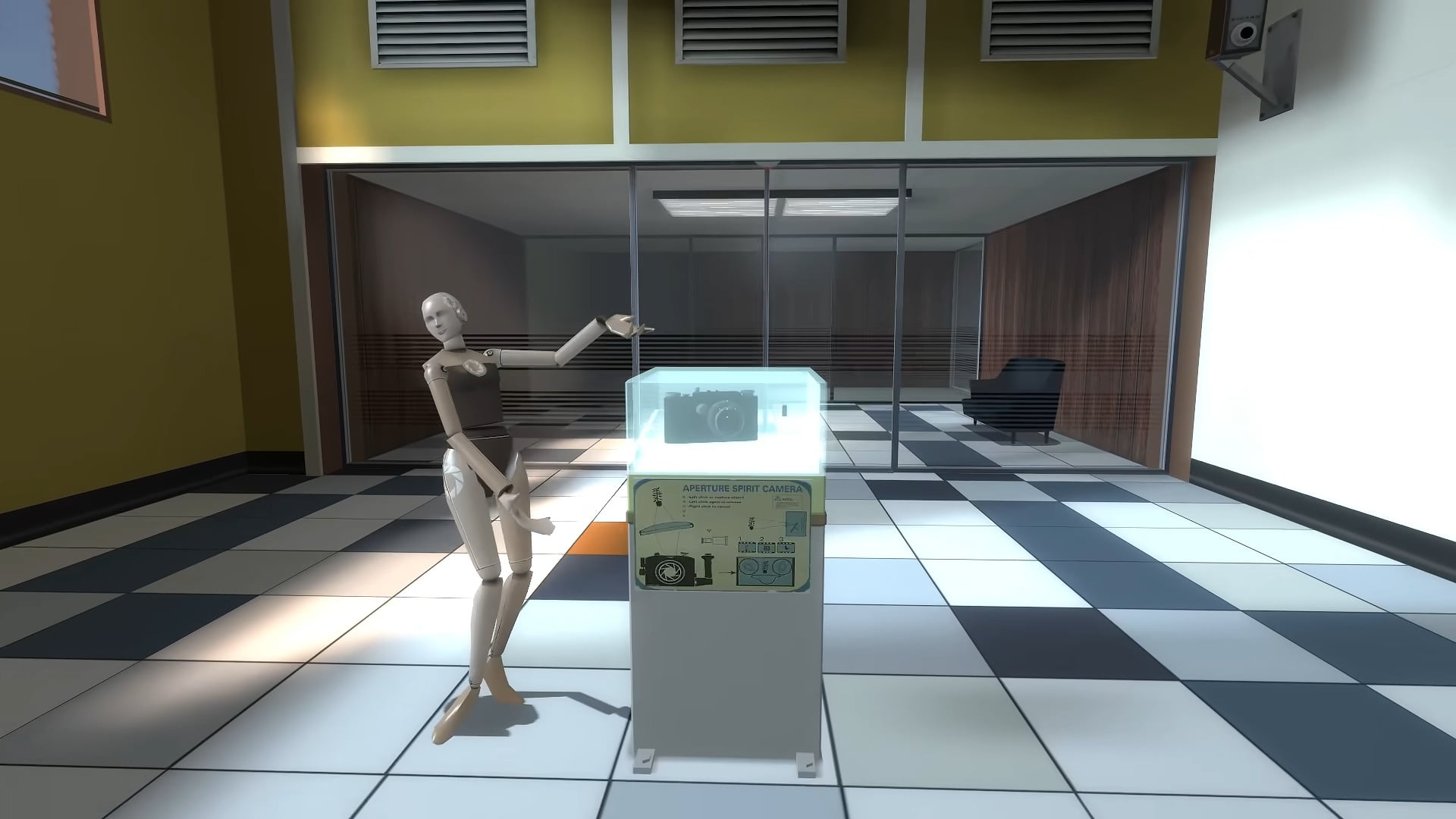
The core mechanic of F-Stop centered on a piece of Aperture Science technology: an experimental camera. Rather than a standard first-person perspective or a puzzle game built around traditional portal placement, F-Stop asked players to manipulate perspective itself. The camera would alter spatial perception and enable solutions to environmental puzzles. This concept proved compelling enough to attract the attention of Gabe Newell personally, who saw potential in the direction the team had taken.
The 2007 Design Experiments
The project existed in a specific moment of Valve’s development philosophy. In 2007, the company organized what leadership termed the Directed Design Experiments. Gabe Newell’s vision for this period was to establish five separate teams, each tasked with designing and partially building their own video game prototype. The intention was exploratory: to test different design concepts and see which ideas had legs. One of these five experiments was designated F-Stop.
However, focus groups and playtesters who sampled the prototype responded with less enthusiasm than internal leadership had hoped. Their feedback proved decisive, and Valve shelved the project outright. The work was not entirely wasted. Certain elements from F-Stop, including specific dialogue, character concepts, and mechanical ideas, found new homes. Portal 2, which released in 2011, incorporated some of this legacy into its final form. F-Stop remained otherwise a footnote in Valve development history, known primarily through community documentation and the accounts of those who had worked on it or played early builds.
Three Leaks, One Complete Game
The August Data Breach
For most observers, F-Stop existed only as a concept with no playable evidence. That changed in late August when a massive data breach surfaced. The incident, termed Steam2 by those who encountered it, released approximately 13 terabytes of Steam depot data spanning from 2003 to 2013. This vast collection included assets belonging to F-Stop, though it lacked two critical components: the actual source code and the mapsrc folder, which contains Valve’s internal map source data. The leak was substantial but incomplete.
The Missing Pieces Appear
What the Steam2 leak could not provide came through an unexpected channel. The Valve Cut Content project, a community-driven effort to archive and document unreleased Valve games, received the missing elements through its Discord server. Someone in possession of F-Stop’s mapsrc data initially sought $1,000 in compensation for access. For reasons that remain unexplained, this person later chose to distribute the files at no cost. The Valve Cut Content moderators authenticated the map files, confirming their legitimacy.
Assembling the Pieces
Once all three components were available, the community moved to assemble them. These included the assets from the August leak, the source code, and the map data from the Discord distribution. The result was a unified, playable version of F-Stop that required no additional reconstruction or reverse-engineering beyond combining existing pieces. Players who have since launched the game report that the experience is substantially complete, with only scattered missing assets and dialogue lines interrupting an otherwise coherent product. Community estimates place the game at 99 percent functional. The completeness is noteworthy precisely because it was never intended for external distribution. Valve would have polished the game further, debugged edge cases, and refined the audio-visual presentation if official release had ever been considered.
What F-Stop Teaches Us
The emergence of F-Stop provides a tangible window into Valve’s design process during a formative period. The game demonstrates the company’s willingness to pursue unconventional mechanical concepts and the rigor of its playtesting culture. The decision to abandon the project, despite Gabe Newell’s personal support, shows that internal leadership enthusiasm alone does not override player feedback when it runs counter to a design’s core appeal.
For archivists and historians of game development, F-Stop fills a gap. It is one of few unreleased Valve experiments with sufficient implementation to be studied and played rather than merely discussed. The camera perspective mechanic offers insights into how Valve engineers approached spatial puzzle design before settling on the familiar portal mechanic as the company’s signature. It also provides concrete evidence of how cancelled projects inform and influence later, released titles, a practice common throughout the industry but rarely documented in such accessible form.
Digital Preservation and Lost Games
The leak also underscores the precarious status of digital history. F-Stop existed in limbo for nearly two decades, known to very few people and preserved through no official archive. Its recovery depended on data breaches and the volunteer efforts of preservation-minded communities. Without the August Steam depot leak, without the separate disclosure through the Valve Cut Content Discord, and without the decision to compile these sources into a unified product, the game would likely have remained inaccessible indefinitely.
For those who choose to engage with F-Stop, the experience remains recognizably incomplete in places yet comprehensive in scope. The missing dialogue and scattered asset gaps do not prevent players from understanding the game’s intent or solving its puzzles. The historical significance of F-Stop’s emergence may ultimately outweigh its value as a finished product. The game itself offers an interesting thought experiment about perspective and spatial reasoning, but its true value lies in documentation. Players can now study how Valve approached the Directed Design Experiments, what F-Stop was trying to achieve, and how those ideas were either abandoned or transformed into subsequent work.
Source: Kotaku
Frequently Asked Questions
What was F-Stop, and why was it cancelled?
F-Stop was Valve's 2007 Portal prequel developed during the company's Directed Design Experiments, featuring gameplay centered on an experimental Aperture Science camera that manipulated perspective to solve spatial puzzles. Though Gabe Newell personally supported the project, negative feedback from playtesters led Valve to abandon it. Some of F-Stop's dialogue, characters, and mechanical concepts were later reworked into Portal 2.
How did F-Stop become playable after 20 years?
The game emerged from three separate data sources: a massive August Steam depot leak containing 13 terabytes of data spanning 2003 to 2013, plus the missing source code and map files that surfaced through the Valve Cut Content Discord server. Someone initially requested $1,000 for the map data but ultimately released it for free, allowing the community to combine all components into a unified, fully functional version.
Is the leaked F-Stop version complete?
The playable version is approximately 99% complete. A few assets and dialogue lines are missing, but the core mechanics, puzzle design, and level layouts are all intact and functional, allowing players to experience the full scope of Valve's 2007 prototype.
