
Key takeaways
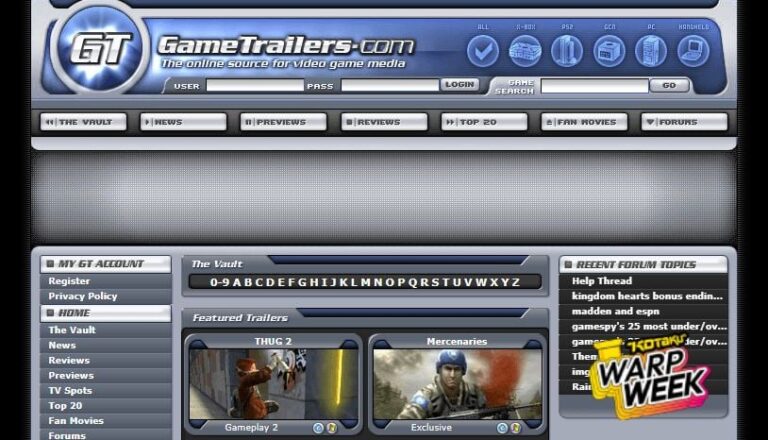
- GameTrailers pioneered game trailer curation in 2002 using TiVo recordings and sourced footage, becoming a Viacom-backed professional operation that dominated online gaming coverage.
- Viacom's refusal to embrace YouTube despite dominating gaming coverage eventually sealed the site's fate, leading to its 2014 sale and 2016 closure.
- Modern gaming trailer culture has shifted from curated editorial taste to algorithmic fragmentation across multiple platforms, diminishing the critical contextualization GameTrailers once provided.
The Colossus Presentation
Viacom president Tom Freston settled into a screening room to watch an executive team present a game called Shadow of the Colossus, the PlayStation 2 masterpiece by designer Fumito Ueda. The footage showcased sophisticated cinematography and a visual departure from the gunfire-dominated games that typically appeared in corporate demonstrations. The editing was professional-grade, substantially more refined than anything appearing elsewhere on the internet. Freston, approaching his sixties, grew visibly bored. For him, video games remained an incomprehensible medium, regardless of artistic ambition or technical sophistication.
Geoff Grotz, co-founder of the site orchestrating this pitch, interrupted the uncomfortable silence. “We look at our major rivals online, like IGN and GameSpot,” Grotz explained, “and what we really want to do is crush them.”
That combination of ambition and corporate resources would temporarily reshape how the gaming world discovered game trailers—before institutional missteps squandered the opportunity entirely.
Origins in the TiVo Era
A Film Graduate’s Evening Rituals
Three years before sitting in that Viacom boardroom, Brandon Jones was a Los Angeles film school graduate struggling through the predictable creative poverty phase. His evenings cycled through instant noodles, Final Fantasy sessions, and checking Apple’s digital hub for the latest movie trailers—the only reliable source for official promotional content in clean 720×480 QuickTime format. Online video distribution barely existed yet.
Game publishers distributed promotional material through crude television commercials and exclusive content locked behind demo discs or IGN’s defunct paywall. The disparity frustrated Jones enough to articulate it directly: “Why can I get movie trailers for free, but I have to pay money for video games?” The question led to a solution built from desperation and resourcefulness.
Scrounging and Recording
Jones and Grotz purchased an array of abandoned domain names, selecting GameTrailers.com from a friend’s casual suggestion. Their operational philosophy accepted no ethical constraints. They systematically extracted trailers from IGN and GameSpot, removed watermarks through manual cropping, and uploaded the material without authorization. Simultaneously, Jones programmed a TiVo to capture television broadcasts—a low-fidelity but reliable source of commercial footage that publishers distributed through terrestrial television with no internet restrictions in mind.
The tactic was crude but effective until legal responses arrived. Nintendo objected to the Super Smash Bros. commercial featuring The Turtles’ “Happy Together” appearing on an internet website. Publishers issued cease-and-desist letters regularly. “Companies didn’t call us, or they did, and when they did it was bad,” Jones recalls.
From Aggregation to Original Creation
Operating as a professional video editor, Jones possessed technical skills exceeding his rivals. Rather than perpetually scrounging external content, he began fabricating material. His most prominent original creation came when he assembled Enter the Matrix promotional material, overdubbing audio from The Matrix Reloaded to construct what appeared to be official marketing footage. The video accumulated 5,000 views—substantial internet traffic by mid-2000s standards—and created sufficient confusion that developers at Shiny Entertainment congratulated him on what they assumed was authorized content.

The Path to Professionalism
The Hornet Animation Moment
The operation ran on minimal resources. Jones and Grotz maintained their own server hardware at a local hosting facility and featured no commercial advertising. To establish credibility, Jones added a banner crediting Hornet Animation, his day job as a motion graphics employee, without authorization from management. The traffic spike crashed Hornet’s website. When his boss Jon Slusser invited Jones to lunch, the conversation could have ended in termination.
Instead, Slusser proposed expansion. The GameTrailers concept had attracted organic audience growth. Blizzard’s increasingly elaborate animated cinematics and The Legend of Zelda: Wind Waker’s visual revolution were driving new visitors without marketing expenditure. Slusser possessed entrepreneurial ambition that Jones lacked, while Jones tired of watching filmmaker friends hemorrhage thousands into projects generating no visibility. The fact that GameSpot and IGN found the site’s existence frustrating provided additional motivation.
The Acquisition Search Begins
Slusser began approaching potential acquirers. Ziff Davis expressed serious interest. Simultaneously, a much larger media conglomerate recognized the strategic value of an established gaming website.
Viacom’s Digital Experiment
Corporate Ownership Without Integration
In 2005, Viacom acquired GameTrailers—a transaction that departed from conventional corporate acquisition patterns. The company operated MTV, Spike Television, and Nickelodeon, a portfolio with established advertiser relationships and broadcast distribution. GameTrailers remained fundamentally digital-first, operating independently of these assets with minimal structural integration.
The arrangement reflected Viacom’s strategic confusion regarding digital properties. The corporation understood it required internet presence without possessing internal expertise to develop one. Viacom CEO Sumner Redstone would famously dismiss Tom Freston for insufficient aggression pursuing MySpace—a misjudgment highlighting the company’s broader strategic disorientation. What Viacom genuinely desired was autonomous operation of GameTrailers that required minimal executive oversight.
Professional Production Escalation
The site expanded considerably under corporate ownership. An editorial team emerged, including Daniel Bloodworth, Justin Speer, Ryan Stevens, and Shane Satterfield, who served as the first editor-in-chief. These individuals possessed professional backgrounds in film editing and animation, dramatically elevating production quality beyond what the site previously achieved. Brandon Jones became the recognizable voice—the personality audiences associated with the brand, though he later regretted not establishing on-camera presence during this expansion.
The operation acquired cultural significance within school computer labs, joining Newgrounds and Candystand as essential destinations. Parents reported difficulty extracting children from the content. GameTrailers also took over production of Spike TV’s Game Head program, a rebrand that ran for seven seasons and was welcomed by host Geoff Keighley.
The Content Diversification
GameTrailers shifted beyond pure trailer aggregation into original editorial. The site produced well-regarded video reviews, retrospectives, and premiere previews. It hosted creators including the Angry Video Game Nerd. Rather than gaming algorithms, the feed simply reflected games as they emerged, assigning equal prominence to first-party blockbusters and emerging independent projects like Dear Esther. Traffic multiplied steadily.
YouTube’s Inescapable Gravity
By the early 2010s, a new video platform called YouTube had accumulated users and cultural penetration at speeds challenging Facebook itself. GameTrailers management repeatedly lobbied Viacom for authorization to establish presence on the rival platform. Viacom refused categorically. To the conglomerate, YouTube was not merely competitive but criminal—systematically stealing clips from SpongeBob, South Park, and The Daily Show. In 2007, Viacom initiated litigation seeking one billion dollars in damages. The lawsuit would persist until 2014, ultimately settling, but the institutional hostility never shifted.
Traffic to independent gaming websites plummeted throughout the 2010s as YouTube’s gravity pulled audiences away. GameTrailers developed subscription tiers called GameTrailers Plus intended to monetize dedicated audiences. None functioned. An unnamed Viacom executive warned Jones that shutdown was inevitable irrespective of retention strategy. Worse, Jones received advance notification approximately eighteen months before execution, accompanied by strict instruction to maintain silence toward his staff.
Viacom sold GameTrailers in 2014, terminating the entire workforce. IGN Entertainment acquired the brand in 2016, reducing it to a YouTube channel header beneath which flashier influencers now operate.
Legacy and Modern Gaming Trailer Culture
Former GameTrailers staff, including Jones, launched Easy Allies in 2016 as a subscriber-supported alternative operation. The venture continues, though Jones departed gaming media by 2022. “The advancements in technology and entertainment always involve loss,” he reflected on his site’s dissolution.
The cultural weight assigned to game trailers has paradoxically escalated. Grand Theft Auto IV generated excitement within core gaming audiences. Grand Theft Auto VI has evolved into speculative theater—a cultural event where streaming services like Netflix premiere footage with Super Bowl-equivalent anticipation. Geoff Keighley, who once worked within GameTrailers’ production framework, now controls trailer distribution rituals through Nintendo Directs and his annual Game Awards broadcasts. These moments launch games onto millions of wishlists or effectively kill projects. Conference “one more thing” announcements sometimes function as pronouncements of doom.
Yet the energy driving modern coverage differs markedly from GameTrailers’ aesthetic appreciation. Keighley demonstrates enthusiasm toward derivative live-service games that Jones would never have elevated. “That kind of energy is not leading to things being acquired,” Jones observed. “It’s all about the eight people in the back who go wild when Ace Combat gets announced.”
The distribution landscape transformed entirely. GameTrailers pioneered aggregation when no alternative existed. Today fragmentation reigns—YouTube, Twitch, TikTok, Discord, and proprietary publisher channels distribute trailers through systems no central authority can coordinate. The institutional knowledge GameTrailers cultivated—understanding which games deserve elevation, contextualizing interactive entertainment as artistic statements rather than products—splintered across algorithmic feeds pursuing engagement over substance.
Frequently Asked Questions
What was GameTrailers.com and when did it launch?
GameTrailers.com was a website founded in 2002 by Brandon Jones and Geoff Grotz that began by aggregating video game trailers and evolved into producing original reviews, previews, and retrospectives before becoming the dominant gaming video outlet of its era.
How did GameTrailers initially source its content?
In its early days, GameTrailers obtained footage by programming a TiVo to record television commercials, downloading trailers from competitor sites like IGN and GameSpot while removing watermarks, and eventually producing original videos as production quality improved.
Why did Viacom shut down GameTrailers?
Viacom, which acquired GameTrailers in 2005, refused to embrace YouTube as a distribution platform due to litigation against the site. As YouTube became inescapable in the 2010s, traffic to independent gaming websites plummeted, making GameTrailers obsolete. Viacom sold the brand in 2014 and it was closed by 2016.
