
Key takeaways
- A cryptic player message telling a Kotaku writer to "Try attacking" forces them to confront whether they'll murder Gwynevere, the princess who just handed them the Lordvessel, testing their fundamental moral code.
- FromSoftware deliberately withholds narrative clarity, compelling players to make permanent choices without obvious right answers, forcing them to live with whatever decision they make.
- The writer had avoided spoilers intentionally, knowing that learning the correct choice would destroy the meaningful nature of deciding, reflecting how FromSoftware games reward that commitment to blindness.
- The encounter showcases how FromSoftware uses sparse dialogue, atmospheric light, triumphant music, and false kindness to create moral ambiguity that transforms a routine progression moment into a crisis of conscience.
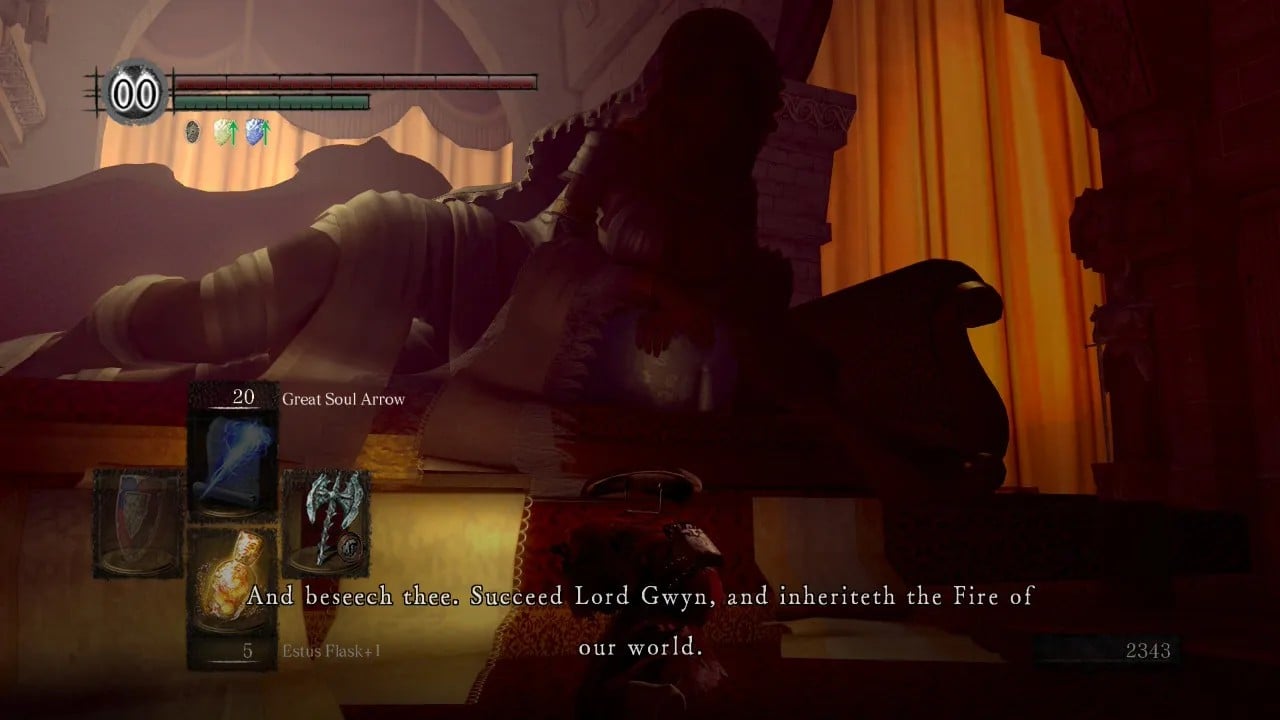
When a Dark Souls player reached Gwynevere’s chamber after defeating Ornstein and Smough, they found a golden room flooded with light, a soaring orchestral score, and a princess offering praise and the Lordvessel—the key to progressing deeper into the game’s second act. Player-left messages decorated the floor with warnings: “Chest ahead,” repeated across every available surface. But one message, scrawled among the jokes about the princess’s physical appearance, contained three words that would paralyze the player for two days: “Try attacking.”
When Kindness Becomes Sinister
The writer at Kotaku had not finished Dark Souls before. They knew pieces through cultural osmosis: Four Kings existed somewhere as a boss, Seath the Scaleless awaited in the depths, Solaire worshipped the sun and would probably die unless saved through means unknown. None of this explained why every instinct screamed that Gwynevere should not be trusted.
Dark Souls reveals almost nothing. Narrative facts scatter across item descriptions, NPC dialogue measured in single sentences, and environmental hints most players miss. The writer had logged significant time in Elden Ring and Elden Ring: Nightreign, dabbled in King’s Field 4, and learned one lesson thoroughly: when a FromSoftware game offers genuine kindness, light, music, and golden surroundings, something terrible is almost certainly wrong.
Gwynevere offered everything. She dispensed blessings and praise. She bestowed the Lordvessel with ceremony. By every convention of video game narrative, this represented the reward for perseverance. The Princess of Sunlight would not betray the Chosen Undead. That would violate every storytelling rule the medium had established.
Except FromSoftware had spent two decades proving those rules did not apply.
The Impossible Choice
Never a Murderer Until Now
The writer had never unprovoked killed an innocent NPC in a FromSoftware game. They could count on one hand the total number of innocent NPCs they had murdered across their entire gaming history, a number low enough to sting. A genocide run in Undertale lasted three battles before they surrendered. One accidental headbutt of the Turtle Pope in Elden Ring sent them frantically reloading, unwilling to live with the consequence of a stray button press.
The player character was not a murderer. More importantly, the player was not a murderer. Their entire gaming identity rested on the distinction between what their characters did under compulsion versus what they chose to do voluntarily.
The Trap Within the Choice
FromSoftware had constructed a scenario where inaction now carried guilt. If “Try attacking” represented genuine warning, refusing to act meant accepting whatever consequence the game was specifically hinting at. Gwynevere might be exactly what she claimed, but if the message was correct, then trusting her would trigger some narrative collapse. The player could not know which was true. The game would not explain. And whichever path they chose, they would carry the knowledge that they had chosen wrong or chosen carelessly.
In Dark Souls, no figure had lied outright yet. Every instruction the player received proved accurate: ring bells, collect the Lordvessel, kill specific enemies. Those enemies had indeed seemed genuinely dangerous. The only voices offering consistent kindness came from Solaire, who worshipped the sun, and now Gwynevere, the sun’s princess. Why distrust them? What evidence existed?
Only instinct. Only FromSoftware’s track record of designing encounters where no right answer existed, only the answer you chose and its consequences.
The Deliberate Refusal to Know
The writer had deliberately avoided learning Dark Souls’ story. They wanted to save Solaire but refused to look up the method. They wanted to locate Siegmeyer and see what he was doing, but accepted that missing him would be their own failure. This deliberate ignorance meant one thing: seeking the answer about Gwynevere would destroy the choice. FromSoftware games reward that commitment. They punish knowledge-seeking. They promise that figuring things out alone, making mistakes, and living with them, creates the experience the studio designed.
So the uncertainty persisted. Maybe attacking would accomplish nothing; Gwynevere was a god, after all, probably immortal. Maybe it would trigger a cascade of consequences. Maybe the message was a trick. Maybe it was genuine warning. The only way to know was to act, and the only way to act meant accepting permanent uncertainty about whether you had just committed murder or made the escape FromSoftware was nudging you toward.
Paralysis and Progression
Paralysis set in. The writer stalled, exploring other areas. They fell through the floor in the Undead Asylum. They entered a painted world and encountered a lady in white claiming the inhabitants she lived among, people they could see being crucified outside, were “kind and good.” Another test. Another voice asking them to trust evidence that contradicted what their eyes reported.
But they felt a clock ticking. Some fundamental decision about the Lordvessel and Gwynevere seemed to gate progression. To move forward without choosing felt wrong. To choose without understanding felt worse. Dark Souls would not offer clarity. FromSoftware had trained players across multiple games to accept that clarity would never come.
The Permanence of the Decision
This is where Dark Souls excels: creating positions where players must act despite incomplete information. Elden Ring had shown the writer that FromSoftware designs specifically around this principle. There is no obvious right path. No easy answer. No guide light pointing toward moral safety. You choose anyway and live with the results. Perfection remains impossible. The game continues.
The writer loved this. They loved the uncertainty. They loved knowing that whatever they decided about Gwynevere, whether to trust her or to attack her, would be their decision alone, made with imperfect knowledge, and lived with for the rest of their playthrough. Dark Souls would not let them undo it. Elden Ring had taught them that FromSoftware games punish the desire to have been right all along. Commit to your choice. Accept its consequences. That is the experience the studio creates.
And so they remained suspended between Gwynevere’s praise and that cryptic message, knowing that moving forward meant accepting that they might become a murderer, or a fool, and that either way, they would carry the weight alone.
Source: Kotaku
Frequently Asked Questions
What decision does the Dark Souls player face in this article?
After receiving the Lordvessel from Gwynevere, the princess who just blessed her work, a player message saying "Try attacking" creates doubt about whether Gwynevere is trustworthy, forcing the Kotaku writer to decide whether to attack her or trust her blessing.
Why is this choice so paralyzing for the writer?
The writer has never voluntarily killed an innocent NPC in a FromSoftware game and refuses to learn the answer beforehand. They must choose blindly, knowing their decision will be permanent and they may have made a terrible mistake.
How does this relate to FromSoftware's broader design philosophy?
FromSoftware deliberately creates moral ambiguity without clear right answers. The writer learned this from playing Elden Ring and Elden Ring: Nightreign, where the studio forces players to act despite incomplete information and live with consequences they cannot undo.
