
Key takeaways
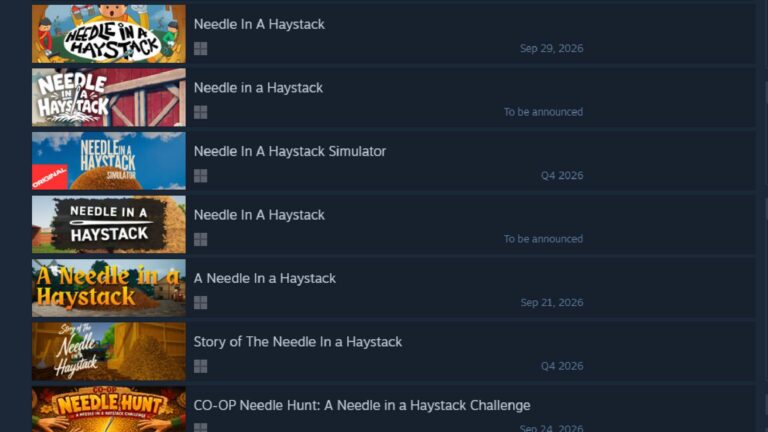
- At least 10 clones of Needle in a Haystack Simulator appeared on Steam within days of its 50 million-view viral moment, some scheduled to release before the original in Q4 2026.
- AI-assisted development appears to have accelerated clone creation, with several copies displaying logos and visual styles consistent with AI generation tools.
- Other viral hits like Meccha Chameleon and Librarian: Tidy Up the Arcane Library! spawned their own cascade of clones, suggesting a systemic platform problem rather than isolated incidents.
- Steam's current curation policies lack standards for mechanically similar games, forcing original developers to add defensive markers to distinguish their work from copycat releases.
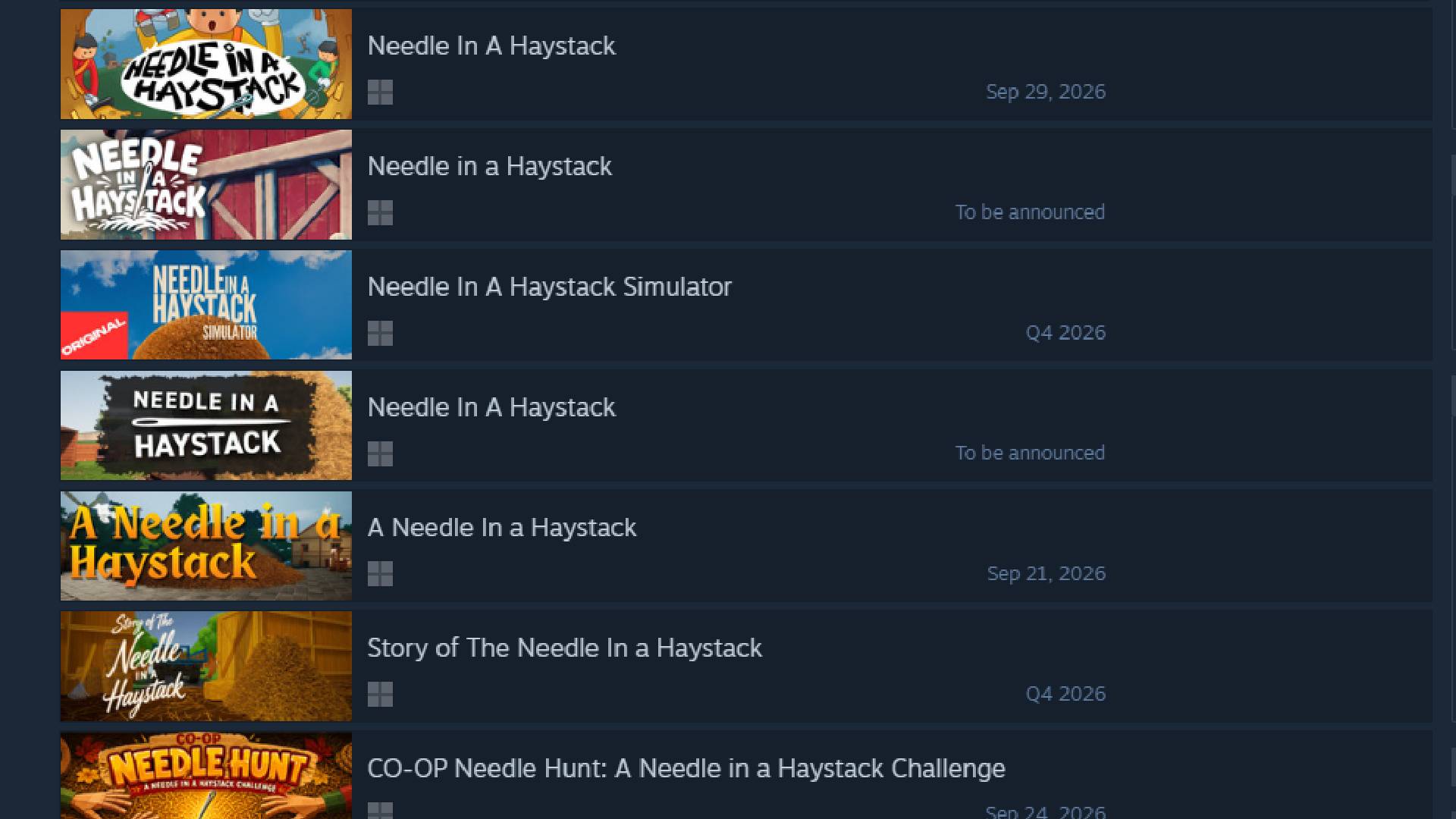
The August viral phenomenon of Needle in a Haystack Simulator—a deliberately tedious incremental game that tasks players with locating a needle in a pile of hay—amassed 50 million views on Twitter during its promotional run. Yet scrolling through Steam’s search results for “needle in a haystack” reveals a problem that extends far beyond one quirky title: a flood of clones and near-identical variations that obscure the original among at least eight to ten copycat releases.
The clones arrived with remarkable speed. Within days of the original’s viral reveal, variations with titles such as A Needle in a Haystack, CO-OP Needle Hunt: A Needle in a Haystack Challenge, Story of The Needle in a Haystack, and Needle in a Million Haystacks appeared on the platform. Others adopted slightly different branding—Hay! One Billion! and Find the Needle—yet maintained the same core gameplay concept. Some of these clones are scheduled to release before the original game, which won’t arrive until the fourth quarter of 2026.
The developer’s response tells its own story. A prominent red box now appears on the official Steam key art to distinguish it as the legitimate version, and the game’s description explicitly identifies it as “the one and only.” That such defensive measures became necessary underscores how thoroughly copycat games have infiltrated the platform.
The Speed of Imitation
What strikes observers about this particular incident is the velocity with which clones materialized. Creating and uploading multiple Steam listings, even for mechanically simple games, typically demands coordination, testing, and store submission time. The sheer number of variations that emerged in just days raises questions about how these projects reached the marketplace so rapidly.
Template-Based Development
Games built around singular, straightforward mechanics—finding an object, organizing items, managing resources—function almost as templates. The core interaction loop requires minimal engineering; the bulk of development effort typically goes into presentation, polish, and content layers. Once a concept proves it can capture audience attention, recreating it with surface-level modifications becomes a lower-barrier proposition for any developer willing to invest the effort.
The Question of AI Assistance
While most of the clones lack formal AI disclosures, several display visual characteristics that suggest artificial intelligence played a role in their creation—particularly in their logo design, which observers note carries “that ChatGPT sheen.” Whether these clones represent complete AI generation or simply AI-assisted art and marketing remains unclear, but the correlation between viral simplicity and rapid multiplication points toward machine assistance as at least a contributing factor to the speed of replication.
A Broader Pattern Across Platforms
Needle in a Haystack Simulator is neither the first nor the only recent victim of this dynamic. Meccha Chameleon, another surprise hit, continues to spawn variations that replicate its basic formula with only cosmetic adjustments—altered player models, character designs, or thematic reskins that leave the fundamental gameplay unchanged. Librarian: Tidy Up the Arcane Library!, a cozy organization game already embroiled in debate surrounding AI-generated assets, triggered a cascade of similar titles flooding Steam with AI-assisted clones centered around the organizing-different-spaces mechanic.
This pattern suggests the problem extends beyond individual cases to represent a structural challenge in how Steam processes and curates new submissions during periods of viral growth. When a game captures mainstream attention, the financial incentive for rapid cloning multiplies, and the platform’s capacity to distinguish original work from derivative content becomes stretched.
Discovery and Discoverability
The Compounding Effect on Search
Each clone that shares similar keywords, titles, and tags dilutes the discoverability of the original. Players searching for Needle in a Haystack Simulator face a wall of similarly named alternatives that push the legitimate version further down results. This isn’t a minor inconvenience—for a game that earned its audience through word-of-mouth attention and social media virality, making it harder to locate could significantly impact pre-launch interest and eventual sales.
Steam Next Fest and Quality Perception
Showcase events like Steam Next Fest, designed to highlight upcoming releases, have reportedly become flooded with what observers term “AI slop”—minimally differentiated, often AI-assisted games that use the visibility of the event as a distribution channel. When hundreds of mechanically identical titles compete for attention alongside genuinely original projects, players struggle to distinguish between discovery and algorithmic noise. The event’s value as a discovery tool diminishes when sorting through the signal requires more effort than the games themselves demand from players.
The Platform’s Responsibility
Current Gaps in Moderation
Steam’s existing policies address outright plagiarism and copyright infringement, but the space between faithful recreation of a simple mechanic and outright cloning remains largely unpoliced. A game where the core interaction is “find an object” occupies fundamentally different territory from titles with complex systems, proprietary technology, or protected intellectual property. The platform currently lacks defined standards for determining when mechanical similarity crosses into problematic territory.
What Prevention Might Resemble
Potential solutions range from stricter review processes that flag mechanically identical submissions to temporary protective periods where platform algorithms de-prioritize clone-adjacent listings after a viral hit. The current approach—essentially allowing the market to sort itself out—has proven insufficient. The visibility given to clones in search results effectively creates a friction tax on legitimate discovery, one that disproportionately harms small developers working on original concepts.
Developer Impact and Sentiment
Dave Gilbert, founder of Wadjet Eye Games, expressed the toll such situations take: “I hope to never have to go through anything like this ever again.” Whether Gilbert’s specific project faced cloning pressure or whether the statement reflects broader industry frustration with clone proliferation remains unstated, but the sentiment captures a real cost. Developers who achieve viral success suddenly must defend their work’s legitimacy on the same platform that sold it to millions.
The burden placed on the original creator—altering key art, modifying store descriptions, explicitly claiming to be “the one and only” game—represents a reactive solution to a systemic problem. The developer of Needle in a Haystack Simulator should not bear responsibility for making their own game easier to identify among knockoffs; that responsibility belongs to the platform infrastructure that permits the situation to develop in the first place.
The Road Ahead
With more games releasing to Steam than ever before and AI-assisted development tools lowering barriers to entry, the conditions that enabled this clone explosion will only intensify. Without policy changes or improved curation mechanisms, original games will face increasingly difficult odds in a marketplace where derivative work arrives faster and cheaper than ever before. The irony of requiring a game about finding a needle in a haystack to include prominent markers identifying it as genuine is difficult to miss—but the situation underlying that irony represents a serious challenge to platform health and developer sustainability.
Frequently Asked Questions
How many clones of Needle in a Haystack Simulator appeared on Steam?
At least eight to ten clones appeared on Steam within days of the original's viral reveal in August, with titles including A Needle in a Haystack, Story of The Needle in a Haystack, Needle in a Million Haystacks, and Find the Needle.
When will the original Needle in a Haystack Simulator release?
The original game is scheduled to release in Q4 2026, with some clones already scheduled for earlier release dates.
Has this clone proliferation happened to other games?
Yes. Meccha Chameleon continues to spawn variations with minor cosmetic changes, and Librarian: Tidy Up the Arcane Library! triggered a flood of AI-assisted organizing games on Steam.
