
Key takeaways
- Legitimate video game merchandise companies like The Yetee and Fangamer require six months minimum to develop and approve products, while genAI-powered dropshippers can flood the market in days.
- Direct-to-garment printing allows cheap production but produces muted colors and fading graphics within ten washes, compared to screen printing's durability.
- Artwork theft by dropshipping platforms is endemic and nearly impossible to stop; legitimate makers accept it as a cost of doing business rather than fight an unwinnable legal battle.
- Despite industry challenges, merchandise leaders remain optimistic that younger consumers actively prefer authentic artist-made apparel and will support legitimate creators over AI-generated alternatives.
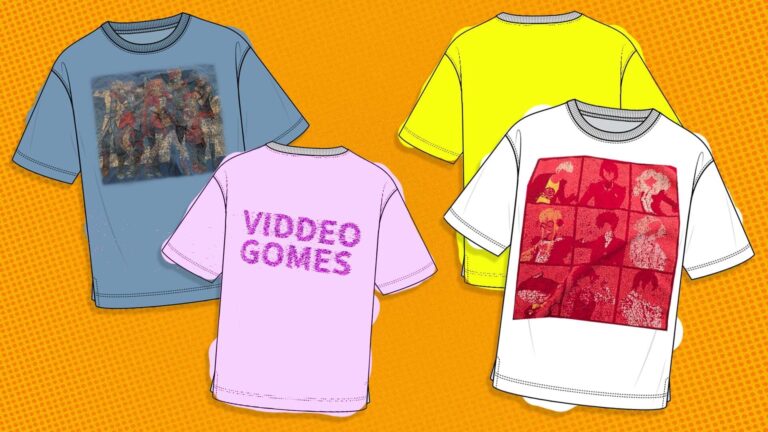
A customer eager to support Slay the Spire made what seemed like a straightforward purchase from what appeared to be the game’s official merchandise store. Upon receiving their order, disappointment set in almost immediately. The t-shirts arrived with a noticeable white border framing every graphic, a telltale sign of hasty, low-quality production. The buyer wasn’t dealing with cost-cutting on MegaCrit’s part—the developer behind Slay the Spire had zero involvement with the operation. Instead, they’d stumbled onto one of countless genAI-powered storefronts masquerading as official channels, complete with the language needed to fool unsuspecting fans into thinking they were buying legitimate merchandise.
“I got a couple of shirts from the official store and was a bit disappointed,” the customer posted on the Slay the Spire subreddit, before realizing the truth. “I was fooled. This is not the official site.”
Finding genuine video game apparel has become a frustrating needle-in-a-haystack task. Search for any popular game’s official merchandise, and the results overflow with options—too many options. Buried beneath mountains of cheap knockoffs and AI-slop operations sit the legitimate makers, companies that have spent years building partnerships with developers and maintaining quality standards. Yet their voices grow quieter each day, drowned out by an army of bot-generated designs and dropshipped garbage flooding every corner of the internet.
The Explosion of Cheap Alternatives
The video game apparel economy has transformed dramatically over the past decade. What once required significant infrastructure and expertise to break into is now accessible to anyone with internet access and a laptop. This democratization of t-shirt manufacturing has benefits, certainly, but it has also unleashed chaos.
Companies like Redbubble and TeePublic revolutionized how small creators could monetize their designs. A fan artist could draw something wonderful, post it online, and within moments receive offers to print it on merchandise. The friction had been removed—no inventory to manage, no upfront costs, no manufacturing expertise required. Social media amplified this further. Years ago, tweeting the word “shirt” in response to cool fan art would trigger an immediate flood of links offering that very design on apparel within seconds.
“That’s been one of the more challenging bits,” Glenn O’Neill, co-founder of The Yetee, told reporters. “Adapting and changing around that.” The Yetee, which has operated for 15 years, is known throughout the gaming community for its partnerships with developers and its collaborations with Games Done Quick, the speedrunning charity event.
Screen Printing Versus the New Economy
The Traditional Method
For decades, screen printing represented the gold standard of t-shirt production. The process involves pressing ink through stenciled screens in multiple layers to build full-color images. It’s labor-intensive, equipment-heavy, and chemical-dependent. Creating merchandise at scale demands dedicated physical space, skilled technicians, and patience. This quality consistency came with a price—quite literally.
Direct-to-Garment Printing Changes Everything
Enter direct-to-garment printing, or DTG. Think of it as an industrial inkjet printer designed specifically for fabric. Drew Wise, a freelance artist and creative consumer products lead at Mob Entertainment (the studio behind Poppy Playtime), describes it plainly: “It’s like an inkjet printer for apparel.” DTG technology is significantly faster and cheaper than screen printing. It can operate from a home studio. It handles unlimited color variations without the complexity screen printing demands.
The catch lies buried in the quality. “You can get an unlimited amount of colors,” Wise explained, “but the colors end up coming out really muted because it’s having to mix the inks in the printer.” More problematically, the graphics simply don’t endure. Jeremy Greco purchased a Persona 5 and Trails In The Sky shirt from TeePublic, which relies on DTG printing. “When I got these shirts,” he recounted, “they seemed a bit cheaper than normal and after like 10 washes the graphics were so faded you can barely tell what they look like anymore.”
Print-on-Demand Services Scale the Problem
Print-on-demand platforms commercialize DTG technology further. Small sellers don’t even need to operate their own equipment anymore. Companies like Redbubble and TeePublic handle everything—they print, ship, and collect payment. The barrier to entry approaches zero. Anyone can upload a design and start selling t-shirts within minutes.
The GenAI Turbocharger
This already-chaotic landscape took a dark turn with the widespread adoption of generative AI. Creating artwork that sells merchandise no longer requires skill, time, or originality. An AI image generator can produce dozens of designs in an afternoon. A malicious actor can spin up a website, populate it with AI-generated artwork, slap “official” across the homepage in bold letters, and begin processing orders before a legitimate developer even knows the site exists.
The speed advantage genAI provides cuts both ways. Drew Wise faced this directly with online character Jimothy the raccoon, which exploded in popularity. “I did a Jimothy drawing, but I didn’t make a shirt of it,” Wise said. “Because I’m like, ‘You know what? By the time I get this set up and it ships, maybe he won’t be cool anymore and there’s already 1000 [AI Jimothys] out there.”
In today’s rapid-fire attention economy, consumers want products while the dopamine hit is still fresh. Legitimate merchandise makers operate under entirely different constraints.
The Real Cost of Doing It Right
Reed Young, CEO of Fangamer, explained the harsh reality. Fangamer has spent years making licensed video game products and collaborating with Games Done Quick. Creating actual quality merchandise involves far more than uploading a design to TeePublic.
Developing a single t-shirt requires soliciting feedback from employees, working through numerous approval rounds with the license holders, and ensuring the final product meets their standards. It’s collaborative and deliberately slow. “In order to do it right and to get a license for a game and to make merchandise that’s approved, it’s generally almost impossible to knock anything out in less than like six months,” Young stated.
Six months. That’s the gap between when an idea is conceived and when legitimate merchandise reaches shelves. GenAI operators can flood the market in six days, or six hours. The consumer shopping for products wants them now, not later. Legitimate manufacturers are structurally incapable of competing on speed.
Theft and the Unwinnable Battle
Even for established companies like The Yetee and Fangamer, theft is a constant plague. Investigators discovered their official artwork reproduced on Redbubble and TeePublic without permission or compensation. The artists behind these designs don’t even know it’s happening until weeks or months later, if ever.
Drew Wise has endured this for nine years. “I’ve been dealing with it for nine years,” Wise said. “I gave up because it was so stressful.” The emotional toll of defending your own artwork, over and over again, erodes the soul.
Stopping theft requires legal intervention, lawyers, and tedious investigation. Young acknowledged the paradox: “Because we don’t post super low res or try to protect the images, they do get stolen. And that’s just kind of a cost of doing business.” Legitimate companies showcase their best work to attract customers. That same high-quality presentation makes it trivial for thieves to steal the designs.
When theft becomes significant enough to warrant action, the process is Sisyphean. Cease-and-desist letters get sent. Websites come down. But within days, the same artwork appears under a different domain, a different storefront. “If you do succeed in getting something taken down, which involves lawyers and a bunch of emails back and forth, and often a lot of investigative work, they’ll say like, ‘yeah, I’ll take it down,’ and then it just pops up on a different site,” Young explained. “It’s just a question of ‘Is it worth the hassle?’”
Glenn O’Neill concluded that it often isn’t. “What I tell myself is that you are better off spending your time creating things with your energy than you are trying to take things down,” he said. “Your soul is kind of eroded by the process of trying to fight the hydra.”
Why the Optimism Persists
Despite mounting frustration, everyone involved in legitimate merchandise remains fundamentally optimistic about the industry’s future. Young believes genAI will ultimately help rather than harm authentic creators. “I’m not worried about genAI for Fangamer existentially at all,” he said. “I think what it will end up doing is helping people understand and appreciate the kind of thing that we’ve done, that a lot of our competitors do as well, which is to pay people to make something really cool that you can hold in your hands.”
Younger consumers, Wise observed, actively prefer art made by actual artists. “Most younger generations want non-AI art,” he stated. “People actually want to support artists.” The sentiment suggests that consumers, once burned by cheap knockoffs and faded graphics, will increasingly seek out merchandise backed by real people and real craftsmanship, even if it costs more and arrives later.
Frequently Asked Questions
How long does it take legitimate companies to create official video game merchandise?
It takes a minimum of six months. The process involves soliciting employee feedback, working through multiple approval rounds with license holders, and ensuring the final product meets their standards.
Why do direct-to-garment printed shirts fade quickly compared to screen-printed ones?
DTG printing mixes inks inside the printer to achieve unlimited colors, which produces muted results. The graphics also don't adhere as durably to fabric, causing significant fading after approximately ten washes.
What makes it difficult for legitimate merchandise makers to stop their designs from being stolen?
Legitimate companies display high-quality images to attract customers, making their designs easy to steal. Taking down stolen artwork requires lawyers and investigation, but the same designs reappear on different sites within days, making enforcement impractical.
