
Key takeaways
- The affected Steam Machine unit failed catastrophically after a firmware update, with Valve’s own support documentation identifying the red LED pattern on the light bar as a definitive indicator of GPU hardware failure.
- Reddit user “me_hill” was among the first to receive a unit and reported it stopped working minutes after installing the latest firmware, with no display output appearing on their monitor.
- The Steam Machine’s RLOD is not merely a coincidental naming similarity to the Xbox 360’s Red Ring of Death—it represents the same fundamental failure mode.
- The coming weeks will determine whether the RLOD incident represents an isolated manufacturing defect or the harbinger of a broader quality control crisis.
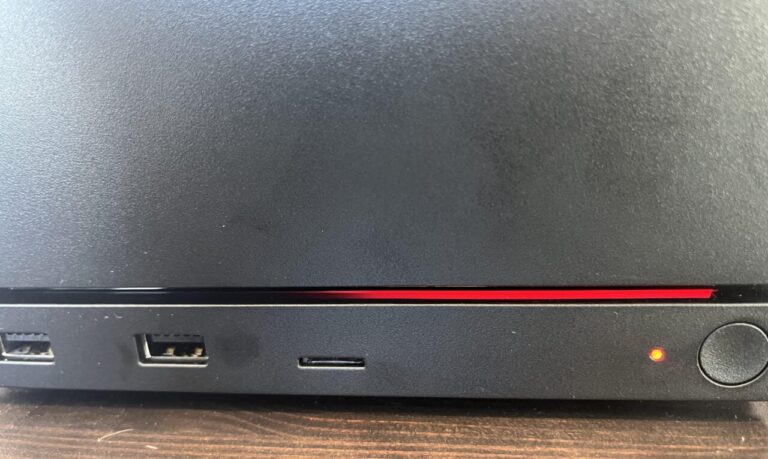
A Steam Machine owner reported the first case of “Red Line of Death” (RLOD) failure after just 20 minutes of use, with the unit displaying a red light on the right half of its light bar—a GPU hardware failure that renders the console unable to boot. The incident mirrors the Xbox 360’s infamous Red Ring of Death (RROD) from 2005, raising serious questions about the reliability of Valve’s console-PC hybrid as it launches into a market already skeptical of the company’s hardware ambitions. The failure occurred shortly after the user installed the latest firmware update and played No Man’s Sky for five minutes, leaving the device permanently non-functional with no user-fixable solution.
The First Hardware Crisis: GPU Failure in Minutes
The affected Steam Machine unit failed catastrophically after a firmware update, with Valve’s own support documentation identifying the red LED pattern on the light bar as a definitive indicator of GPU hardware failure. Because the semi-custom AMD RDNA3 GPU is soldered directly to the motherboard—a design choice made to optimize the 1080p gaming experience at 60 FPS—the user cannot replace the component themselves. The owner’s only recourse is to pursue a warranty repair or full replacement through Valve Support, transforming what should have been a launch-day celebration into a hardware recall situation.
The timing of this failure is particularly damaging. The Steam Machine features an AMD 6-core Zen 4 x86 CPU running up to 4.8 GHz paired with 8GB GDDR6 memory on the soldered GPU, representing significant engineering investment. The system ships with a single 16GB DDR5 stick by design, simplifying the hardware architecture but eliminating any redundancy or user upgrade paths. A catastrophic failure within minutes of firmware installation suggests potential issues with thermal management, power delivery, or the update process itself—any of which could affect units still in warehouses or arriving at customers’ doors.
Supply Chain Chaos and Pricing Under Pressure
The Steam Machine launches into an industry gripped by component shortages and skyrocketing memory costs, a crisis Valve itself acknowledged when it delayed the console’s launch specifically due to DDR5 and storage component unavailability. This “RAMpocalypse” has forced Valve to price the base 512GB model at $1,049 without a controller, or $1,128 with one, making it substantially more expensive than the PlayStation 5 and Xbox Series X at launch. The 2TB variant commands $1,349 to $1,428, pricing that industry observers have criticized as psychologically damaging and uncompetitive.
Valve stated it is not subsidizing the price despite its “religious commitment” to the hardware quality, meaning every dollar of that $1,000+ price tag reflects actual manufacturing costs driven by global supply constraints. The Steam Deck itself is completely out of stock in many regions due to these same memory and storage shortages, creating a roadblock not just for new hardware launches but for Valve’s entire ecosystem expansion. Customers paying premium prices for a console-PC hybrid expect reliability guarantees, making the RLOD incident particularly damaging to consumer confidence at the worst possible moment.
Community Reports and Industry Skepticism
Reddit user “me_hill” was among the first to receive a unit and reported it stopped working minutes after installing the latest firmware, with no display output appearing on their monitor. The red LED pattern—specifically the right half of the light bar breathing in red—is a specific error code documented by Valve Support as GPU failure, leaving no ambiguity about the nature of the problem. Forum consensus quickly shifted from troubleshooting suggestions to RMA recommendations, with users acknowledging that a soldered GPU failure cannot be repaired by end users.
This early-stage hardware failure echoes industry concerns about Valve’s track record with console hardware. The original Steam Machine, launched in 2015, sold roughly 500,000 units but failed to gain traction due to only 21.5% of Steam’s catalog being compatible with SteamOS at launch and manufacturer confusion about which version to produce. Most manufacturers including Alienware dropped the line by 2017, and Valve quietly de-listed the product in April 2019, officially ending the first iteration. The company’s decision to return to hardware manufacturing with the Steam Deck proved more successful, but the RLOD incident suggests the company has not solved the fundamental engineering and quality control challenges that plagued previous attempts.
A Ghost of Hardware Past: The Xbox 360 Parallel
The Steam Machine’s RLOD is not merely a coincidental naming similarity to the Xbox 360’s Red Ring of Death—it represents the same fundamental failure mode. Microsoft’s console suffered from GPU overheating and solder failures beginning at launch in 2005, ultimately triggering a massive RMA program that cost the company an estimated $1.15 billion in warranty repairs and replacements. The reputational damage lasted for years, with consumers viewing the Xbox 360 as fundamentally unreliable despite the console’s eventual market success.
Valve faces the prospect of repeating this history at a moment when the company is already fighting skepticism about its hardware division. The original Steam Machine’s failure was attributed to software and market positioning issues; if the new generation begins failing due to hardware defects, Valve’s credibility in the console space could suffer irreparable damage. A widespread RLOD epidemic would force the company into a costly warranty program at a time when it is already struggling with supply chain constraints and elevated component costs.
Software Compatibility Improvements and Remaining Gaps
Valve has attempted to address the compatibility issues that killed the original Steam Machine by releasing SteamOS 3.8.10, which improves support for recent Intel and AMD platforms and officially allows users to install the operating system on their own desktops. This represents a strategic shift toward ecosystem flexibility rather than locked-down hardware, potentially mitigating the software compatibility problem that plagued the 2015 launch. The move signals Valve’s recognition that SteamOS adoption requires broader hardware support and user choice.
However, critics note that many AAA single-player games and indie titles still face compatibility hurdles on Linux, limiting the Steam Machine’s appeal compared to Windows-based consoles that offer universal game library access. The hardware’s optimization for 1080p gaming at 60 FPS also struggles with advanced textures at higher resolutions, positioning it as a lower-powered console in an era where consumers increasingly expect 4K capability. These software and performance limitations compound the damage from the RLOD incident, creating a narrative that the Steam Machine is simultaneously unreliable and underpowered.
The Critical Weeks Ahead for Valve’s Console Ambitions
The coming weeks will determine whether the RLOD incident represents an isolated manufacturing defect or the harbinger of a broader quality control crisis. Valve must transparently communicate its investigation findings and any remediation steps to customers who have already pre-ordered or received units. The company’s handling of this situation will directly influence adoption rates and long-term consumer trust in its hardware division.
The Steam Machine’s launch was already complicated by premium pricing driven by component shortages and skepticism rooted in the original product’s 2015 failure. A hardware reliability crisis in the first days of availability could prove fatal to Valve’s console ambitions and reinforce the industry narrative that the company excels at software and services but struggles with the physical engineering and quality control demands of consumer hardware manufacturing.
