
Key takeaways
- Arc System Works' TÅkon prioritizes mechanical innovation and visual personality over mainstream brand recognition in its roster construction philosophy.
- Seven deeper-cut Marvel characters—from Multiple Man's clone mechanics to Clifford F. Michaels' flying bicycles—offer distinct gameplay and thematic possibilities absent from competitors.
- Fighting games succeed when rosters embrace unexpected choices, a lesson proven by early arcade crossover fighters and validated by TÅkon's unconventional design direction.
- Danger's redesign as an anime android exemplifies how TÅkon translates comic characters into fighting game mechanics that prioritize gameplay clarity over source material accuracy.
Arc System Works’ Marvel TÅkon: Fighting Souls arrives with a philosophy that surprises in its restraint. Producer Michael Francisco clarified that character popularity did not drive roster decisions, a position that distinguishes TÅkon from Marvel Rivals’ mainstream-focused selections. This approach echoes arcade history, when Capcom’s Marvel vs. Capcom featured genuinely unorthodox roster choices. Those early crossover fighters secured spots for Spiral, Blackheart, and Shuma-Gorath years before more obvious selections like Thor or Iron Man ever appeared in a fighting game.
The contrast between TÅkon’s philosophy and Marvel vs. Capcom: Infinite—which locked out the X-Men entirely to synchronize with Disney films—reveals what TÅkon understands about fighting game design. A roster’s strength isn’t measured in brand recognition. Mechanical diversity, visual personality, and willingness to surprise matter more. Danger, TÅkon’s most unconventional character, exemplifies this philosophy. Rather than render her as a tangle of deadly traps, Arc System Works designed her as an anime-style android, prioritizing silhouette and gameplay clarity over comic-accurate representation.
Roster Philosophy: Why TÅkon Should Embrace the Unhinged
The Unhinged Roster Theory
A crossover fighter is only as compelling as its willingness to embrace the unhinged. When rosters stick to obvious, marketable characters, they become indistinguishable from each other. When they dig into a franchise’s deeper cuts, they create distinct identity and provide mechanical options that feel genuinely novel. TÅkon currently shows this promise, but substantial opportunity remains to explore Marvel’s catalog of forgotten antiheroes, minor villains, and genuine oddities.
TÅkon’s Current Direction
The game already demonstrates willingness to take visual and mechanical risks. Danger proves that uncommon character choices can work within Arc System Works’ technical framework. This foundation supports more ambitious roster expansion beyond the immediately recognizable names.
Multiple Man: Marvel’s Clone-Based Rogue
Madrox, known as Multiple Man, is Marvel’s perpetual underdog. His core ability—replicating himself seemingly without limit—carries inherent fighting game appeal. The critical mechanic lies in his clones’ deteriorating mental state the longer they exist independently from the original. In a fighting game context, Multiple Man could function as a one-man army, compensating for poor martial technique through sheer numerical advantage. Alternatively, the character could operate as a parody of technical precision, approximating complex choreography through chaotic multiplication rather than skill. Either direction creates mechanical novelty distinct from standard fighting game archetypes.
Silvermane and the Cyborg Tradition
Silvio Manfredi, who became Silvermane, presents an unorthodox selection. Originally a powerful figure in New York’s underworld, Manfredi faced physical decline and pursued unconventional resurrection through cybernetic enhancement. He emerged as a gnarly cyborg with the leathery visage of a tomb guardian, combining aged human trauma with mechanical replacement. While other Spider-Man mobland villains—Tombstone and Hammerhead—would serve as capable fighting game candidates, Silvermane offers maximum mechanical potential. His cyborg nature justifies heavy hits and unorthodox movement patterns. His visual design, anchored in grotesque intersection of human decay and mechanical replacement, would stand apart in any crossover roster.
Dead Girl, Nightshade, and Madelyne Pryor
Dead Girl: Necromancer from X-Force
Dead Girl emerged from Mike Allred’s X-Force as a character defined by self-absorption and tragedy. She moved to the city pursuing art, only to be murdered by her boyfriend. The moment of her death triggered latent mutant powers. She woke in her tomb with complete control over necrotic tissue, including her own body. This origin carries visual and mechanical promise. Necromantic abilities suggest command-based gameplay, summoning energy or conjured forms. Her history with Dr. Strange adds mystical credibility. A fighting game version could emphasize her grotesque aesthetic—a character who literally returned from death, reshaping her own corpse through willpower alone.
Nightshade: Werewolf Commander
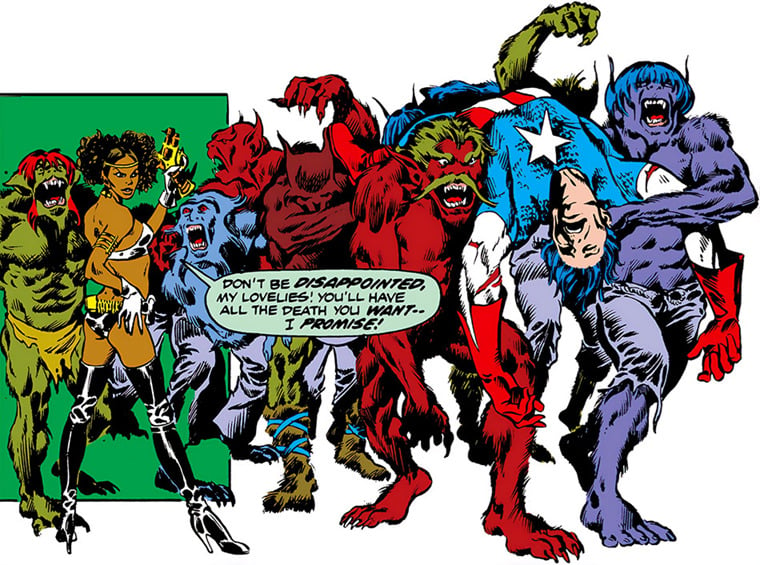
Tilda Johnson, known as Nightshade, operates through scientific obsession. A Captain America villain whose sole purpose revolves around promoting werewolves through supernatural science, she commands fuzzy armies as personal enforcers. Her signature strategy involves transforming Avengers into werewolves, weaponizing the transformation for her own ends. Though dangerous without her entourage, Nightshade maintained an anti-hero presence in Marvel’s criminal underworld. She appeared in Netflix’s Luke Cage series, notably without any of her signature werewolves—an omission TÅkon could easily correct. A fighting game version could feature her summoning werewolf enforcers or transforming herself into beast form mid-match.
Madelyne Pryor: The Goblin Queen
Madelyne Pryor occupies unique position as a Jean Grey clone infused with dangerous chemistry. Forbidden magic combined with mutant psychic power creates mechanical and thematic depth. She functions sometimes as the legitimate article, sometimes as a psychic illusion, using her mutations to transform surroundings into hellish landscapes exploiting latent fears. Her signature move involves summoning gnashing demons conjured from psychological terror. A fighting game adaptation could emphasize her dual nature—solid strikes combined with illusion-based mixups. Her visual design, anchored in demonic imagery and mutant power, would distinguish her from other Marvel fighters.
Rom the Space Knight and Anachronistic Chaos
The 1970s and 1980s saw Marvel publish numerous comic runs for toy licenses, particularly Transformers and Micronauts. Few original characters achieved permanent Marvel residency, but Rom the Space Knight transcended his toy origins to become genuinely compelling. While the original toy failed commercially, the comics succeeded, giving Rom extended team-ups with the Avengers well past his real-world shelf-life expiration. His visual design—resembling a beautiful, shimmering beer can—somehow translated into genuine charisma on the page. A Spawn refugee version of Rom is currently slicing through Marvel Rivals. The people want Rom; TÅkon should deliver.
Clifford F. Michaels pushes furthest into unorthodox territory. Disgusted by contemporary life and modern technology, he pined for the American Gilded Age. His response? Engineering flying tandem bicycles, killer mannequins, and sonic phonographs to terrorize San Francisco. Despite such absurdist ambitions, he proved surprisingly effective as a Spider-Woman and Spider-Man antagonist, eventually joining the Hood’s indentured legion. The character carries genuine comedic presence while maintaining serious threat capability. Seeing Clifford F. Michaels’ flying tandem bicycle mechanics in a fighting game would signal that TÅkon understands design transcends brand familiarity.
Why Unhinged Rosters Define Fighting Games
The fighting game landscape increasingly homogenizes around safe, recognizable names. Marvel Rivals succeeds through mainstream appeal. TÅkon can succeed through mechanical innovation and visual personality. By selecting characters like Madrox, Silvermane, Dead Girl, Nightshade, Madelyne Pryor, Rom, and Clifford F. Michaels, Arc System Works would create a roster genuinely distinct from every other Marvel fighting game ever released. That distinction isn’t a luxury—it’s essential to long-term player investment and franchise identity. The early arcade crossover fighters proved this principle: the willingness to take roster risks creates the most memorable competitive environments.
Frequently Asked Questions
What is Michael Francisco's role at Arc System Works?
Michael Francisco is the producer of Marvel TÅkon: Fighting Souls.
Which Marvel fighting game locked out the X-Men entirely?
Marvel vs. Capcom: Infinite locked out the X-Men, choosing instead to synchronize with Disney films.
How did Arc System Works redesign Danger for TÅkon?
Danger was designed as an anime-style android rather than her traditional tangle of deadly traps, prioritizing fighting game silhouette and gameplay clarity over comic-accurate representation.
