
Key takeaways
- Strange Scaffold's Truck-kun Is Supporting Me from Another World?! succeeds by separating the isekai narrative into the background, keeping the driving gameplay as the main focus while Ward levels up offscreen.
- The game features responsive arcade-style driving with satisfying drift mechanics, boost functions, and environmental obstacles that reward creative chaos over simulation accuracy.
- A single map limits long-term engagement as objectives become predictable, missing opportunities for trick mechanics despite the truck's jumping ability.
- At $20, the game's brief, focused design avoids padding and delivers consistent comedic value while standing apart from typical isekai storytelling tropes.
Strange Scaffold’s latest release, Truck-kun Is Supporting Me from Another World?!, succeeds at something that rarely registers on a critic’s radar: making the isekai genre entertaining for someone who actively despises it. The isekai trope dominates anime, manga, and television productions across Asia—a storytelling formula where characters slip between worlds, whether from present day into fantasy or historical settings, forced to navigate impossible circumstances and find their way home. The repetition has worn thin enough to generate reflexive eye-rolls, yet this $20 driving game manages to find genuine charm within the framework that typically feels exhausted.
A Premise Built On Comic Violence
The setup arrives with dark humor intact: you occupy the role of a delivery driver whose truck collides with Carissa Ward, a corporate climber on the verge of a promotion that would finally rescue her from financial instability. What should have been a tragic accident becomes the inciting incident for an unexpected partnership. Ward materializes as a voice in your head, communicating from the fantasy realm she now inhabits—a callback to the anime trope where isekai stories often begin with vehicular impact. Her demand is straightforward: you destroyed her path to advancement, and now your job is to restore it.
The mechanics emerging from this bizarre circumstance create an elegant separation between narrative layers. Rather than spending time in the fantasy world itself—the aspect of isekai that most frequently grates—the game keeps you grounded in reality. Your responsibility remains singular and motorized: drive through the city, hit as many objects and pedestrians as possible, and let the progress bar reflecting Ward’s advancement handle the rest. When she needs an extra boost, you press a button to trigger her ultimate attack. Otherwise, your focus stays on the road.
Driving Mechanics That Prioritize Fun Over Simulation
Movement and Control Feel Responsive
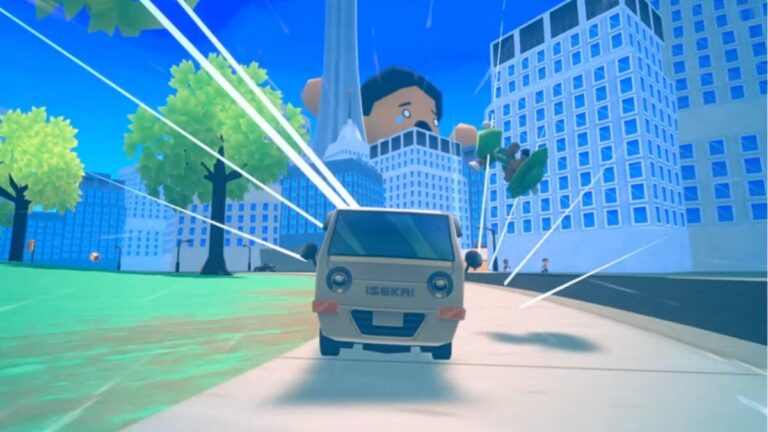
The truck itself—rendered as an adorable kei delivery vehicle complete with an expressive face—handles with a lightness that contrasts sharply with driving simulators like Forza Horizon. This game explicitly rejects simulation in favor of arcade sensibilities. The vehicle responds immediately to input, making high-speed navigation through the city feel exhilarating rather than tedious. A boost function combines with satisfying drift mechanics to reward both aggressive driving and precise control. Players who lean into the game’s intended chaos discover that speed comes naturally, and breaking things becomes the default state rather than an exception.
Environmental Design Encourages Experimentation
The cityscape surrounding your delivery route contains structures built for destruction and discovery. Boost pads scattered throughout the streets propel the truck forward with cinematic flair. Ramps provide opportunities to launch airborne, triggering wide-angle camera angles reminiscent of Fast and Furious style sequences. Flying rings exist seemingly for no purpose beyond the joy of passing through them, contributing to an overall environment that celebrates chaotic exploration. A shoulder button allows you to sideswipe obstacles—both for powering up Ward’s sword and for shaking off pursuing police, adding a Twisted Metal-adjacent layer of criminal evasion to the driving action.
Single-Map Limitation Creates Predictability
The game’s primary constraint becomes apparent after memorization sets in. One map, regardless of how well-designed, eventually yields to autopilot gameplay. Objectives devolve into straightforward tasks: drift for exactly ten seconds, strike thirty objects, complete other similarly unimaginative targets. The developers created an environment suitable for Tony Hawk-style tricks—the truck can jump—yet never implemented combo systems or stick-flicking mechanics that would have elevated environmental interaction beyond basic traversal. The absence of trick mechanics represents a missed opportunity to layer complexity onto an already engaging foundation.

Narrative Structure That Sidesteps Isekai Fatigue
The genius of Truck-kun lies in its architectural choice to minimize the very element that defines the isekai genre. Because the fantasy world remains peripheral to your experience, you never encounter the typical isekai beats that wear thin across dozens of shows and hundreds of manga chapters. Carissa exists as a disembodied voice dispensing occasional commands, her character development happening entirely offscreen. The game refuses to linger on exposition about the fantasy realm’s magic system, political structures, or the mystical forces that transported Ward from corporate disaster to sword-wielding hero. Instead, the narrative stays tethered to your truck, your victims, and your criminal enterprise of vehicular manslaughter.
This structural choice transforms an otherwise predictable framework into something fresh. The comedy derives entirely from the absurdity of the arrangement—you killed someone and now serve her goals through organized chaos—rather than from recycled isekai tropes about power leveling, dimensional rifts, or fish-out-of-water adaptation moments.
Value Proposition At The $20 Price Point
The game’s brevity and focused design align with its modest $20 price tag. A longer experience might warrant deeper environmental variety, multiple maps, and more sophisticated driving mechanics. At this scale, the focused approach reads as intentional design rather than incomplete implementation. Strange Scaffold created something you can complete in a reasonable timeframe without requiring hours of grinding through repetitive objectives or padding that extends playtime artificially. The developers also ensured the game remains free from artificial intelligence generated content—a notable distinction in an industry increasingly saturated with gen-AI materials.
What Strange Scaffold Accomplished
Truck-kun successfully accomplishes the narrow goal it sets for itself. It delivers a short, focused experience that maintains comedic consistency throughout, rewards skillful driving with visual spectacle, and—most importantly—demonstrates that the isekai framework can work in interactive media if developers trust the premise enough to avoid the genre’s most tiresome conventions. The game proves that transportation-focused gameplay paired with dark humor can create something both entertaining and refreshingly original within a genre typically defined by stagnation. While it falls short of being a definitive driving game alongside Crazy Taxi, it occupies its own space effectively, proving that sometimes the best way to save a tired genre is to ignore most of what makes it tired in the first place.
Frequently Asked Questions
What is the core gameplay premise of Truck-kun?
You play a delivery driver who killed Carissa Ward, a corporate executive, and must drive around the city hitting pedestrians and objects to power up her character as she levels up in a fantasy world she was sent to through the accident.
How many maps does Truck-kun feature?
The game contains only one map, so players who memorize its layout can complete basic objectives on autopilot, though the environment includes boost pads, ramps, and flying rings to encourage exploration.
