
Key takeaways
- GameStop’s closure of approximately 390–400 stores represents the most visible symptom of physical gaming’s decline.
- The shift to digital distribution explains why bargain bins no longer exist in meaningful volume.
- Sony confirmed it will stop supporting physical discs for PlayStation games beginning January 2028, a decision designed to eliminate resale and used markets while driving 100% of revenue through the PlayStation Store.
- Content creator Scott The Woz noted that games requiring peripherals—DJ Hero, Band Hero, Karaoke games, and Dance Pad titles—were almost exclusively sold in the “dollar below” crowd or bargain bins.
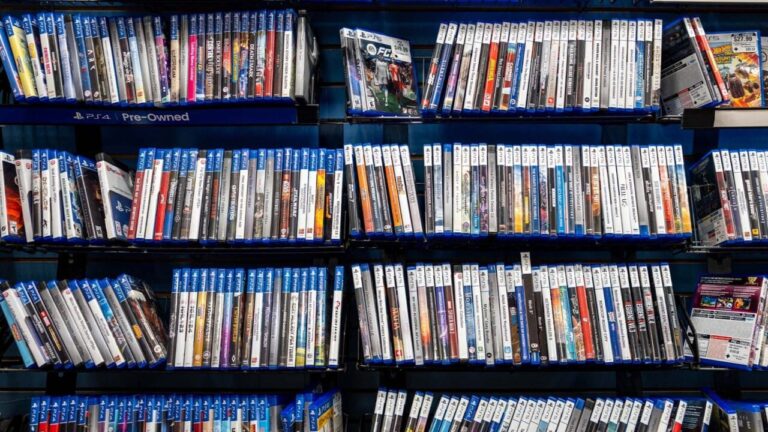
GameStop began closing hundreds of stores in the first week of 2026, with plans to shutter 180–200 underperforming locations by year’s end, effectively eliminating the physical retail infrastructure that once sustained the bargain bin culture. U.S. physical video game sales in 2025 totaled roughly $1.5 billion—the lowest tracked figure since data collection began in 1995—marking an 87% decline in spending over 17 years. The disappearance of the $5 bin, once a staple discovery mechanism for gamers, reflects a fundamental shift in how the industry distributes and monetizes games.
The Physical Retail Collapse Erases Bargain Bin Infrastructure
GameStop’s closure of approximately 390–400 stores represents the most visible symptom of physical gaming’s decline. The retailer’s global sales dropped 14.3% to $1.3 billion in Q2, with hardware sales declining 41.1% and software sales dropping 5.3%. These figures underscore a market in structural contraction rather than temporary slowdown.
The closures eliminate the physical locations where bargain bins thrived. In the United Kingdom, UK retailer Game entered administration for the second time and closed its remaining three standalone stores, ending a presence that once included over 300 locations. The combination of GameStop’s mass closures and Game’s exit marks a near-complete dismantling of the brick-and-mortar ecosystem that generated overstock inventory for discount bins.
Digital Distribution Has Fundamentally Reshaped the Market
The shift to digital distribution explains why bargain bins no longer exist in meaningful volume. In 2023, an estimated 83% of console games were sold as digital copies, leaving only 17% on physical discs. For PC games, digital sales account for 95% of the market. This dominance of digital formats means there is no physical overstock to discount and no retail shelf space to fill with bargain merchandise.
UK data illustrates the speed of this transition. Boxed game sales fell 35% year-on-year in 2024, now representing just 10.4% of new sales. The 9th generation of consoles—PlayStation 5 and Xbox Series X—cemented digital as the default distribution method, making the physical bargain bin a relic of the previous era.
Sony’s 2028 Disc Ban Will Eliminate Used Game Markets Entirely
Sony confirmed it will stop supporting physical discs for PlayStation games beginning January 2028, a decision designed to eliminate resale and used markets while driving 100% of revenue through the PlayStation Store. Industry analysts note the move removes the final barrier to complete digital control, making the “bargain bin” and “used game” markets obsolete by corporate decree.
By removing discs, Sony forces consumers into digital storefronts where prices are rarely discounted to $5. The decision signals that major publishers no longer view the used game market as competition to be tolerated. Instead, they view it as lost revenue that can be recaptured through digital-only distribution and subscription services.
The Peripheral Game Era Disappeared With Physical Media
Content creator Scott The Woz noted that games requiring peripherals—DJ Hero, Band Hero, Karaoke games, and Dance Pad titles—were almost exclusively sold in the “dollar below” crowd or bargain bins. These niche titles, often bundled with hardware, were frequently dumped into $5 bins because they were difficult to sell at full price and had limited appeal beyond their target audiences.
The decline of physical media means these specific “gimmick” games are no longer produced on discs, ending an era where bargain bins served as the primary discovery mechanism for gaming oddities. Titles that couldn’t sustain full-price retail sales found a second life in discount bins; with no physical media to discount, that pathway has closed entirely.
When the Bargain Bin Was a Gateway to Hidden Gems
The 1990s represented the golden age for bargain bin culture in home gaming. During this period, consoles like the SNES, Sega Saturn, and PlayStation established themselves in households, and retailers like Sears Funtronics filled bargain bins with unsold inventory. In 1996, a bargain bin at a Sears Funtronics location was filled exclusively with Sega Saturn games, all marked down to $5 each. This low price point made gaming accessible for kids to discover titles they couldn’t afford at full retail, creating the “hidden gem” culture that defined bargain bin discovery.
Gamers recall the experience of finding PS3 titles in GameStop’s $5 bins, using those discount sections as their primary means of expanding their libraries. That mechanism—overstock inventory discounted to clear shelf space—simply cannot exist in a digital-dominant market where supply is infinite and marginal distribution costs are zero.
The Used Game Market Shifts Online While Facing Digital Competition
The global second-hand game platform market was valued at $7.2 billion in 2025 and is projected to reach $13.8 billion by 2034, representing a compound annual growth rate of 7.5%. However, the method of used game sales is shifting from physical “bargain bins” to digital resale platforms. Reports note “increased competition from digital game distribution platforms,” suggesting that even the growing used market may eventually be cannibalized by subscription services and digital-only releases that cannot be resold.
The growth in used game market value masks a fundamental transformation in how that market operates. Physical bargain bins represented a visible, accessible discovery mechanism. Digital resale platforms require active searching and participation. Subscription services eliminate the resale market entirely by offering unlimited access without ownership.
What Comes Next as Physical Retail Vanishes
The next critical date arrives in January 2028, when Sony’s disc support ends. This event will mark the formal closure of the PlayStation’s physical retail era and accelerate the timeline for other platforms to follow. Before then, GameStop’s ongoing store closures throughout 2026 and 2027 will continue eliminating physical retail locations where bargain bins could theoretically exist.
The bargain bin—once a cultural institution where gamers discovered hidden gems, peripheral-based oddities, and affordable entry points into gaming—has effectively ceased to exist. Its disappearance reflects not a temporary market correction but a permanent structural shift in how the gaming industry manufactures, distributes, and monetizes its products. For the next generation of gamers, the $5 bin will exist only in memory.
