
Key takeaways
- Agent 64: Spies Never Die captures the feel of classic N64 shooters like GoldenEye and Perfect Dark on PC with auto-aim mechanics and level design inspired by Rare's originals.
- The game's auto-aim system and sliding movement create a distinctly different, more accessible FPS experience compared to modern precision-focused boomer shooters and tactical titles.
- Multiplayer and full campaign co-op support, including split-screen options for up to four players, provide replayability alongside difficulty tiers that unlock new objectives and secret collectibles.
For decades, first-person shooters on the Nintendo 64 occupied a peculiar niche in gaming history. While the console never matched the raw performance or precision aiming of their PC counterparts, titles like GoldenEye 007 and Perfect Dark created an entirely different style of FPS gameplay. They relied on auto-aim targeting, tight level design with hidden objectives, and a flow-based combat system that rewarded methodical exploration over raw reflexes. That era faded as the industry moved toward faster, more mechanically demanding shooters, leaving nostalgic fans without contemporary games that captured that specific formula. Agent 64: Spies Never Die, now available on PC via Steam from solo developer Replicant D6, directly addresses that absence.
A Love Letter to Rare’s N64 Shooters
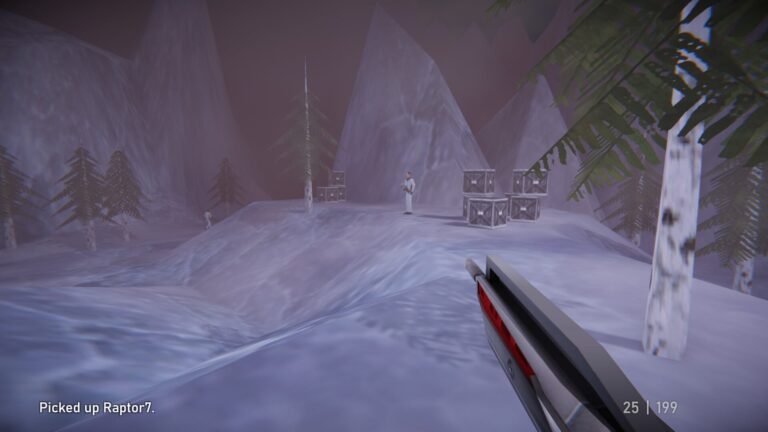
Agent 64 announces its intentions immediately. Upon starting the first campaign level, players find themselves in a room containing a television and N64-style console. The screen displays pixelated gameplay footage that could plausibly be either Agent 64 itself or GoldenEye 007, depending on how much forgiveness one extends to memory. This opening establishes the game’s core philosophy: faithfully recreating the experience of playing Rare’s classic N64 shooters for a modern audience.
The design team has studied its source material carefully. The game strips away mechanics that became standard in the decades following those N64 originals. There is no aiming down sights. There is no bunnyhopping or sprint-canceling through levels at extreme velocity. Instead, players walk briskly through environments, with a movement system that emphasizes sliding around corners and through rooms with momentum-based fluidity. Combat relies entirely on the game’s auto-aim system, which automatically locks onto enemies as players move through spaces, eliminating the need for precise mouse positioning or analog stick tweaking.
Mechanics That Define a Generation
The absence of jumping and crouching buttons is deliberate. These omissions force players to navigate levels differently than in modern FPS games, where verticality and cover-based movement dominate. Instead, Agent 64 encourages flowing from room to room, weapons blazing, trusting the auto-aim to handle targeting while the player focuses on positioning. Early gunplay with the SMG delivers immediate satisfaction; sliding into a room of guards and watching them fall without manually adjusting aim creates a sense of smooth competence that modern precision-focused shooters intentionally deny.
Replicant D6 has been forthright about the trade-offs inherent in this approach. The combat system is deliberately simple, with no upgrade trees, unlockable weapons, or progression mechanics that extend beyond each level. This simplicity is not a limitation but rather a feature—it mirrors the straightforward, arcade-like nature of the games that inspired it, where skill came from understanding level layouts and mastering movement rather than optimizing loadouts.
Visual Identity and the CRT Debate
Visually, Agent 64 embraces its retro heritage without being slavishly bound to it. The default graphics settings render the game with enough clarity and detail to be functionally modern, yet stylistically it reads as distinctly dated compared to contemporary releases. The development team provides an optional CRT filter that intensifies the nostalgia factor, warping the image with scan-lines and color simulation to approximate how these games appeared on 1990s television sets. Players who crank up all visual settings will notice the game maintains its retro aesthetic regardless; the rose-tinted memories of how GoldenEye and Perfect Dark actually looked serve as a useful reference point for what Replicant D6 was targeting.
Level Design That Demands Replaying
What separated GoldenEye and Perfect Dark from lesser shooters was their environmental design. Each mission could be tackled on multiple difficulty settings, with higher tiers introducing additional objectives that altered how players approached familiar spaces. A basic run through a level might involve simply reaching an exit point and eliminating enemies along the way. That same level on a harder difficulty might require destroying specific equipment, hacking a terminal with a gadget before a helicopter lifts off, or gathering intelligence before leaving.
Difficulty Tiers as Design Philosophy
Agent 64 replicates this design philosophy with fidelity. Starting on the lowest difficulty allows players to learn a level’s basic layout and enemy placement without worrying about secondary objectives. Increasing the difficulty introduces new areas to explore and new goals to accomplish, transforming familiar routes into fresh challenges. The game includes hidden collectibles scattered throughout levels that can be shot to unlock bonus content and additional playable areas. This structure creates substantial replay value; players who enjoyed a level on easy difficulty have legitimate reasons to return at higher settings, chasing completion times and discovering secrets they missed during initial runs.
Objectives That Matter
The secondary objectives feel meaningfully integrated into level architecture rather than tacked-on after the fact. Whether blowing up supplies, using gadgets to interact with environmental systems, or timing actions around NPC movements, each task requires understanding the space and planning approaches accordingly. This mirrors the design sensibility of the original games, where players who ignored optional objectives typically found themselves missing significant portions of what each mission had to offer.
Multiplayer and Cooperative Play
If single-player campaigns drive engagement, multiplayer and co-op features seal a shooter’s legacy. GoldenEye’s split-screen multiplayer became iconic enough to inspire references in films and television decades later. Perfect Dark expanded those options with bot AI and customizable match parameters. Agent 64 includes a comprehensive multiplayer suite that accommodates both nostalgic players seeking that split-screen experience and modern players who prefer online connectivity.
The multiplayer modes support various configurations: matches against AI bots exclusively, online play against human opponents, or hybrid modes mixing players and bots. Developers have included granular customization options, allowing players to tweak match parameters to their preferences. Campaign co-op support runs on both online and split-screen implementations, with up to four players fitting on a single screen for multiplayer matches. This accommodates the couch-gaming experience that defined these games for a generation while not forcing that constraint on players who prefer modern online connectivity.
Platform and Performance Considerations
Controller Versus Keyboard and Mouse
The development team has thoroughly tested Agent 64 with multiple input methods. The game excels with a controller, where analog stick movement combined with auto-aim creates the intended experience. However, mouse and keyboard players receive full support, with the control scheme mapping intuitively across both input types. The auto-aim system works equally well with precision mouse input, though controller players report a slightly more satisfying sensation given that input method’s historical association with N64-era console gaming.
Accessibility and Hardware Requirements
One of Agent 64’s strengths is its modest technical footprint. The game runs on virtually any PC manufactured within the last decade, making it accessible to players who cannot or do not wish to invest in current-generation gaming hardware. This approach mirrors the original games’ ability to run on consumer hardware of their era, spreading access beyond enthusiast markets. The price point remains reasonable, avoiding the premium positioning of AAA releases.
Who Should Play This
Agent 64: Spies Never Die will not appeal to everyone. Players unfamiliar with the N64 shooter era may find the control scheme limiting and the graphics dated by contemporary standards. Those accustomed to twitch-based precision aiming and complex movement mechanics may perceive the auto-aim system as reductive rather than accommodating.
For everyone else—players who spent formative gaming years sliding through Facility multiplayer matches or exploring the extra objectives available on Agent difficulty in Perfect Dark—Agent 64 represents something rare: a new game that genuinely understands what made those originals special and has the design discipline to recreate that magic without betraying it with modern conventions. It is a solid value proposition that demands neither significant financial investment nor cutting-edge hardware, offering instead the chance to experience that specific style of first-person shooter gameplay for audiences who thought the era had permanently passed.
Frequently Asked Questions
What makes Agent 64 different from other boomer shooters?
Agent 64 uses auto-aim targeting, eliminates jump and crouch buttons, and emphasizes momentum-based sliding movement rather than precision aiming and fast-paced bunnyhopping. These mechanics are designed to recreate the feel of N64 shooters like GoldenEye and Perfect Dark.
Does Agent 64 include multiplayer and co-op?
Yes. Agent 64 features multiplayer modes against bots or online opponents with customizable settings, and full campaign co-op support for online and split-screen play with up to four players on one screen.
What platforms is Agent 64 available on and what are the system requirements?
Agent 64 is available on PC via Steam. It runs on virtually any PC manufactured within the last decade and is fully playable with either a controller or mouse and keyboard controls.
