
Key takeaways
- Pokopia's Bubbly Basin DLC explores a post-apocalyptic Kanto where humans abandoned Earth to escape climate disaster, leaving Pokémon behind with the assumption they would eventually return.
- The expansion features submerged ruins of iconic locations tied to beloved characters like Misty and Bill, serving as poignant reminders that these figures are either dead or permanently separated from their world.
- The game creates emotional tension through asymmetry: the player understands the tragedy of permanent abandonment through environmental storytelling, while the character Ditto explores unknowingly.
- Bubbly Basin deepens Pokopia's thematic exploration of grief, hope, and moving forward in a fundamentally changed world shaped by climate catastrophe.
Playing through Pokopia’s latest expansion, Bubbly Basin, feels less like exploring a new game area and more like bearing witness to the finality of loss. The base game already delivered an emotionally devastating ending, yet the DLC manages to excavate fresh layers of sorrow from the same post-apocalyptic premise. The underwater region is undeniably gorgeous and mechanically engaging—the gameplay remains as cozy and satisfying as ever—but the emotional weight of what unfolds beneath the surface makes it difficult to continue.
Understanding Pokopia’s Catastrophic Setting
For those unfamiliar with Pokopia’s world, the game takes place in a post-apocalyptic version of the Kanto region. Humanity faced an escalating climate disaster and made the decision to abandon Earth entirely, escaping into space to wait out the crisis. Before departing, people stored their beloved Pokémon in the PC storage system, with the expectation they would eventually return to reclaim them once conditions improved.
That return never came. As players explore the ruins of Kanto throughout Pokopia, it becomes increasingly clear that whatever was supposed to happen didn’t. The scattered notes and environmental storytelling suggest something went catastrophically wrong. Evidence surrounding Ditto’s appearance in the world hints at a darker possibility: humanity may never return at all.
This premise creates a persistent undercurrent of melancholy that colors the entire experience. Every location represents loss—familiar places from the original games now reduced to ruins, with subtle hints of the fates that befell the characters players remember. Most of these narrative breadcrumbs maintain a somewhat lighthearted tone, but they’re always tinged with the knowledge that these beloved figures are either dead or so far removed in space that they’ll never see their Pokémon again.
Bubbly Basin: A Gallery of Abandoned Legacies
Where the base game distributed this melancholy throughout its world, Bubbly Basin concentrates it with devastating focus. Nearly every notable location in this underwater expansion ties directly to specific characters that players have emotional connections to—and each one serves as a memorial to their permanent absence.
Misty’s Gym and the Weight of Waiting
The most immediately recognizable landmark is Misty’s gym, positioned just off the town square in a cavern marked by Pokémon statues. The structure remains identifiable despite the accumulation of sand, with the distinctive swimming pools visible once you clear away the debris. Behind the main area sits a room furnished with Mermaid furniture items, a clear reference to Misty’s historical title as the “tomboyish mermaid.”
Standing in that submerged space, confronting the pools where the fierce water-type gym leader once trained, hits differently than other ruins. Misty isn’t just a historical artifact anymore—she’s a specific person who you met across the anime, whose personality and bonds with her Pokémon felt real. The realization that she’s either deceased or impossibly distant in space, that her beloved Starmie still seems to be waiting for her despite the astronomical odds of reunion, transforms an exploration segment into something approaching a memorial visit.
Bill’s Unfinished Legacy
A short distance northeast of town sits a small house containing a computer setup and one of the new portal pod items. The portal pod system represents a significant expansion feature, allowing players to access their storage from any compatible pod anywhere in the world. Based on the building’s location and contents, the connection is unmistakable: this is Bill’s house.
Bill, the original creator of the Pokémon PC storage system itself, was an inventor with an accident-prone streak—he famously transformed himself into a Pokémon just before players first encountered him. It’s straightforward to infer that he designed the portal pod system shortly before his departure into space, viewing it as a tool that would help rebuild civilization once humans returned. But he never got to see that recovery happen. He never witnessed his invention become crucial to reorganizing the abandoned world. The irony is thorny: humanity’s absence makes his final creation more essential than ever, yet he’ll never know it.
Submerged Memories and Unfinished Construction
Beyond these specific character memorials, Bubbly Basin contains numerous other locations that accumulate sadness through circumstance rather than identification. A massive Japanese-style tower and bridge sink deep beneath the ocean, stripped of any explanation for its original purpose or who constructed it. Players will never learn its history. Nugget Bridge, once a gauntlet of trainers ready to battle, has sunk as well, its former purpose now inaccessible.
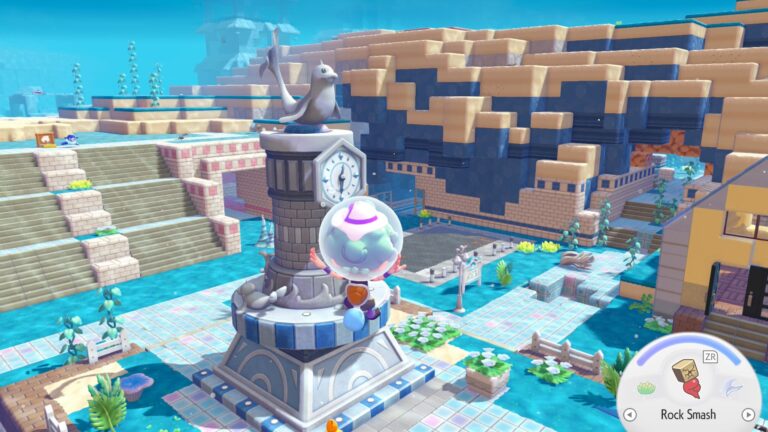
Perhaps most poignant are the fragments of abandoned plans. Notes throughout the region document humanity’s desire to construct a Dewgong clocktower in the city’s center—an ambitious project that never came to fruition. As Ditto, you manage to complete what humans conceived but never executed. The tower stands as a monument to your efforts, yet the people who originally imagined it will never see its completion.
Ditto’s Unknowing Journey Through Sorrow
The narrative structure compounds the emotional impact through a clever asymmetry of knowledge. Ditto, your playable character, explores all of this wreckage completely unaware of its true significance. Ditto cannot read the notes scattered throughout Bubbly Basin that explain what transpired. Ditto doesn’t understand that humanity isn’t coming back.
From the player’s perspective sitting outside the character’s consciousness, this ignorance becomes almost painful to witness. You read the environmental storytelling that paints a picture of permanent abandonment. You see the architectural reminders of people who will never return. You understand the hopelessness of the situation. But your character stumbles through this graveyard of intentions and lost futures, seemingly unaware of the tragedy surrounding them, driven only by that characteristically goofy Ditto smile.
Grief, Climate Catastrophe, and Interactive Storytelling
Pokopia functions on multiple thematic levels simultaneously, and Bubbly Basin sharpens several of them at once. On the surface, the game operates as cozy gameplay with colorful aesthetics and satisfying mechanics. Beneath that veneer lies a sophisticated meditation on grief and loss—the acceptance that some things are gone forever, and the only path forward involves embracing change rather than clinging to restoration.
The climate disaster that prompted humanity’s escape carries real contemporary weight. The game examines not just immediate survival, but the consequences of abandoning a world. Resources, relationships, legacies—all left behind with the hope of reclaiming them later. The cruel twist is that “later” never arrives. The future that was supposed to restore everything never comes, and the present becomes defined by absence.
Bubbly Basin presents this thematically richer story to players through exploration and environmental narrative rather than cutscenes or exposition. You piece together the world’s history through ruins and notes. You understand characters’ fates not through dialogue but through the spaces they occupied. It’s a surprisingly sophisticated approach to interactive storytelling, letting players arrive at conclusions organically rather than having them spelled out.
Facing What Remains
The source material hints at more areas to come—possibilities like Lavender Town, Cinnebar, and Indigo Plateau. Each of those locations carries its own weight in Pokémon history. The prospect of exploring them in Pokopia’s melancholic framework is simultaneously compelling and daunting. What further emotional devastation waits in these familiar spaces transformed into monuments to loss?
Pokopia represents something unusual in interactive fiction: a game about nostalgia that uses that nostalgia as a weapon against player emotions. Bubbly Basin proves that the game hasn’t exhausted that approach. It’s deepened it.
Frequently Asked Questions
What is the basic premise of Pokopia?
Pokopia takes place in a post-apocalyptic Kanto region where humanity escaped Earth to avoid a climate disaster, leaving their Pokémon stored in the PC system with the expectation of returning once conditions improved. That return never came, and the game explores the consequences of that abandonment.
Who is the main character in Pokopia?
The player character is Ditto, who explores the ruins of Kanto while remaining unaware that humanity may never return, since Ditto cannot read the notes and documents that reveal the truth about the world's fate.
What specific character locations appear in Bubbly Basin?
Bubbly Basin includes Misty's gym with its distinctive swimming pools and mermaid furniture, Bill's house containing the computer setup and portal pod system he created before departing into space, and other submerged landmarks like Nugget Bridge and a Japanese-style tower.
