
Key takeaways
- Mike Klubnika's Machine Party expands his breakthrough Buckshot Roulette formula into a four-player party game with 12+ lethal gauntlets mixing cooperation and direct combat.
- The game combines dark absurdism with mechanical horror, featuring challenges from cigarette smoking races to ACME gun construction, punctuated by drone and robot spider threats.
- Buckshot Roulette became a surprise Steam hit in 2023, establishing Klubnika's design philosophy that treats party games as platforms for grotesque, darkly comedic social collapse.
- Machine Party represents a deliberate inversion of traditional party-game expectations, positioning entertainment through degradation, betrayal, and the constant threat of elimination.
Mike Klubnika, the architect behind 2023’s breakout hit Buckshot Roulette, has orchestrated a fresh descent into mechanical cruelty with Machine Party. The new title pushes his signature brand of grotesque entertainment further, transforming the isolated tension of Russian roulette into a multiplayer bloodsport where up to four players navigate over a dozen elaborate death traps disguised as party games.
From Roulette Success to Multiplayer Mayhem
Buckshot Roulette’s rapid ascent through Steam’s charts established Klubnika as a designer willing to embrace dark absurdity and mechanical horror. The 2023 release became one of that year’s highest-selling titles on the platform, a surprise hit that saw players repeatedly face off against a grinning opponent in a high-stakes gamble over life and death. The game’s success prompted Klubnika to expand the concept, introducing multiplayer functionality that extended the experience beyond its original duel format.
Machine Party represents a deliberate pivot toward chaos. Rather than the contained intensity of two opponents, Klubnika now unleashes four-player competition across asymmetrical challenges that reward both cooperation and betrayal. The result feels less like a party game and more like a darkly comedic interpretation of survival reality television, where social games become literal tests of endurance and cunning.
The Gauntlets: Cooperation and Cutthroat Competition
Cooperative Challenges
Not all of Machine Party’s gauntlets pit players directly against one another. Several challenges require collective survival. A narrow minefield dotted with deadly pressure points demands that all four players successfully navigate the hazard zone together. These cooperative moments provide brief respite, though success remains far from guaranteed—players can escape largely intact or not at all, creating genuine tension around shared survival.
Combat and Escalation
Most gauntlets, however, embrace direct player-versus-player competition. An out-of-control escalator forces players to remain standing as the speed increases, with each misstep potentially meaning elimination. In another challenge, players race to construct a functioning ACME gun, with successful builders gaining the firepower to eliminate their rivals. These scenarios strip away any pretense of friendliness, transforming party-game mechanics into survival scenarios where victory requires outmaneuvering opponents.
Absurdist Skill Tests
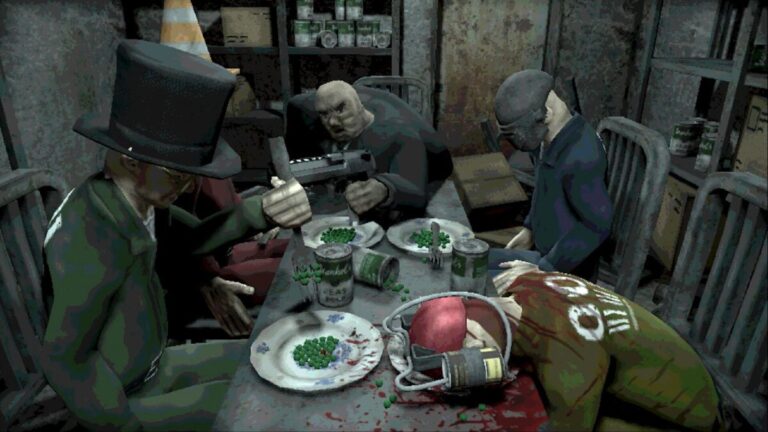
Klubnika doesn’t neglect dark humor alongside the brutality. One gauntlet requires players to consume green peas as rapidly as possible, mimicking a hungry duck’s feeding frenzy. A cigarette smoking competition tests lung capacity and determination. These quirky challenges inject an almost surreal quality, reminding players that Machine Party operates in a register where genuine peril coexists with comedic absurdity. The tone feels deliberately unsettling—a marriage of Squid Game’s stakes with the cartoonish aesthetics of party-game tradition.
Environmental and Mechanical Threats
Beyond player-to-player conflict, Machine Party introduces environmental antagonists. Autonomous drones actively hunt players during certain challenges, firing indiscriminately at anyone in their path, penalizing poor performance in art-related tasks. A robot spider emerges in another gauntlet, practicing what the game describes as unlicensed chiropractic techniques—a darkly absurd way of describing a mechanical threat that targets the player’s body itself.
These automated obstacles reinforce Klubnika’s design philosophy: Machine Party exists in a grotesque industrial landscape where machines, mechanisms, and player agency collide. The setting feels less like a party venue and more like the interior of a meat processing facility, rusted and functional, where entertainment derives from watching participants navigate lethal obstacles.
Klubnika’s Broader Game Design Portfolio
Machine Party doesn’t exist in isolation within Klubnika’s catalog. Beyond Buckshot Roulette, the developer has cultivated a reputation for small, intensely unnerving body-horror games that explore discomfort as a design mechanic. Fused 240, described as Ballardian garage horror, exemplifies this approach—creating oppressive atmospheres through grotesque visual design and unsettling mechanical interactions.
This body of work reveals a consistent artistic vision. Klubnika appears interested in spaces where social structures break down, where participants are forced into compromising or degrading situations, and where the human body becomes a source of vulnerability rather than strength. Machine Party extends this preoccupation into multiplayer space, asking what happens when multiple bodies are subjected to humiliation, pain, and the constant threat of elimination simultaneously.
The Party Game Genre’s Darkening Trajectory
Machine Party arrives at a moment when party games increasingly interrogate their own traditions. The genre has historically relied on lighthearted competition and social bonding through structured games—Mario Party remains the definitive template. Klubnika’s approach inverts these assumptions, treating the party game format as an opportunity to expose cruelty, escalation, and the thin line separating entertainment from torture.
The game’s title itself functions as irony. It’s your party, Klubnika suggests, and yes, you can die if you want to. The casual phrasing masks a genuine threat. Participants gather expecting social entertainment and instead encounter mechanical death traps, betrayal mechanics, and environmental hazards designed to eliminate them. The cognitive dissonance—between party-game expectations and actual content—appears intentional, part of the design’s unsettling power.
Reception and Implications
Klubnika’s proven track record with Buckshot Roulette suggests Machine Party will find an audience receptive to its particular brand of entertainment. Players who embraced the earlier game’s strategic gambling and graphic consequences will likely recognize Machine Party as a natural escalation, applying Buckshot Roulette’s design principles to the multiplayer format. The question becomes whether that audience can sustain interest across twelve distinct gauntlets or whether novelty fatigue sets in as players cycle through the challenges.
Machine Party also signals broader industry interest in party games that embrace darker tones and themes. Rather than targeting family audiences, Klubnika has carved space for party experiences designed specifically for adult sensibilities—players seeking entertainment that provokes discomfort alongside engagement. As mainstream party-game design has remained relatively conservative, these darker alternatives fill a growing niche.
Frequently Asked Questions
What is Machine Party?
Machine Party is a four-player party game from Mike Klubnika featuring over a dozen gauntlets where players compete through cooperative challenges, direct combat scenarios, and absurdist skill tests like cigarette smoking or eating competitions. Environmental threats including drones and robots actively eliminate players during challenges.
Who created Machine Party and what was their previous work?
Mike Klubnika created Machine Party. He previously developed Buckshot Roulette, released in 2023, which became one of Steam's highest-selling games that year and featured two-player Russian roulette gameplay. Klubnika has also created body-horror games including Fused 240, described as Ballardian garage horror.
How does Machine Party differ from traditional party games?
Machine Party inverts traditional party-game expectations by replacing lighthearted social bonding with lethal gauntlets, betrayal mechanics, and genuine elimination threats. While most gauntlets pit players directly against each other in combat or survival scenarios, some cooperative challenges require all players to survive together to progress.
