
Key takeaways
- Endacopia fuses the design language of 1990s edutainment games like Putt-Putt with cosmic horror, creating an unsettling experience through genre collision.
- Developer Andyland joins an emerging sub-genre of games created by people processing childhood trauma from school computer lab software.
- Unlike similar titles that pose as lost or cursed media, Endacopia operates as its own aesthetic space where childhood game rules are invaded by nightmare logic.
- The game's use of nostalgic visual rendering combined with genuine horror creates cognitive dissonance that reinforces its surreal impact.
The late 1990s computer lab was a peculiar place for artistic development. While educators intended to foster learning through whimsical adventure games, for many who experienced them, those titles instead planted seeds of unease that would bloom decades later. Endacopia, a new surreal horror adventure from Picayune Dreams developer Andyland, openly embraces this cultural scar tissue, constructing something that occupies a genuinely strange creative space: part edutainment nostalgia, part nightmare fuel, wholly original in execution.
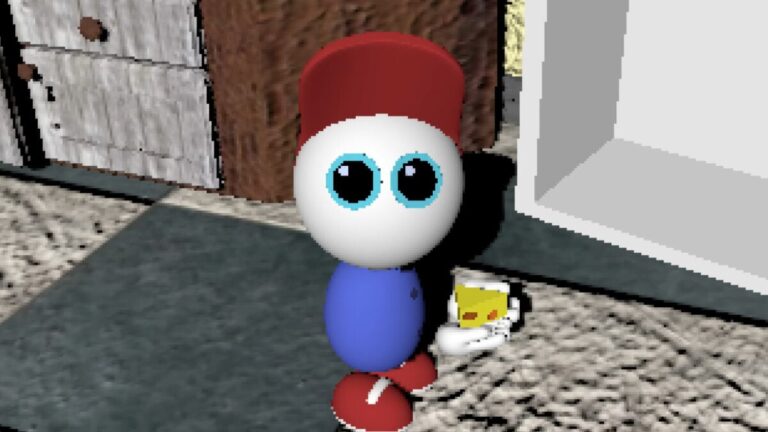
The game positions you as Mellow, a pale character with googly eyes and a baseball cap, rendered in a style evocative of early 3D computer graphics. Your situation is dire if mundane—you wake trapped in the house of Henry, a hulking, sallow creature whose communication style defaults to violence. He regularly clubs you over the head, which conveniently explains both your amnesia and apparent illiteracy. Standing between you and escape is a combination of lighthearted logic puzzles, surreal environments, and entities that belong in no children’s game.
The Design Philosophy: Familiar Territory With Uninvited Guests
Endacopia’s architectural DNA draws heavily from Putt-Putt Goes to the Moon, a foundational title in the edutainment adventure space. The design mirrors that template: click-based exploration, environments that animate in response to interaction, hidden solutions woven into visual tapestries. Yet where Putt-Putt offered consistency in its whimsy, Endacopia introduces ruptures. Behind most doors lies either a smiley face, a mini-game, or a sound effect designed to elicit a smile. But certain passages lead elsewhere—to visions that linger uncomfortably, to presences that shouldn’t exist within a logic puzzle framework.
Puzzle Design and Environmental Storytelling
The puzzles themselves maintain the accessibility that defined early edutainment. Solutions are discoverable through exploration and observation rather than obtuse adventure game logic. Clicking interactive elements reveals clues, and the game communicates its rules through visual feedback. This approachability serves a specific purpose: it makes the moments of genuine horror resonate harder. A player accustomed to cheerful problem-solving suddenly confronting something deeply wrong experiences cognitive dissonance that pure horror games cannot manufacture.
Combat and Physical Confrontation
Breaking up exploration and puzzle-solving are sequences that borrow their DNA from Punch-Out!!. These combat sections demand timing and pattern recognition rather than reflexes alone. Describing them as “surprisingly viscous” acknowledges an incongruity with the rest of the experience—they possess weight and consequence that feels somewhat disconnected from clicking around Henry’s house solving logic problems. This tonal clash is deliberate, further reinforcing Endacopia’s commitment to unsettling its audience through genre and design language mismatches.
The Broader Sub-Genre of Cursed Edutainment
Endacopia doesn’t exist in isolation. Over the past few years, a recognizable sub-genre has emerged among independent developers: games that weaponize nostalgia for school computer lab software. The common thread connecting these titles is that their creators apparently experienced genuine distress from the edutainment games of their childhoods, and they’ve processed that trauma through interactive fiction.
Baldie’s Basics operates under the pretense of uncovering lost, dangerous software—a game so cursed that mere exposure carries consequences. Amanda the Adventurer presents itself as a dig through dusty archives, recovering digital artifacts that society has rightfully forgotten. Forbidden Solitaire functions similarly, treating a card game as forbidden media requiring excavation. Each title in this emerging category trades in the aesthetic and design language of early computer education while introducing elements that corrupt its intended wholesome purpose.
What Sets Endacopia Apart
The distinction Endacopia claims is meaningful. Rather than pretending to be lost media, rather than framing itself as digital archaeology of cursed software, it occupies its own void entirely. The game doesn’t claim authenticity to a real edutainment title or position itself as excavated from some digital graveyard. Instead, it constructs an elevated space that acknowledges the rules and aesthetics of childhood computer games while being invaded by something alien to that framework. Mellow’s predicament in Henry’s house isn’t presented as uncovering hidden darkness within a corrupted program—it’s a scenario that simply shouldn’t exist within these design conventions.
This distinction matters for tone. Games like Baldie’s Basics and Amanda the Adventurer derive much of their horror from revelations about the games themselves—discovering something was never what it seemed, that genuine threat lurked beneath cheerful surfaces all along. Endacopia instead presents an ontological rupture: a character designed by edutainment visual conventions encountering genuine nightmare logic, neither fully adopting the language of the other.
Visual Language and Aesthetic Construction
The rendering of Mellow in “nascent computer orbs”—early 3D character construction that mimics late 1990s modeling capabilities—establishes visual authenticity to the source material while maintaining a deliberate artificiality. There’s no attempt to update or smooth these aesthetics. Similarly, Henry’s design as a “hulking sallow beast” plays against the cartoony proportions and friendly creature designs typical of edutainment franchises. The environment exists somewhere between Putt-Putt’s vibrant worlds and something far more oppressive.
Animation serves narrative purpose throughout. Clicking elements causes “loopy-land animations” to spring into existence—the exact vocabulary of edutainment design, where environmental interaction breeds visual spectacle and reward feedback. But when the game chooses to withhold this reward and instead present static horror, the absence becomes significant. Players trained by the game’s own design language to expect cheerful animation will feel the weight of restraint.
The Mechanics of Player Agency and Progression
Endacopia structures progression through a familiar portal: escape. You need to reach freedom from Henry’s domain. This goal provides motivation without requiring elaborate narrative justification. The path forward alternates between puzzle sequences that reward observation and logic with combat encounters that demand precision. Mini-games appear as interruptions or distractions, existing somewhere between punishment and respite depending on the player’s psychology at that moment.
The “light-hearted logic puzzles” and “dark realm creatures” exist in constant tension. A successful puzzle solution might lead to an encounter with something unnerving. The game trusts players to navigate this tonal duality without explanation. It doesn’t justify why nightmare entities coexist with cheerful problem-solving. It simply asserts that they do, and players must adapt.
Cultural Context and Industry Trends
Endacopia arrives at a moment when nostalgia-driven horror has become increasingly sophisticated. Developers recognize that the strongest horror often arrives through subversion of established comfort—taking things that feel safe and introducing elements that destabilize that safety. The edutainment game represents a particularly potent vector for this approach, as these titles occupy genuine childhood memory space for entire generations. They carry emotional weight beyond their actual content.
That Andyland and the independent development community continue mining this vein suggests something broader about how contemporary artists process formative media experiences. Rather than rejecting childhood software as embarrassing or dismissing it as harmless, they interrogate it as a cultural artifact worthy of horror-focused recontextualization. Endacopia stands as perhaps the most successful manifestation of this impulse, achieving genuine weirdness rather than mere pastiche.
Frequently Asked Questions
Who developed Endacopia?
Endacopia was created by Andyland, a developer working under the studio Picayune Dreams.
What games inspired Endacopia's design?
Endacopia draws its design philosophy heavily from Putt-Putt Goes to the Moon, incorporating click-based exploration and interactive environments, while also featuring combat sequences inspired by Punch-Out!!.
How does Endacopia differ from similar horror games like Baldie's Basics?
Unlike games such as Baldie's Basics and Amanda the Adventurer that present themselves as lost or cursed software, Endacopia occupies its own void—a space with the rules of childhood games but inhabited by uninvited nightmares, rather than claiming to be authentic recovered media.
