
Key takeaways
- According to Kotaku, a Dark Souls player finds the room before Ornstein and Smough more frustrating than the boss itself.
- Enemy aggro ranges force players to kill three knights before summoning Solaire, creating a tedious loop that wastes healing resources.
- The frustration reveals a gap between what's optimal in Dark Souls and what players prefer aesthetically, highlighting the game's flexibility.
According to Kotaku’s Rebekah Valentine, Dark Souls remains a masterclass in unforgiving game design, but not always where players expect it. While working through a replay of FromSoftware’s classic, Valentine found herself stuck not on the infamous Ornstein and Smough boss duo, but on the corridor leading directly to them. The location: a single room in Anor Londo that has become her personal nightmare, precisely because of how it blocks access to a companion she wants.
Replaying Dark Souls: The Unexpected Obstacle
FromSoftware excels at cruel humor, moments where the game’s punishing design feels almost comedic in its hostility toward the player. Valentine acknowledges this talent freely, yet this particular room crosses from amusing torment into genuine frustration. The irony lies in what actually causes the problem: not the difficulty of what occupies the space, but rather how its enemy placement interacts with a straightforward desire—summoning Solaire of Astora to fight alongside you through the next boss encounter.
For those unfamiliar with Dark Souls’ summon system, calling an NPC into your world requires activating their summon sign, a glowing sigil placed on the ground. Solaire’s sign sits deep within Anor Londo’s confusing architecture, specifically in the room right before Ornstein and Smough. This positioning creates an architectural trap. Every path between the entrance and Solaire’s sign runs through hostile territory, and the route from any nearby bonfire requires navigating long, restrictive corridors first.
The Room That Should Be Easy
Three Enemies, One Problem
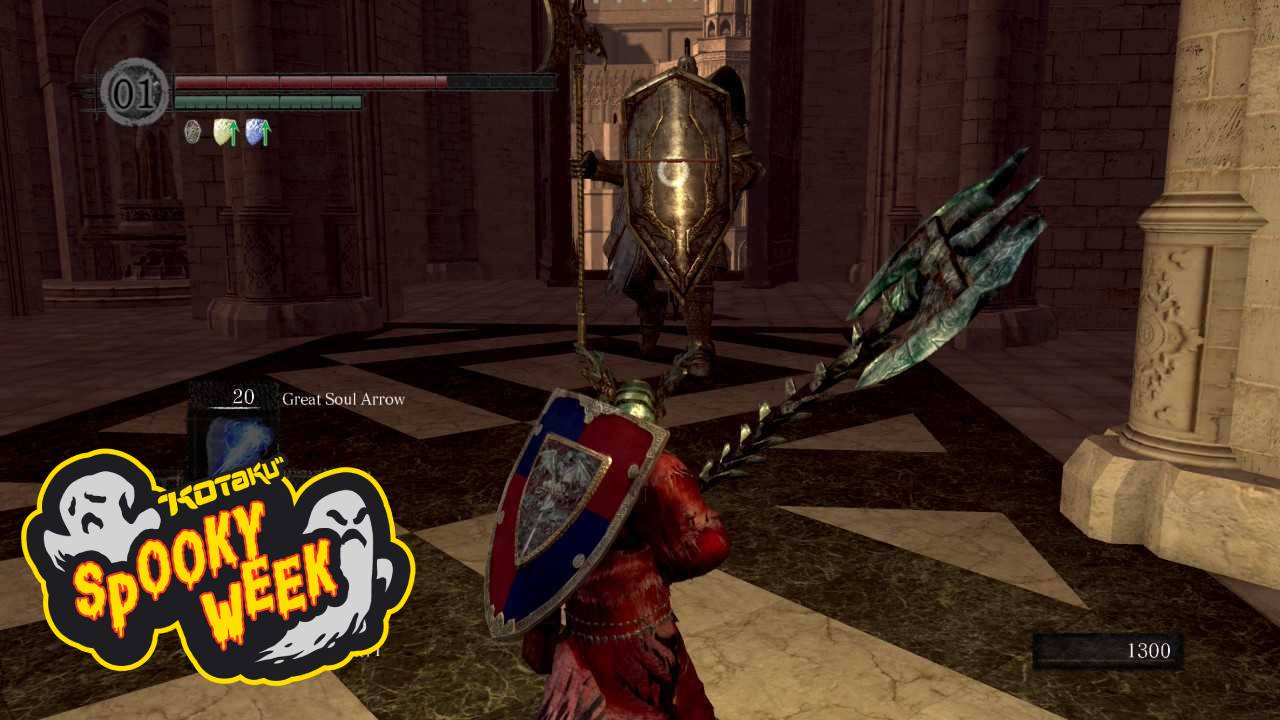
Three enemies guard the space between the player and Solaire. An archer occupies the upper level, relatively manageable to dispatch with a sprint and a couple of axe swings. The real problem waits downstairs: two heavily armored knights with oversized shields and devastating attacks. Their gear and moveset suggest they’re formidable opponents. Yet Valentine notes that mechanically, they should pose minimal challenge—they move slowly, telegraph their attacks clearly, and can be dodged with proper timing. In isolation, killing them takes perhaps thirty seconds of competent play.
The archer requires two or three swings to defeat; his arrows can be avoided by rushing directly at him. The knights take several good hits to the back since their shields block frontal damage, but they are slow enough that dodging should be straightforward. Their attacks consist of obvious poke attempts with their spears, occasional shield slams that create radius damage, and even self-healing spells when they retreat. All of this should be routine for anyone who has progressed this far through Dark Souls.
Solaire’s Impossible Summon
The complication emerges from aggro range. Once at ground level in the chamber, these enemies will detect you from nearly anywhere in the room. Their awareness extends far enough that any path leading toward Solaire’s summon sign will trigger combat. Worse still, their aggression extends to summoned phantoms. If you attempt to summon Solaire before eliminating all three enemies, the knights will attack him instead of following you to the boss fog gate. Sometimes Solaire fights them for several seconds, takes heavy damage, then follows. Sometimes he simply remains in the room, doomed to die before you reach Ornstein and Smough.
The timing mechanics worsen the situation. Summoning Solaire takes several seconds to complete, leaving you vulnerable and preventing a simple sprint past the enemies while they’re distracted. There is no mechanical shortcut. The only solution is killing all three before touching his sign.
How Aggro Ranges Create Tedium
For a casual run-through without NPC backup, the room presents no real obstacle. You push through, ignore the enemies if willing to take chip damage, and proceed straight to the fog gate. Summoning a human player or phantom works similarly—they’ll phase through and join you regardless of enemy interference. But Solaire’s AI operates differently. His code prioritizes combat over following, creating a situation where wanting his company requires first defeating his would-be opponents.
This contradiction explains Valentine’s frustration better than simple difficulty would. The enemies aren’t hard. Killing them three or four times in succession across multiple boss attempts becomes tedious, especially when each attempt potentially wastes healing items and consumes Humanity—the resource required to summon NPCs in the first place. Humanity functions as Dark Souls’ summoning currency. You burn one at a bonfire to return to human form, enabling summons. Every failed attempt where you die before reaching the boss door means that Humanity vanishes to waste.
The resource loop compounds the problem. After dying to Ornstein and Smough, you must return to the bonfire to farm more Humanity, a journey requiring navigation back through Sen’s Fortress, across the map, and return. Each cycle that follows demands clearing the same three enemies again. Valentine describes the cumulative exhaustion of this loop as the real frustration—not the individual encounters, but their repetition in service of a single aesthetic choice.
The Mechanics of Frustration
Frustration intensifies precisely because these enemies present no intellectual challenge. Valentine describes them as obvious, dodgeable, and slow. Yet repetition combined with the knowledge that failure costs resources breeds the kind of tilting that degrades performance. You start second-guessing dodges that should work easily. Attacks that are obviously telegraphed somehow catch you. Health and Estus charges that should carry you through the room vanish to errors you wouldn’t normally make. What begins as routine becomes impossible through sheer psychological pressure.
What makes this worse is that it’s entirely optional. You could run straight through, accept minor damage, and face Ornstein and Smough alone. Most players do exactly that. You could summon a human phantom, who will definitely make it to the fog gate. The entire frustration stems from an aesthetic choice: wanting to fight alongside Solaire because he’s a cool character and the thematic resonance appeals more than mechanical optimization.
Choosing Aesthetics Over Efficiency
Valentine refuses to change tactics, and her reasoning reveals something important about how players approach Dark Souls. The game offers multiple solutions to its challenges, but some players’ satisfaction derives not from solving problems efficiently but from achieving specific visions of how fights should unfold. Facing Ornstein and Smough with Solaire’s assistance isn’t the optimal path. It’s the preferred one, even if that preference requires clearing the same three enemies dozens of times across a playthrough.
Compare this to the much-maligned archers on the fortress ramparts outside, another Anor Londo obstacle notorious for frustrating players. Those enemies have become infamous enough that most players know to expect them. Their placement is so obviously hostile that the game itself seems to be making a joke. Valentine describes the rampart archers as “cake” compared to this single room, despite their reputation for difficulty. The difference lies partly in expectation management and partly in mechanics: you can run past the archers easily. You cannot comfortably summon Solaire while other enemies remain hostile to him.
A Lesson in Design Philosophy
This room encapsulates what makes Dark Souls a generative experience even in its irritating moments. It’s not cruel in obvious ways—no bottomless pits, no invisible walls, no instant-kill traps. It’s cruel in the way it creates situations where the game permits your preferred approach but makes the cost annoyingly high. FromSoftware didn’t need to place Solaire’s summon sign in a hostile room. Solaire’s character arc would work fine if he were positioned just outside the fog gate. That the developers chose this placement suggests either indifference to this scenario or a deliberate joke at player expense. Either way, it transforms a mechanically trivial encounter into psychological warfare, where the real opponent isn’t the knights—it’s the knowledge that better solutions exist, and your refusal to take them.
Source: Kotaku
Frequently Asked Questions
Which boss is the frustrating room leading to?
Ornstein and Smough, the duo boss fight located in Anor Londo.
Why can't players just run past the enemies to reach Solaire's summon sign?
The three enemies have aggro ranges so large that they'll attack Solaire if summoned before they're defeated, forcing him into combat instead of joining the player for the boss fight.
Why doesn't the player just skip summoning Solaire?
According to Kotaku, the player prefers fighting alongside Solaire as a character companion, finding it more satisfying than fighting the boss alone, even though it requires repeatedly clearing tedious enemy encounters.
