
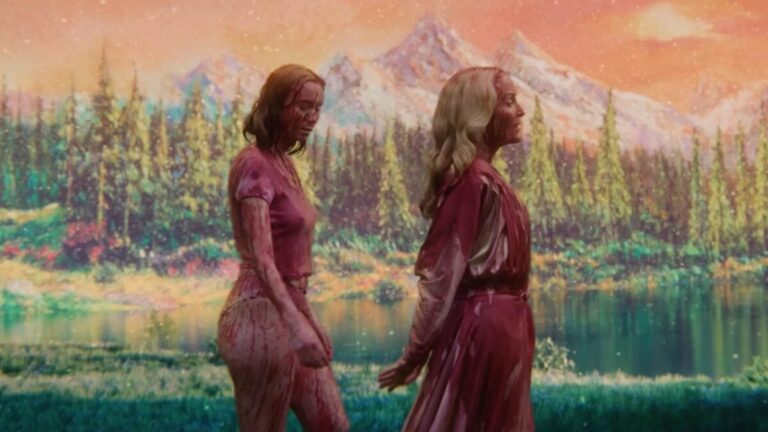
Key takeaways
- Schoenbrun's directorial vision excels at visual composition and mood but is undermined by a screenplay that constantly explains its own metaphors rather than trusting the audience.
- The film explores how artists reckon with media that shaped them, embodying the contradiction between preserving and correcting the works that influenced them.
- Camp Miasma functions simultaneously as satire and sincere participant in contemporary film discourse, creating internal tension between its stated intentions and actual execution.
Jane Schoenbrun’s latest feature film, Teenage Sex and Death at Camp Miasma, arrives as a provocative attempt to simultaneously mock and participate in the discourse surrounding serious reassessment of genre cinema. The director, known for previous works including I Saw The TV Glow and We’re All Going to the Worldís Fair, crafts a film that wrestles with desire, grief, and the complicated legacy of 1980s slasher iconography.
The narrative centers on Kris Williams, portrayed by Hannah Einbinder of the HBO series Hacks, a queer filmmaker tasked with modernizing the Camp Miasma franchise. The fictional original was a prominent 1980s slasher, but its problematic approach to transgender representation has left ideological wounds. Williams seeks redemption through reinvention, wanting to honor what attracted them to the material while excising its dated cruelties. To achieve this vision, Williams tracks down Billy Presley, the original filmís lead performer, now living as a virtual hermit on the actual set where the classic film was shot. Gillian Anderson plays Presley in a role that explores the psychological weight of being both creator and victim of culturally charged entertainment.
As Williams and Presley develop a relationship spanning intellectual discourse and physical intimacy, the boundary between their professional collaboration and personal connection dissolves. The introduction of a murderer ó named Little Death ó rising from the lake grounds the meta-textual conversation in genuine body horror and slasher violence. The filmís central fixation emerges from a single image within the fictional Camp Miasma: a reflection of Little Death visible in Presleyís eye during a scene of sexual climax. Williams becomes obsessed with untangling this image, seeking to understand the nexus between violence and desire that made the original film magnetic to them in youth.
Schoenbrun’s Visual Mastery vs. Textual Self-Consciousness
Directorial Precision
Schoenbrun demonstrates extraordinary skill at constructing specific visual moments and composing images that convey psychological states without explicit explanation. The film operates most compellingly when it surrenders to visual storytelling ó a particularly effective sequence involves a killing spree choreographed to Counting Crows, where the imagery transcends the script’s theoretical debates. Schoenbrun’s compositional vocabulary and ability to render mood through cinematic language elevates the material whenever it escapes the confines of dialogue and narration.
Textual Self-Awareness as Limitation
The screenplay, however, frequently undermines the directorís strengths. Williams functions as a thinly veiled self-insert for Schoenbrun, and the character is written as aggressively self-aware ó constantly articulating interpretations of their own creative project with the exhausting verbosity of an extended Letterboxd essay. Before the audience can draw parallels to Sunset Boulevard, Wes Cravenís New Nightmare, or Sleepaway Camp, the film announces these connections explicitly. The result is a work that explains its own metaphors rather than trusting the viewer to discover them.
Defensive Posturing
The film operates from a fundamentally defensive stance, as though uncertain whether its audience will understand its intentions without constant clarification. This contradicts the filmís stated desire to cultivate a warped, personal relationship between viewer and what were once labeled “video nasties” ó transgressive entertainment that demanded active, independent interpretation from its audience.
The Intersection of Art and Desire
Williams’ mission to reboot Camp Miasma becomes a vessel for exploring broader questions about how artists reckon with media that shaped them. The character wants simultaneously to preserve what made the original compelling and to correct its sins ó an inherently contradictory goal. The film itself mirrors this contradiction: it wants to critique pseudo-intellectual horror discourse while simultaneously participating in exactly that kind of reassessment.

Casting and Character Dynamics
Hannah Einbinder brings anxious energy to Williams, embodying a filmmaker caught between academic ambitions and instinctive response. Gillian Anderson’s casting as the mysterious Presley, once an icon of unattainable cool, reinforces the filmís preoccupation with fame, aging, and the gap between public persona and private self. Anderson’s willingness to engage with the material’s intimate and violent dimensions provides grounding for moments that might otherwise dissolve into abstraction.
Context and Precedent
Schoenbrunís previous films suggested gifts for accessing and deconstructing the media obsessions of a particular generation. I Saw The TV Glow and We’re All Going to the Worldís Fair both excavated personal investment in television and internet culture, finding emotional truth beneath surface nostalgia. Teenage Sex and Death at Camp Miasma extends this project into feature filmmaking with a larger budget, attempting to do for slasher cinema what those earlier works accomplished for television and online spaces. The director has reportedly engaged with material from other screenwriters as well, with a table reading of Secretary suggesting interest in adapting work beyond their own scripts.
The Film’s Central Contradiction
Teenage Sex and Death at Camp Miasma wants to simultaneously decry and exemplify the kind of pseudo-academic reassessment of genre filmmaking that dominates contemporary film discourse. It functions as both satire and sincere participant in that very conversation. The film is most alive visually, least compelling verbally. Where it embraces the decadence it claims to interrogate ó the Counting Crows murder sequence stands as the clearest example ó it transcends its structural limitations. Where it retreats into explanation and defense, it diminishes its own power. The central tension between Schoenbrunís considerable visual gifts and the screenplay’s anxious self-consciousness renders this a film in dialogue primarily with itself, uncertain whether it trusts an audience to meet it halfway.
Frequently Asked Questions
What is the plot of Teenage Sex and Death at Camp Miasma?
The film follows Kris Williams, a queer filmmaker tasked with rebooting a problematic 1980s slasher called Camp Miasma, who seeks out the original film's star Billy Presley. As their professional and personal relationship develops, a murderer called Little Death emerges, and Williams becomes obsessed with untangling the connection between violence and desire central to the original film.
Who directs and stars in the film?
Jane Schoenbrun directs and wrote the film. Hannah Einbinder plays Kris Williams, and Gillian Anderson plays Billy Presley.
What are the main criticisms of the film?
The screenplay is criticized for being overly self-conscious and defensive, constantly explaining its metaphors and announcing references to films like Sunset Boulevard and Wes Craven's New Nightmare rather than trusting viewers to discover them. The film succeeds most in visual moments, particularly a killing spree set to Counting Crows.
