
Key takeaways
- Wordeex requires both vocabulary and strategic deduction: finding not just any word, but the specific word sequence that clears all 16 letters and ends the game.
- The game offers multiple modes including daily puzzles, progressive chapters, competitive seasonal leagues, and community-created puzzle sharing, with most content playable offline.
- Available on iOS and Android for free in 27 languages, Wordeex includes a language-switching feature that turns puzzle-solving into a language learning tool.
- Unlike traditional word games, Wordeex changes its board state with every move, transforming a vocabulary challenge into a logic puzzle where future moves depend on current choices.
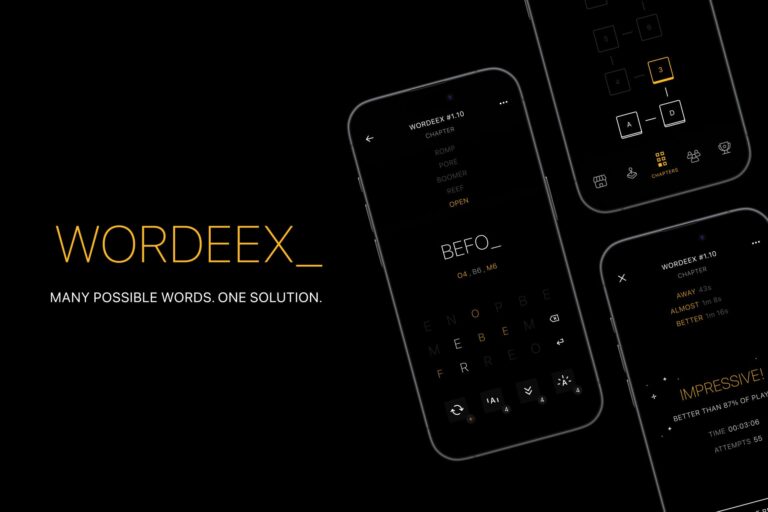
Wordeex, a new free-to-play puzzle game available on iOS and Android, operates from a premise that most word games actively avoid. Rather than providing a fixed board where you can play words in any order, Wordeex removes letters as you use them. The board transforms with each move. The goal is not simply to find words, but to find the exact sequence of words that clears every letter from the board without leaving any unused.
The mechanic creates a compounding series of constraints that shift traditional word game strategy into logic puzzle territory. According to Kotaku, the distinction is subtle to describe but consequential in play. A word that looks optimal in isolation can dead-end the puzzle. Another word that seems suboptimal might be the only one that preserves a path to victory.
How the Board Shifts
Each Wordeex puzzle begins with 16 letters arranged on the board, concealing between 3 and 5 words. When you identify and play a word, those letters vanish immediately. The remaining letters form the new puzzle you have to solve. Kotaku cited an example: a board containing the letters for MOUSE, TRAIN, and PLANET, three unrelated words that collectively use all 16 letters. Only one combination of these words clears the board completely.
The core demand differs fundamentally from word-finding games. You are not choosing freely among valid words. You are reading ahead, deducing which move preserves solvability, and committing to a sequence. Wordeex tests whether you can hold multiple constraints in mind simultaneously: discovering what words you can make right now alongside which of those words leaves you with letters that still form words.
Vocabulary and Logic Working Together
Players accustomed to treating Wordeex as a standard vocabulary game tend to hit dead ends. They find letters that no longer combine into valid words and cannot proceed. Players who treat it as a logic puzzle, paired with solid vocabulary, navigate to the single valid solution. The game is thus a hybrid: vocabulary opens the set of possibilities, and deduction narrows that set to the single correct path.
A Question That Reframes Everything
Most word puzzles ask what word you can make. Wordeex asks what word should you make given where the board needs to end up. That reformulation changes everything about how you approach the board state. A move that seems marginal can become essential because it leaves you with letters that have more word combinations remaining. The board tells you when you have understood the logic by going empty.
Four Ways to Engage
Wordeex structures its content across four distinct modes, each serving a different engagement pattern. Daily Wordeex delivers a single puzzle to all players each day, creating a natural comparison layer. Every player confronts identical constraints and must find the identical solution. This shared framework builds community rhythm, particularly for players who already maintain a daily puzzle habit.
Chapters progress through a designed sequence of puzzles, increasing in difficulty in a graduated way. Early puzzles in the progression are forgiving enough to teach the board-clearing logic. Later chapters raise the stakes. Kotaku noted that the difficulty curve earns its ascent rather than imposing challenge arbitrarily. The mode teaches the specific planning instinct the core mechanic demands.
Academy Mode introduces competitive structure through seasonal leagues and ranking. Players compete against others in ranked seasons, with performance determining placement. This mode requires an internet connection, distinguishing it from the offline-friendly options. Community Mode inverts the puzzle relationship. Rather than solve puzzles, players construct and share their own Wordeex boards. Building a valid puzzle is itself a logic exercise, since the board must have exactly one solution.

Offline Play and Global Reach
Playing Anywhere
Daily Wordeex, Community Mode, and Chapters load entirely within the app. Players can engage with these modes on planes, subway tunnels, or anywhere else a signal is unreliable. Only Academy Mode requires a persistent internet connection for seasonal scoring and rank tracking. This offline-first approach removes a friction point that prevents some players from adopting daily puzzle habits.
27 Languages, Plus Language Learning
The game ships in 27 languages, reflecting a release strategy built for a global audience. Kotaku highlighted a practical feature: players can switch languages within the game itself. A player can solve the daily puzzle in their native language one day and switch to a language they are learning the next. The mechanic transforms the puzzle into a language acquisition tool, and the offline availability means international players can play wherever they are.
Puzzle Games and Community-Driven Content
Short-session puzzle games have grown in popularity substantially over the past several years. Audiences have demonstrated tolerance for variations on established formats, provided those variations introduce genuine mechanical differences rather than reskinned constraints. Wordeex occupies this market by asking a fundamentally different question. Rather than find a word, it asks find the word that makes the next word findable.
The game’s free-to-play model and lack of forced monetization barriers position it to compete with other daily puzzle alternatives that have built engaged communities. By offering multiple modes of engagement, it appeals to players seeking different experiences: daily ritual, progressive challenge, competitive structure, or creative expression.
The Community Mode creates a sustainable content model. Rather than relying entirely on developers to design and ship new puzzles, the game can grow through player-created content. This approach has sustained other puzzle games by converting an audience from consumers into co-creators. Over time, a library built by the community can extend the game in directions development roadmaps alone could not reach.
Available Now, Free
Wordeex is available on iOS and Android at no cost. The game requires nothing beyond the vocabulary to recognize words and the deduction to understand how the board’s state constrains future possibilities.
Source: Kotaku
Frequently Asked Questions
What is the main goal in Wordeex?
Clear the board completely by finding the exact sequence of words that uses every one of the 16 letters. According to Kotaku, there is only one combination of words that accomplishes this for each puzzle.
How is Wordeex different from other word puzzle games?
Most word games let you play words freely on a fixed board. Wordeex removes letters as you play them, transforming the puzzle with each move. You must think strategically about which word to play next, since your choice determines what letters remain and what future words are possible.
Can I play Wordeex without an internet connection?
Yes. Daily Wordeex, Chapters, and Community Mode work entirely offline. Only Academy Mode, which tracks seasonal rankings and competitive placement, requires an internet connection.
