
Key takeaways
- Content creator Aspen Tree successfully recreated the controversial backflip from GTA 6's August trailer, proving it's physically possible despite looking awkward.
- The animation stands out because it prioritizes design choices over realistic movement, with intentional rotation slowdown that catches viewer attention.
- Rockstar has approximately 70 days until the November 19 release to refine the animation, though the studio rarely revises animations based on fan feedback.
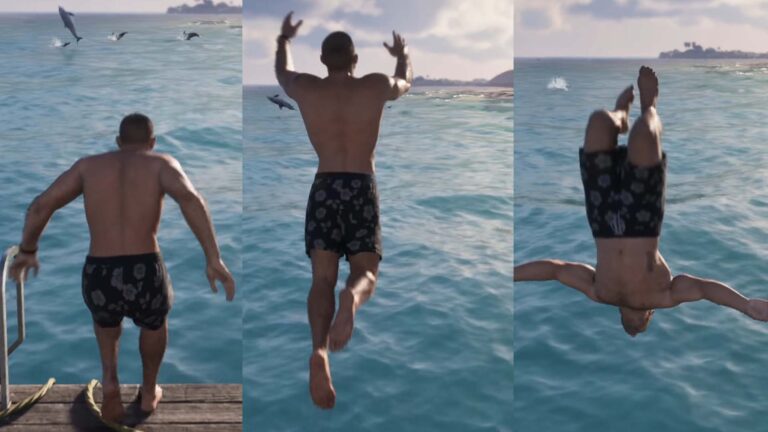
The August 27 release of nearly 30 minutes of Grand Theft Auto 6 extended gameplay gave fans their first substantial look at Rockstar’s next blockbuster. The trailer packed dozens of scenes showcasing mechanics, characters, and environments across Vice City. Among all the footage, one particular moment involving protagonist Jason emerged as unexpectedly divisive: a running backflip off a pier into ocean water that looked, to many viewers, biomechanically questionable.
A Moment That Caught Everyone’s Eye
When Rockstar dropped the extended look trailer in late August, fans immediately began frame-by-frame analysis. The footage revealed mission design, NPC interactions, traversal systems, and combat sequences spread across nearly half an hour. Jason’s backflip became the focal point not because it was impressive, but because it looked off. Multiple viewers questioned whether the animation was even physically possible, spawning threads and clips across social media.
The running backflip itself isn’t inherently problematic as a game mechanic. Games have featured acrobatic animations for decades. What distinguished this particular backflip was its execution—the rotation speed, the arc, the timing of the jump. It appeared to slow mid-flip in a way that seemed unnatural or clumsy compared to other animations in the trailer.
Why It Became a Talking Point
The backflip gained traction precisely because it stood out negatively. In a trailer that demonstrated polished character animations, environmental detail, and cinematic direction, this one moment felt disconnected. When asked about GTA 6, several people watching the trailer independently flagged the backflip as the one sequence that didn’t land.
The comparison game proved irresistible. Fans contrasted Jason’s awkward pier-side flip with other movement animations in the gameplay footage. The stiffness and the odd rotational speed became shorthand for criticizing the entire animation system, even though the rest of the footage suggested otherwise. It was one moment amplified into a broader conversation about animation quality.
An Athlete Tests the Theory
The Recreation Process
Content creator and athlete Aspen Tree decided to investigate whether the backflip was physically possible. Rather than dismissing it as poor animation, Tree treated it as a challenge: could a trained athlete actually execute this move?
The recreation involved several complications. Tree had to match the exact conditions: running start, dual-foot takeoff, rotation speed that included a noticeable deceleration mid-flip, and landing. These parameters created a specific movement problem that couldn’t be solved the way a standard backflip normally is.
What It Proved
Tree’s attempt took multiple tries. Despite evident athleticism and extensive experience with flipping, the particular combination of variables in the GTA 6 animation proved difficult to replicate. This difficulty undermined the idea that the backflip was impossible—if anything, it proved the opposite. The move is doable, just not trivial. If a professional athlete struggles with it, the average person almost certainly cannot perform it.
Understanding the Animation
Design Choices vs. Errors
The backflip’s awkwardness likely stems from animation design choices rather than technical error. Video game animations exist in a different physical space than human biomechanics. Animators make deliberate choices about timing, arc, and rotation to serve gameplay and visual presentation rather than strict realism.
Jason’s backflip might prioritize visual clarity over naturalness. Slowing the rotation ensures players see the flip happening and can follow the action. Alternatively, the animation might be designed to serve a specific gameplay purpose—perhaps it’s meant to clear a specific distance or fit within a particular action sequence timing.
The fact that an athlete could reproduce it after effort suggests Rockstar’s animators weren’t careless. The backflip represents a calculated design decision that happens to look unusual because it prioritizes something other than human movement authenticity.
The Path to November 19
Grand Theft Auto 6 launches on November 19, roughly 70 days from the August extended look release. Rockstar has time to make adjustments if the team wants to refine the backflip animation. Whether they will remains an open question.
The studio rarely changes animations post-trailer unless they represent genuine errors. A backflip that’s technically possible and serves its purpose in gameplay would likely stay as-is, quirks included. The meme status of the animation won’t necessarily prompt changes—Rockstar has historically ignored fan nitpicks about cosmetic details.
Players will encounter this animation repeatedly if Jason performs backflips during missions or exploration. The moment will retain its current form or receive refinement in the remaining development window. Either way, fans will scrutinize it frame-by-frame when they get hands-on access.
What This Reveals About Game Development
The backflip discourse illustrates how players engage with modern game trailers. With nearly 30 minutes of footage available, fans perform detailed analysis that would have been impossible in earlier eras. Every animation gets examined, compared, and critiqued. An awkward moment that’s actually physically possible becomes viral because it differs from player expectations of animation smoothness.
Aspen Tree’s recreation adds a meta layer to this conversation. Rather than accepting the game as a pure fiction disconnected from real physics, recreating the backflip grounds the animation in actual human capability. It’s a reminder that even the odd-looking moments in games sometimes reflect genuine physical constraints and deliberate artistic choices.
The August 27 trailer gave fans hundreds of moments to analyze. Dozens of details sparked discussion about mission design, map features, and character interactions. Jason’s backflip became the unexpected focus not because it’s a highlight, but because it breaks the pattern of polish and precision visible throughout the rest of the footage.
Frequently Asked Questions
Why did the GTA 6 backflip animation become controversial?
The running backflip Jason performs off a pier in the August trailer looked unusual compared to other animations, with viewers questioning its physical plausibility and citing odd rotation speed and stiffness.
Did Aspen Tree successfully recreate the backflip?
Yes, content creator Aspen Tree recreated the backflip after multiple attempts, proving it's physically possible but difficult even for trained athletes with extensive flipping experience.
Will Rockstar change the backflip before the game releases?
Grand Theft Auto 6 launches November 19, giving Rockstar about 70 days to make adjustments, but the studio rarely revises animations based on fan feedback about cosmetic details.
