
Key takeaways
- Halloween: The Game differentiates itself through map-wide NPC populations that create additional hunting targets for Michael and moral rescue decisions for survivors, adding strategic depth beyond standard asymmetrical formulas.
- Technical issues including stuck NPCs, broken attacks near walls, janky executions, and unresolved performance problems undermine the experience, though developer patches are promised for launch.
- The single-player campaign recreates scenes from the original film with attention to detail but lacks gameplay substance; multiplayer sessions with human survivors provide the genuine appeal.
- Michael Myers feels genuinely threatening yet defeatable through survivor coordination, tactical tool usage, and escape planning, creating memorable moments despite the jank.
Halloween: The Game places one player as the iconic slasher villain Michael Myers against up to four human survivors on maps populated with civilians attempting escape. The game launches via early access on PlayStation 5, Xbox, and PC on September 4, with full public release on September 8. After playing roughly a dozen hours across both killer and survivor roles, the experience stands distinctly apart from similar asymmetrical multiplayer horror titles like Predator: Hunting Grounds, Friday the 13th, Killer Klowns From Outer Space, and Dead by Daylight—though technical problems occasionally undermine the underlying design quality.
Core Asymmetrical Structure
The fundamental gameplay loop is familiar to the genre: one immortal killer hunts four ordinary people trying to survive and escape. Michael Myers cannot be permanently eliminated. Survivors can damage him and even momentarily incapacitate him, but they must ultimately flee rather than defeat him. What distinguishes Halloween from established competitors is not the basic premise but rather architectural decisions about how that premise unfolds across each match. Populated maps, interconnected escape objectives, and the NPC populations create mechanical depth beyond the standard formula. Developer announcements promise day-one patches addressing several bugs discovered during the testing period, though notable problems—including performance stuttering and occasional crashes—remain unaddressed in that initial support plan.
Michael Myers’ Arsenal and Psychological Advantage
Ghost Movement and Invisible Stalking
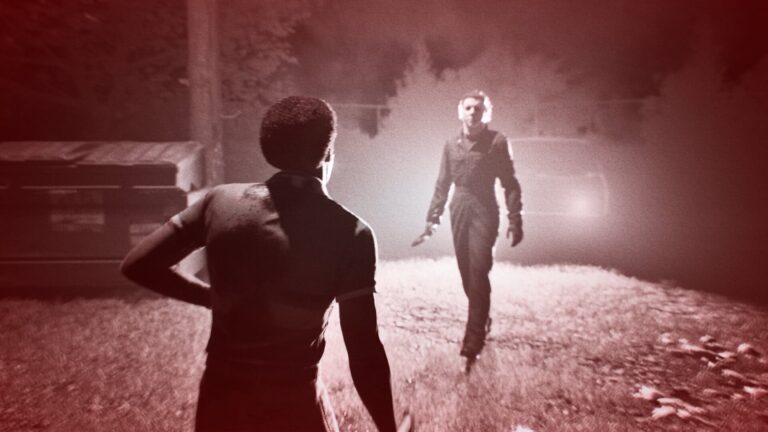
Michael’s power set emphasizes mobility and psychological torment. His signature ability grants invisibility, allowing him to drift silently across the map and pass through doors that lack lighting without materializing in survivors’ direct line of sight or well-lit areas. The mechanic enabled one memorable sequence: drifting invisibly into a bedroom where survivors attempted to convince an NPC character to follow them toward safety, then materializing from the closet to eliminate both the player and the civilian. This supernatural movement transforms Michael from straightforward threat into ambient danger. Survivors never know precisely where he lurks.
The Stalking Reward System
The game actively encourages psychological gameplay over immediate murder. Michael receives bonus experience points for stalking victims before striking, creating mechanical incentive to toy with opponents rather than simply eliminate them. Walking around a corner to startle teammates, breaking adjacent windows then vanishing into darkness, disabling power systems to create disorientation—these tactics prove both mechanically rewarded and psychologically satisfying. The power fantasy feels authentic to the film’s presentation of an unstoppable, intelligent killer. However, this dominance comes with definable constraints. Michael cannot simply overpower the entire group within minutes; survivors possess sufficient defensive tools to force him to adapt strategy and pick targets carefully.
Survivor Decision-Making and Escape Mechanics
Multiple Exit Paths with Escalating Time Pressure
Survivors must collectively gather resources to activate one of several escape routes. Options include fleeing via vehicle, using basement passages, or waiting until sufficient time passes for police to arrive and extract them via wagon. Each approach presents distinct risk-reward calculations. Attempting to reach a vehicle requires traversing open ground where Michael hunts. Basement escape routes offer concealment but demand extended time to navigate. Police wagons only appear after the killer has had ample opportunity to accumulate kills and solidify control of the map. This structural variety prevents matches from settling into predictable patterns.
The Rescue Dilemma
Choosing to help townspeople escape provides bonus experience points and denies Michael additional victims, yet every moment spent assisting civilians extends exposure. Survivors face genuine moral-mechanical tension: prioritizing personal escape proves strategically optimal, but helping others yields greater rewards and prevents the killer from expanding his body count. This dynamic prevents matches from devolving into selfish individual sprints toward exits. Teammates must communicate about which NPCs to attempt rescue on and whether the time investment justifies the risk.
Defensive Equipment and Temporary Countermeasures
Survivors possess flashlights to disorient Michael, firearms to inflict temporary damage, motorcycles for rapid transportation, and various magical items that feel mechanically functional despite thematic disconnection from slasher genre conventions. These tools create breathing room; survivors cannot simply hide until police arrive. The sudden appearance of Michael—slamming a survivor’s head into a television, materializing from unexpected angles, severing escape plans through devastating surprise attacks—constantly forces abandoned strategies and improvised response.
NPC Populations as Differentiating Factor
The core distinguishing feature separating Halloween from competitors is the abundance of non-player civilians throughout each map. Townspeople occupy the spaces realistically: cleaning houses, watching television, smoking on porches, performing everyday routines. This population transforms atmospheric presentation and strategic depth simultaneously. As Michael, hunting expands beyond four human targets to encompass dozens of potential victims, multiplying tactical possibilities. Survivors navigate not only escape mechanics but moral calculations about civilian protection.
Maps feel genuinely inhabited rather than sparse arenas designed purely for pvp combat. The sense of place—a town with actual residents, civilian infrastructure, routine interrupted by slasher violence—anchors the horror in lived environment rather than abstract arena. Michael’s accumulated body count spreads awareness through the map as survivors realize the killer has murdered multiple townspeople. Psychological burden intensifies. The game tracks each death, audibly notifying survivors when Michael has claimed new victims, particularly terrifying when they realize he operates nearby.
Technical Problems That Disrupt Experience
Persistent Bugs Affecting Core Gameplay
Halloween encounters significant technical obstacles that frustrate otherwise compelling moments. Non-player characters occasionally become stuck on rooftops inaccessible through normal map pathways. Michael’s attack functions occasionally fail when he equips weapons or objects positioned too close to walls or during animation sequences. Execution animations—the violent, graphic kills mimicking the original films’ aesthetic—sometimes display visually janky or awkward. These bugs do not merely create comical moments; they actively break core gameplay loops by preventing eliminations or trapping NPCs in unintended states.
Performance and Resurrection Issues
Performance stuttering and occasional crashes plagued testing sessions, with developer communications offering no confirmed schedule for fixes. Beyond technical stability, the resurrection system proved inconsistent. Dead players returned as police officers capable of continuing participation only once during testing despite multiple death scenarios. Whether this reflects incomplete implementation or player misunderstanding remains unclear, but inconsistency disrupts the social momentum multiplayer horror requires.
Single-Player Campaign: Source Material Detail Without Substance
A story mode allows players to control Michael Myers through missions recreating scenes from the original film. The developers demonstrated considerable attention to source material authenticity and detail, commendable for preserving the franchise’s visual and narrative identity. However, limited mission count, minimal gameplay variation, and underwhelming challenge make the campaign function more as extended interactive tutorial than substantive solo experience. Players attracted primarily to single-player content or those without friend groups interested in multiplayer horror should seek alternatives. The online multiplayer—specifically playing with human survivors—constitutes Halloween’s actual draw.
Final Assessment
Despite persistent jank, unresolved crashes, and incomplete resurrection mechanics, Halloween delivers its core promise: asymmetrical multiplayer horror that genuinely frightens through environmental presence and NPC interaction rather than relying solely on player-versus-player tension. The iconic film score, atmosphere, and moment-to-moment gameplay create compelling sessions when systems function correctly. Michael feels genuinely threatening yet defeatable through survivor coordination, tactical tool usage, and escape planning. The question becomes whether post-launch updates arrive quickly enough to smooth technical rough edges before community fragmentation occurs. As of September 4’s early access launch, Halloween: The Game requires patience with bugs but rewards players willing to tolerate imperfection with the strongest asymmetrical horror multiplayer experience released in recent years.
Frequently Asked Questions
What platforms will Halloween: The Game release on and when?
Halloween: The Game launches on PlayStation 5, Xbox, and PC on September 4 via early access, with the full public release coming September 8.
How does NPC inclusion change Halloween: The Game compared to other asymmetrical horror games?
Maps are populated with dozens of non-player civilians performing everyday activities, creating additional targets for Michael to hunt and moral rescue decisions for survivors that grant bonus experience points. This fundamental design choice distinguishes it from games like Dead by Daylight that focus purely on survivor-versus-killer confrontation.
What technical problems is the game experiencing at launch?
Halloween encounters bugs including non-player characters stuck on inaccessible rooftops, broken attack functionality when Michael is positioned near walls, janky execution animations, and performance issues. The developer has announced day-one patches for some problems but has not confirmed fixes for performance stuttering and crashes.
