
Key takeaways
- House House created Big Walk's prototype in one week during the pandemic, starting with just a jumping model and proximity voice chat in a blank space.
- The game's design philosophy shifted toward communication and bodily expression—hand movements, waves, and gestures—over traditional mechanical puzzle-solving.
- Early challenge attempts like the door-based puzzle failed, but taught developers that scale of interaction and focused social presence made the experience resonate.
- Conducting the interview inside Big Walk itself demonstrated how proximity, communication, and shared environment are central to the game's entire design philosophy.
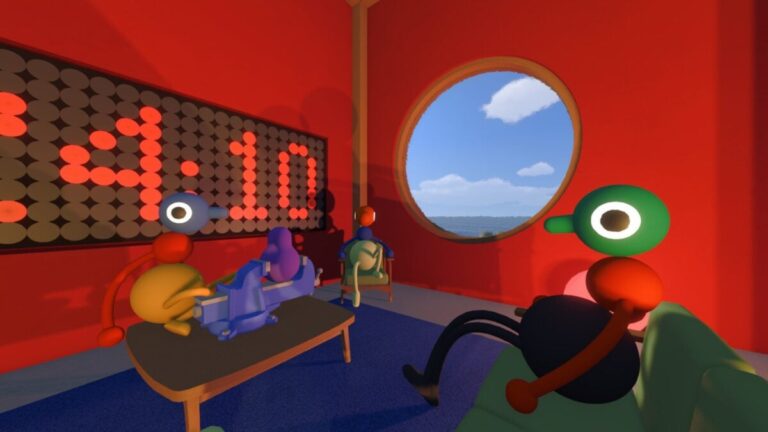
Big Walk stands as one of 2024’s most talked-about game releases, and getting developers to break down their creation has proven as unconventional as the game itself. Rather than settling for standard video calls, the studio behind the title—House House—extended an invitation to conduct the entire interview inside Big Walk, with three of the game’s five full-time developers. The result was a nearly 90-minute stroll through the game’s environment, with Stuart Gillespie-Cook, Jake Strasser, and Nico Disseldorp discussing how the title evolved from a pandemic-era experiment into a polished multiplayer experience designed around human connection.
The Five-Person Team Structure
House House consists of five full-time members. Gillespie-Cook handles game design, animation supervision, and quality assurance work. Strasser, alongside Kalonica Quigley (the studio’s first new hire when it expanded from four to five people), shapes the world and its visual identity through technical art. Disseldorp works as a programmer and designer, while Michael McMaster, absent from the interview, oversaw the game’s aesthetic direction. Quigley herself was brought on between House House’s previous release—Untitled Goose Game—and Big Walk’s development.
All three present developers shared the same official title: developer. Yet their contributions to Big Walk reveal a deeply collaborative approach to game-making, with each person’s work bleeding into the others’ responsibilities.
Pandemic Beginnings: A Single Week to Prototype
Big Walk emerged during lockdown, arriving in a form so minimal that describing it as a “game” would have been premature. Within one week of starting work, House House had assembled what would become the foundation for everything that followed. Disseldorp recalled the earliest version simply as a model that jumped up and down. Players could spawn as one of two characters, positioned in what amounted to a massive blank space with nothing but terrain underneath.
Finding the Aesthetic
The landscape itself came from photogrammetry scanning, though the developers remain somewhat uncertain about which exact location served as the original inspiration. References to Björk’s house and the Faroe Islands came up during discussion, though the precise geography matters less than the mood they were chasing. Strasser described the Faroe Islands as “very isolated, beautiful islands” that made sense as a video game level because of their contained scale. The developers eventually moved away from this aesthetic, deciding that after Untitled Goose Game, creating something rooted in their own backyard felt more appropriate.
Proximity Chat as Foundation
The original prototype featured proximity voice chat—a critical early design choice that would shape everything moving forward. Players could only hear others when standing close together, creating natural moments of connection and separation. Disseldorp explained the experience: “You’d walk around, but there was nothing in it at all. Like it was, it was just a terrain basically… you’d have to really turn around and say, like, ‘Is everyone here? One, two, three. Okay.’”
The developers weren’t initially thinking about this as a commercial product. Disseldorp noted that the idea of actually selling Big Walk to players came much later. Their immediate goal was simpler: “if we get this good enough, we can have a little party with our friends here. In like a month.”
From Blank Canvas to Designed Experiences
During the pandemic, video calls had become unavoidable for most people working remotely. Gillespie-Cook remembered the chaos of birthday calls where everyone talked over each other simultaneously. He envisioned Big Walk as a solution to that problem: a space where people could naturally break into smaller conversations by simply walking around a corner, creating breakout rooms without the artificial interface of video conferencing software.
When the team considered what “good enough” would actually look like, Gillespie-Cook gave a blunt answer: “Being desperate for human connection of any kind at all.”
The House Party Evolution
Strasser contributed his own recollection of how the game’s scope expanded. When they began discussing bringing Big Walk into a more recognizable setting, the idea of a house party emerged naturally. “You can walk down to the park that’s nearby and go hang out there, and just the urban experience of being at a party felt very appealing,” Strasser said.
The Failed Door Puzzle
The first formal challenge represented a tentative step toward game design. Gillespie-Cook created an obstacle gauntlet that no longer exists in the final product. Disseldorp described it as “a bunch of doors, basically. And one player had to walk through a tunnel and the other player had to open all the doors to let them through. And it was just like real basic co-op stuff.” He noted that it ultimately didn’t work well—”It was un-fun”—but the attempt led the team toward understanding what actually made their game click.
Communication Over Mechanics
The pivotal shift in Big Walk’s design philosophy arrived when the developers recognized what genuinely captivated them about the prototype. Rather than focusing on splitting players apart or building traditional challenge structures, they became fascinated by the scale of interaction itself.
Disseldorp articulated this realization: “I think the scale of the interaction was actually the revelatory thing. If you don’t have something else to do and you’re really just focusing on the people you’re playing with, then you can put in things like hand movements and waves and picking people up.”
The team discovered that when nothing else competed for attention, these seemingly small gestures became profound. “Rather than it feeling like a bit of added noise or something, it’s something that you really pay attention to and can feel really intimate and make you feel connected to the people you’re playing with,” Disseldorp explained. The developers realized they wanted to operate at a specific scale: “this place where you’re making lots of eye contact and everyone’s noticing things you’re doing and lots of your verbs were about showing and expressing and communicating rather than anything else.”
This design philosophy influenced every feature added afterward. The team expanded beyond proximity voice chat to include radios and other communication tools, but crucially, they also emphasized bodily communication—the visual language of movement, gesture, and presence.
Building Puzzles Around Expression
As the framework solidified, Big Walk’s challenges began to emerge organically from this communication-focused foundation. Rather than complex mechanical puzzles disconnected from the core experience, the developers started crafting challenges that hinged on players’ ability to coordinate and express themselves to one another.
The fact that early attempts failed—like the door-based puzzle—didn’t derail the project. Instead, each unsuccessful iteration taught the team more about what actually worked. Gillespie-Cook reflected on the strange experience of conducting interviews inside the game itself: “I’m shocked every time how derailing it can be that you just all of a sudden have to do a big jump.”
That very unpredictability, where the game’s environment constantly demands adaptation and coordination from players, became central to Big Walk’s identity.
Environmental Details and Technical Mastery
Throughout the interview conducted during actual gameplay, certain environmental details emerged—like a clock at a train station that serves purposes players likely haven’t discovered yet. Disseldorp mentioned possible synchronized puzzle solutions using the clock: “a couple of really far-away synchronized button presses… you can sync up without communicating just with that as you play it, provided everyone brings a clock.”
The developers created Big Walk’s world with this kind of depth. Strasser noted responsibility for placing “all the rocks everywhere,” handling the technical art that determines how movement feels, acknowledging that his work likely “made it really hard to walk for you” at times. These are the kinds of details that players interact with constantly but rarely consider in isolation.
An Interview Unlike Others
Conducting this interview inside Big Walk rather than over video call proved transformative. The environment itself shaped how the conversation flowed—when the train pulled into a tunnel, voices echoed. When the group needed to jump down a cliffside, the interview simply continued below, the developers moving with practiced familiarity through their own creation while the questioner struggled to keep up in the darkness, saved only by the light orb that Gillespie-Cook carried.
This choice to have the interview happen within the game’s space reflected House House’s philosophy. In a project built around proximity, communication, and shared presence, discussing it anywhere else would have felt like a compromise.
Frequently Asked Questions
How many developers work at House House on Big Walk?
House House consists of five full-time members: Stuart Gillespie-Cook, Jake Strasser, Nico Disseldorp, Kalonica Quigley, and Michael McMaster. Quigley was hired when the studio expanded from four to five people between their previous release, Untitled Goose Game, and Big Walk's development.
What was Big Walk's original prototype like?
The prototype, created within one week during the pandemic, featured a character model that could jump up and down in a blank terrain space. Players could spawn as one of two characters and communicate using proximity voice chat, which only allowed them to hear each other when standing close together.
What design philosophy guides Big Walk's challenges?
Rather than complex mechanics, Big Walk focuses on communication and bodily expression—hand movements, waves, picking people up, and other gestures that create intimate connection between players. The developers realized that when players focus entirely on each other without distracting mechanics, these small gestures become profound and feel really intimate.
