
Key takeaways
- Suppressive fire debuts in GTA 6, letting players startle police and civilians with nearby shots to escape without killing anyone.
- A criminal profile system tracks lethal vs. non-lethal choices, reshaping how NPCs, police, and the world treats Jason and Lucia.
- Store robberies support multiple approaches influenced by player preparation, visible weapons, and accumulated reputation within the world.
- Police are designed as tough combat opponents, making non-lethal escape through suppressive fire and tactical thinking strategically sound.
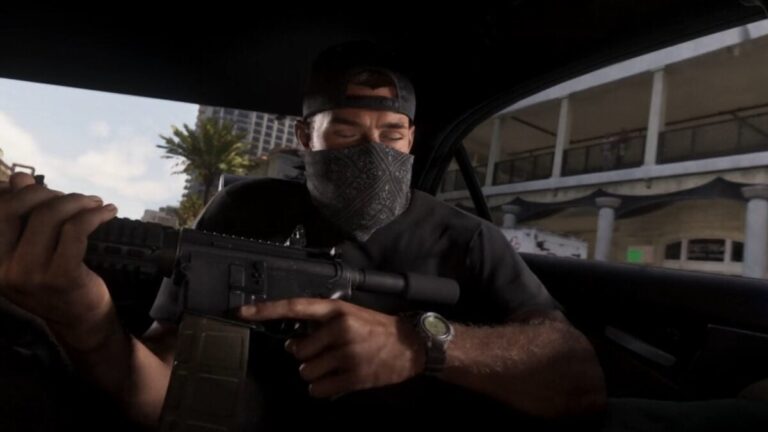
Rockstar Games has confirmed a new gameplay mechanic for Grand Theft Auto 6 that fundamentally shifts how players approach combat encounters. Suppressive fire will make its franchise debut, offering players a viable path to avoid killing police and civilians during escape sequences and criminal activities like store robberies. Rob Nelson, head of development and co-studio head at Rockstar Games, revealed the feature in an interview with Japan’s Famitsu magazine, discussing how it fits within the broader design philosophy alongside other mechanics showcased in a 26-minute Netflix trailer released earlier this week.
The confirmation reflects a deliberate design choice prioritizing player agency and meaningful consequence. Rather than funneling players toward lethal outcomes in confrontations, the game provides multiple mechanical and narrative paths to success during escalating moments.
Store Robberies and Criminal Economy
Money-making opportunities in GTA 6 extend well beyond traditional theft and vehicle sales. Store robberies now offer another primary avenue for generating income, introducing variables that ensure distinct encounters rather than predictable sequences. Nelson confirmed players can “make money by robbing stores” as part of a broader range of criminal pursuits designed to feel dynamic and player-driven.
The initial conditions matter significantly. A visible firearm changes NPC behavior before any crime occurs—witnesses may call police simply upon seeing the player armed, escalating situations based entirely on player approach and preparation. This single variable reshapes available options during the robbery itself.
This systemic design means robberies emerge from player choice rather than scripted sequences. Entering visibly armed triggers different responses than carrying a concealed weapon. A reputation as a non-lethal operator generates different police tactics than one established as a killer. Each robbery branches based on the intersection of immediate tactical choices and accumulated reputation.
How Suppressive Fire Mechanics Work
Directing Your Fire With Precision
The core mechanic empowers players to control gunfire direction independent of target aim. Rather than shooting directly at pursuing police or defensive targets, players deliberately fire shots in proximity to opponents. Nelson explained: “We have a new mechanic where you can control the direction of your gunfire. Instead of shooting directly at the police, you can deliberately miss and fire your shots near to them instead, which may confuse or startle the opponent and allow you time to make your escape.”
Mechanically, the technique generates breathing room during pursuits. By startling rather than eliminating threats, players create escape opportunities without extended firefights. The system rewards tactical positioning, shot timing, and situational awareness rather than pure accuracy or firepower. Understanding police patrol patterns allows players to thread suppressive fire effectively, forcing officers to take cover while protagonists extract.
Maintaining Story Coherence
Suppressive fire integrates with the narrative construction of Jason and Lucia as fugitives attempting to evade law enforcement. The mechanic prevents narrative dissonance by acknowledging realistic decision-making under pressure. Nelson emphasized this connection: “We wanted to give players the choice not to kill police or civilians while trying to get away. In other words, you can force them to remain in place while you escape, but it also sits in line with the story of how Jason and Lucia are trying to get away from the law.”
Nelson continued with the design rationale: “It would be unnatural to have the pair stay there and get involved in a long gunfight when they aren’t cornered or left with no other choice but to shoot. You can shoot, of course, but it will impact your reputation, and the police are tough opponents this time round.”
The system acknowledges that cornered individuals rationally choose non-lethal methods when available. Rockstar deliberately constructed scenarios where lethal force becomes optional rather than mandatory, preserving character coherence while respecting player agency.

Criminal Profile System and Reputation Consequences
Rockstar integrated a criminal profile system that catalogs player conduct across the entire campaign, functioning as an active reputation engine reshaping how the world treats the player. The system tracks behavioral patterns and translates them into a spectrum ranging from calculated thief to indiscriminate murderer.
Reputation directly influences world response. NPC dialogue, police deployment tactics, criminal associate opportunities, and even store employee fear levels shift based on player reputation position. Over dozens of hours, these micro-responses accumulate into a distinct character arc reflecting player choices and methods.
Killing during escapable situations generates reputation penalties extending beyond immediate gameplay pressure. A non-lethal operator and a trigger-happy criminal accrue fundamentally different reputation trajectories. The system makes these accumulated choices visible and consequential across the full campaign, ensuring that divergent playstyles produce divergent world responses.
Non-Lethal Tactical Options
Wounding and Vehicle Sabotage
The suppressive fire mechanic connects to a broader toolkit of non-lethal alternatives. Recent gameplay previews and trailer moments demonstrate that wounding enemies or rendering them unconscious serve as viable approaches. A featured scene illustrates Jason shooting out tires on a pursuing police truck—neutralizing the vehicle threat without killing occupants.
Nelson highlighted this trailer moment: “There are quite a few moments where you can make progress without killing anyone. [In that scene from the trailer] they were able to overturn the police car by shooting the tyres, but none of the police involved in that chase died. If Jason aimed directly at the policeman he could have killed him, but instead he chose not to do so.”
The example demonstrates how tactical thinking creates viable alternatives. Disabling vehicles, wounding officers, and forcing retreat all accomplish objectives while preserving life—options that complement suppressive fire as part of a larger non-lethal toolkit.
Police Difficulty and Strategic Incentives
Law enforcement has received significant combat enhancements this iteration. Nelson described police as “tough opponents,” suggesting that sustained firefights systematically favor law enforcement through superior numbers and resources. This difficulty balance creates natural incentive structures where avoidance and tactical escape become strategically sound approaches rather than merely story-preferred options.
Extended combat becomes mechanically risky, making suppressive fire and escape not just narratively thematic but tactically necessary. The design ensures that lethal approaches carry real costs—not just reputation penalties, but immediate danger. A non-lethal player who escapes via suppressive fire gains both narrative coherence and tactical advantage over one who engages in prolonged firefights against superior opposition.
Frequently Asked Questions
What is suppressive fire in GTA 6?
A new mechanic that lets players control gunfire direction to shoot near police and civilians instead of directly at them, startling them and creating escape opportunities without killing anyone.
How does the criminal profile system work?
The system tracks player conduct across the game, building a reputation spectrum from calculated thief to indiscriminate killer. Reputation determines how NPCs, police, and the world respond to Jason and Lucia.
Can players complete store robberies without killing anyone?
Yes. Robberies support multiple approaches based on player preparation, visible weapons, and reputation. Players can use suppressive fire, wound enemies, and sabotage vehicles to complete objectives without lethal force.
