
Key takeaways
- Microsoft transfers Halo to Activision as Halo Studios downsizes, marking the end of an era for the 25-year franchise.
- Friends Clay Purdom and Eric Sams reunited to play Halo: Campaign Evolved, reconnecting after decades separated by geography and life's demands.
- The original Halo's level design and AI create emergent gameplay moments that arise from interacting systems rather than scripted sequences.
- The two players debate whether optimization and strategy or spontaneous, loose-cannon play better captures the essence of Halo's design philosophy.
Microsoft’s recent announcement to transfer the Halo franchise to Activision stewardship marks a watershed moment for one of gaming’s most storied series. The move arrives just months after Halo celebrated its 25th anniversary, signaling the end of an era for both the franchise and Halo Studios itself. For two players in particular, this transition carries weight beyond industry news: it closes a chapter on a quarter-century of shared history that has defined their friendship and their lives.
A Franchise in Transition
The decision to shift Halo under Activision’s umbrella represents a significant pivot for Microsoft’s legendary shooter. Halo launched in November 2001, becoming a cornerstone of gaming history and establishing itself as one of the industry’s most significant franchises. Over 25 years, the series has remained central to the gaming landscape, even as the industry around it transformed. The move to Activision signals that Microsoft is repositioning its approach to the property, leaving Halo Studios to manage a diminished scope of operations.
Two Players, One Obsession
Clay Purdom and Eric Sams have been inseparable from the Halo series since its inception. They played the original campaign on futons, dorm-room floors, and in basements, moving through each new installment with devotional rigor. Their connection to the games ran so deep that when they collaborated on a Halo 5 review over a decade ago, the premise itself centered on the idea that they had been playing Halo together forever. They were not casual players. They were the kind of enthusiasts who would enter meditative flow-states running through the same campaign dozens of times on Legendary difficulty.
A Friendship Across Distance
Twenty-five years is a long time in anyone’s life. For Purdom and Sams, it has been transformative. They now live on opposite coasts. Purdom has built a suburban life: a successful business, two children, and the perpetual exhaustion that comes with parenting. Sams, by contrast, inhabits what Purdom characterizes as a life of “unbounded leisure” in Los Angeles, though Sams himself paints a different picture, describing a career arc that moved from law to social media management and culminated in burnout so visible his friends have told him he is “sizzling” with it. They speak at each other’s weddings. Halo was mentioned in at least one vow. But the inseparable bronemies of their youth have been pulled apart by time, geography, and the relentless march of adulthood.
The Reunion
When Halo: Campaign Evolved was announced as Halo Studios’ apparent final project, Sams texted Purdom with a proposition: play it together and write about the experience. Purdom was skeptical. He would kill for four hours of free time, let alone the twenty hours required to replay a campaign he and Sams had already beaten hundreds of times together. He spent weeks emailing Sams reasons why they should do literally anything else. Eventually, something about the tension of that moment, the franchise at a crossroads with two old friends separated by life’s demands yet bound by shared history, felt worth exploring. They committed to the project and strapped on their headsets one more time.
The Nature of “Halo Moments”
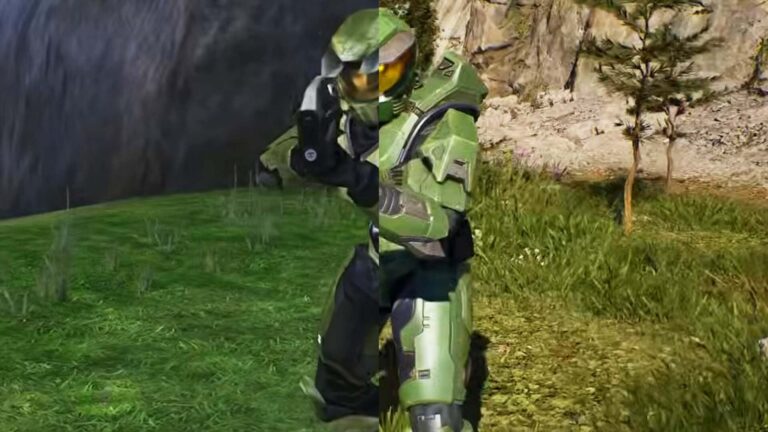
Playing Campaign Evolved together, both Purdom and Sams found themselves transported back to something fundamental about what the original Halo achieves. The game’s physicality, enemy artificial intelligence, and level design combine to create what the two friends call “Halo moments” – spontaneous eruptions of emergent gameplay that feel authored by the game itself even though they arise from the collision of systems working together.
When Chaos Creates Magic
These moments accumulate across a single playthrough. A grunt carrying two plasma grenades yells “surprise!” before charging down a hallway. A Banshee, a one-person alien attack ship, dives directly in front of the player, practically begging for a rocket. Purdom fires. The Banshee explodes. A piece of shrapnel careens across the battlefield and kills him instantly. It is absurd. It is hilarious. It is the AI setting up the joke and the physics engine delivering the punchline. In the 25 years since Halo’s release, neither player believes another shooter has matched it in consistency, with the possible exception of Halo 3 and Reach. The game creates these moments on every run when played on Legendary, tuned as hard as the difficulty permits.
Optimization vs. Spontaneity
A philosophical rift emerges between the two players as they tackle the campaign. Purdom tends toward optimization, studying the most efficient routes and strategies. Sams resists this approach entirely. He charges into firefights without calculation, dies frequently, and respawns without comment. When choosing weapons, Purdom gravitates toward the assault rifle, which he describes as the purest expression of Bungie’s weapon design, a blend of mid-range spray-and-pray chaos and lethal precision that practically demands the player mutter “get some” under his breath. Sams prefers the submachine gun.
Sams argues that Purdom has become what he calls a “modern gamer” – someone who lets stats and optimization overwhelm the actual experience of play, reducing video games to spreadsheet manipulation. He contends that when you optimize every decision, you risk eliminating the spontaneity that generates genuine Halo moments. The game’s brilliance, he maintains, lies in its refusal to require perfection. It rewards precision but does not demand it. Loose-cannon play succeeds even on Legendary. For Sams, this is evidence of the design’s genius and the surest path to the moments that define the experience.
The Practical Reality of Reunion
Their reconnection reveals other friction points beyond play philosophy. Purdom finds aspects of Sams’s approach inexplicable from a cognitive standpoint. Sams, for his part, has accepted that he is simply bad at video games by any competitive metric. But this acceptance does not extend to punctuality or technical preparation. Each session requires twenty minutes of troubleshooting Discord audio settings. Scheduling a time to play involves badgering via text and email. Yet beneath the friction runs something deeper: the muscle memory of friendship. Once they settle into the rhythm, the old patterns return. Two players who have done this together for so long that the movements feel automatic, even as the years have made them rusty.
A Game That Endures
Halo: Campaign Evolved proves that the original campaign still delivers on its core promise. The level design, the enemy behavior, the interplay between player agency and systemic reaction, these elements hold up not through nostalgia but through sound engineering. The Pillar of Autumn, the opening level, transports both players back through muscle memory to a dorm room at Ohio University where they had played this level perhaps 150 times over the decades. That repetition has revealed optimal methods for moving through each encounter unscathed, yet the game never becomes mechanical. Variation emerges even in the familiar.
What Remains
The question hanging over this reunion, though neither player states it directly, is what the franchise shift to Activision means for the series that has meant so much to them. The original game created something rare: a shooter that rewards precision without requiring it, that accommodates both strategy and chaos, that generates these sudden moments of emergent brilliance that feel almost authored by an intelligence beyond the code. Whether Activision’s stewardship preserves that quality, or whether Halo Studios’ move signals a fundamental break with what made the series special, remains to be seen. For now, Purdom and Sams have their Campaign Evolved playthrough, their rediscovered rhythm, and the strange alchemy of returning to something that shaped your life only to find it still capable of surprise.
Frequently Asked Questions
How long have Clay Purdom and Eric Sams been playing Halo together?
They have played every Halo game together since the original's release in November 2001, spanning 25 years of shared gaming history.
What is a "Halo moment" according to the article?
A Halo moment is a spontaneous, emergent gameplay interaction where the game's AI, physics, and level design combine to create surprising and delightful situations that feel authored by the game itself rather than deliberately scripted by developers.
