
Key takeaways
- Mass Effect: Universe would have accommodated all three endings from Mass Effect 3 without declaring any single version as canon, respecting players' accumulated choices.
- BioWare's approach reflected the same philosophy used in Dragon Age: The Veilguard—avoiding narrative that invalidates player decisions wherever possible.
- The cancelled game would have bridged the Milky Way and Andromeda galaxies while bringing back Liara as a returning character from the original trilogy.
- Details came from someone claiming to be part of BioWare's community council and were independently verified by a separate source confirming accuracy.
Details continue to emerge about Mass Effect: Universe, the fifth game in BioWare’s sci-fi RPG franchise that never reached players. After EA shut down the studio responsible for the project, a community council member claimed to have information about how the game would have tackled one of the series’ most contentious legacies: the multiple, divisive endings of Mass Effect 3.
Mass Effect: Universe Was Cancelled Alongside BioWare’s Closure
BioWare, the legendary studio behind the Dragon Age and Mass Effect franchises, wound down operations in 2024 after years of declining projects and studio instability. EA pulled the plug on Mass Effect: Universe as part of this collapse, leaving the game’s skeleton crew without a project to complete. The cancellation marked another chapter in the gaming industry’s ongoing contraction, particularly affecting established franchises and veteran studios.
A leaked trailer had surfaced showing glimpses of what the game would have become, with imagery suggesting it would bridge the gap between the Milky Way and Andromeda galaxies—the setting of Mass Effect: Andromeda from 2017. The game would also feature the return of Liara as a returning party member, connecting it directly to the original trilogy.
BioWare’s Strategy for Mass Effect 3’s Problematic Endings
The Challenge of Three Different Endings
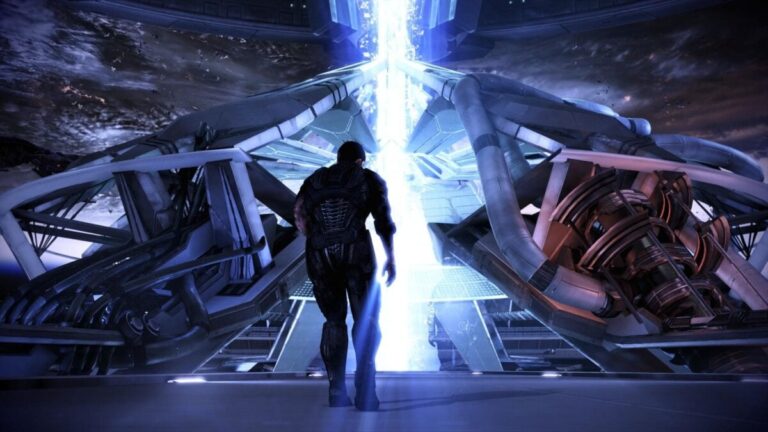
Mass Effect 3 concluded in 2012 with three endings that players could reach based on their choices throughout the game, but the endings were widely criticized for feeling restrictive and for not adequately reflecting the hundreds of hours players had invested in building their version of Commander Shepard. The endings generated enough backlash that BioWare eventually released an Extended Cut that added more context and narrative depth to each conclusion.
Writing Around All Choices Without Declaring Canon
Rather than selecting one ending as the “official” continuation for Mass Effect: Universe, BioWare intended to write the game in a way that respected the full range of player decisions made in the original trilogy. According to information shared by a YouTuber claiming community council involvement and later verified by a separate source who spoke to Kotaku, the studio would construct the story around all three endings simultaneously without forcing players to accept that their choices had been invalidated.
This approach reflected a philosophy that had taken shape at BioWare during the development of Dragon Age: The Veilguard. Creative director John Epler stated in 2024 that the studio deliberately avoided establishing a single canon: “Honestly, we try to avoid the idea of there being a single canon. I mean, it’s a game about choice. This is a game about your decisions as a player. The philosophy is we never want to invalidate your choices. And if we don’t feel we can do something respectful of the choice we made, we oftentimes just don’t necessarily reference it. So we never want you to feel like your world is being invalidated.”
Respecting Player Legacy in a Returning Setting
The decision to avoid overwriting player choice was particularly significant because Mass Effect: Universe was planned as a direct sequel to the original trilogy, set in a galaxy where players’ cumulative decisions would theoretically matter. Rather than retconning the endings or creating narrative workarounds that would feel forced, BioWare chose a more respectful path: acknowledging that different players experienced different conclusions and building the story to accommodate that reality without requiring anyone to surrender their version of events.
What We Know About the Game’s Scope
The leaked trailer and community council information provide limited but concrete details about Mass Effect: Universe’s setting and cast. The game would have featured a connection between two galaxies—the Milky Way, where the original trilogy took place, and Andromeda, the frontier explored in Mass Effect: Andromeda. This suggests a larger scope than the previous game, potentially aiming to unify the franchise’s two primary narratives.
Liara T’Soni, the long-running companion and romantic option from the original trilogy, was planned to appear as a returning character. Her presence would anchor the game in the established timeline and provide continuity for players whose version of Shepard had developed a relationship with her across three games.
The Information Comes From a Community Council Member
A YouTuber named Dantics released video analysis breaking down various narrative and world-building elements of Mass Effect: Universe based on information claimed to be from a BioWare community council—a group of dedicated fans who provided feedback to developers during the game’s production. While Kotaku could not independently verify Dantics’ involvement with the council, the outlet confirmed the accuracy of the information through a separate source.
Dantics appears to have some credibility within BioWare circles: former BioWare Executive Producer Michael Gamble follows him on Twitter, though this alone does not constitute verification. The separate confirmation of the story details lends weight to the claim that the information originated from someone close to the project.
Industry Context: Another Cancelled Game, Another Lost Vision
The cancellation of Mass Effect: Universe adds to a growing list of high-profile games that never reached completion due to studio closures, layoffs, and corporate restructuring. The loss of the game also represents a loss of BioWare’s approach to narrative and player agency at a time when the studio was experimenting with how to honor complex player choice across multiple games and storylines.
EA’s decision to shut down BioWare rather than continue funding Mass Effect projects has been controversial among fans and industry observers who viewed the studio as essential to the franchise’s identity. The closure also eliminated any possibility that Mass Effect: Universe would have demonstrated BioWare’s philosophy on player choice in practice.
An Amazon television adaptation of Mass Effect is currently in development, raising questions about whether the show’s writers will demonstrate similar respect for the source material’s multiple endings or whether they will select a single canon path for their adaptation.
Source: Kotaku
Frequently Asked Questions
How was Mass Effect: Universe going to handle the three different endings from Mass Effect 3?
According to leaked information verified by Kotaku, BioWare planned to write the game in a way that respected all three endings without declaring any single version as canon. The studio would construct the story to accommodate all player choices without invalidating anyone's experience of Mass Effect 3.
Who revealed the details about Mass Effect: Universe's story?
A YouTuber named Dantics claimed to be part of BioWare's community council and released a video breaking down narrative details. While Kotaku could not verify Dantics' direct involvement, a separate source confirmed the information's accuracy.
What setting and characters would Mass Effect: Universe have featured?
The game would have bridged the Milky Way and Andromeda galaxies, suggesting a larger scope than previous entries. It would have included Liara T'Soni returning as a party member from the original trilogy.
