
Key takeaways
- Early Kingdom Hearts games featured Final Fantasy characters like Tidus, Wakka, and Leon alongside Disney's cast, suggesting genuine parity between the franchises.
- Kingdom Hearts III's base game contained zero Final Fantasy characters, with the RPG series only returning via the Re:Mind DLC expansion.
- Final Fantasy characters have gradually diminished in prominence since the first game, suggesting Kingdom Hearts evolved beyond its original crossover identity.
- Lightning and Noctis from modern Final Fantasy games never appeared in Kingdom Hearts III despite their contemporary relevance when the game was in development.
The opening sequences of Kingdom Hearts present something the series has slowly abandoned: genuine parity between Disney and Final Fantasy as co-equal creative forces. According to Kotaku’s year-long replay of the franchise through its central narrative arc, this balance was most visible during the Destiny Islands introduction and the Traverse Town sequences, where characters from Square Enix’s prestigious RPG lineage interacted naturally with Disney’s animated pantheon. Two decades later, Kingdom Hearts III’s base game would release without a single Final Fantasy character, a reversal so significant that it raises questions about whether the original crossover concept meant what fans believed it meant.
Kingdom Hearts exists in the unusual space of merging Square Enix’s Final Fantasy franchise with Disney’s character library. The conceptual framework positions Sora, a protagonist original to the series, between two distinct universes: one anchored in Disney’s family-friendly sensibility and visual language, the other drawing from Final Fantasy’s tradition of dramatic storytelling, combat-driven narratives, and complex character psychology.
Destiny Islands: Introducing the Final Fantasy Guard
The first location players encounter establishes immediate ties to the FF universe through three characters carefully adapted for Kingdom Hearts’ younger aesthetic. Tidus and Wakka from Final Fantasy X appear alongside Selphie from Final Fantasy VIII, though all three have been substantially aged down from their source material appearances. The reduction strips them of adult responsibilities and contexts, transforming them into childhood playmates engaged in beach activities and island adventures appropriate for the game’s target demographic.
Design Choices That Respect Both Worlds
The developers made a deliberate decision to maintain visual and thematic connections to the original games despite the tonal shift. Tidus carries a bokken, a wooden training sword, rather than the actual blade he wields in FFX. Selphie swaps her signature nunchucks for a jump rope, a substitution that preserves her combat personality while adhering to Disney’s content boundaries. These modifications represent a conscious attempt to honor Final Fantasy players in the audience while ensuring the game’s overall tone remained consistent with Disney’s brand.
Despite these careful introductions, the trio’s narrative footprint remains limited. Their screentime never dominates Kingdom Hearts’ opening hours, yet their mere presence carries weight: Final Fantasy characters would occupy legitimate space within this new franchise.
Traverse Town: The Crossover Realized
Moving beyond Destiny Islands, players encounter Traverse Town, a refuge city built to shelter displaced persons whose worlds face erasure. This location delivers the crossover that FF fans anticipated: a space where established characters from the RPG series command presence alongside Disney representation.
The Familiar and the Transformed
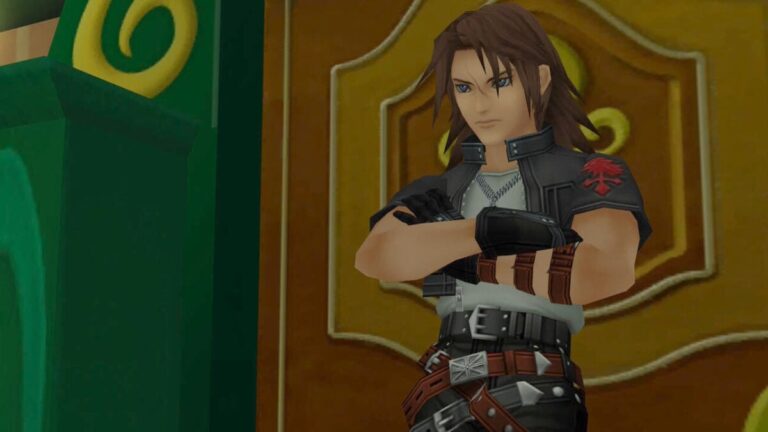
Squall Leonhart enters under his adopted name, Leon, maintaining close thematic and visual ties to his Final Fantasy VIII origin. His ice magic sensibility and analytical personality remain intact. Aerith and Yuffie from Final Fantasy VII complement the group, with Yuffie notably occupying a development slot originally reserved for Rikku from FFX before the creative team altered their approach. Cid Highwind, the mentor archetype from FFVII, also inhabits Traverse Town. Rather than cast voice acting for the character, the developers left him communicating solely through text bubbles, a technical limitation that still allows his gruff personality to shine through while eliminating dialogue that would contradict Disney’s guidelines around smoking and adult language.
How Tone Actually Serves Both Franchises
The Traverse Town sequences demonstrate genuine compositional skill: the interplay between Donald Duck’s comedic reflexes, Goofy’s earnest confusion, and the FF characters’ serious demeanor produces authentic humor without undermining either franchise. Kotaku observed that these moments feel earned rather than forced, suggesting Disney maintained creative input over how Kingdom Hearts portrayed the company’s characters within this more complex environment.

Character Adaptation: Consistency Within Divergence
Kingdom Hearts’ interpretation of FF characters raises questions about narrative consistency that fans have debated extensively. The Destiny Islands trio appear simplified compared to their source material: Selphie registers as younger than Leon, who roughly matches his age at the end of FFVIII. Neither character carries the narrative weight from their original games. The version of Wakka who appears in Kingdom Hearts harbors no hint of the cultural prejudice that defined his character in FFX. References to Spira, his home world, are absent entirely. The FFVII characters operate under different adaptation rules. Aerith and Yuffie require minimal adjustment for Kingdom Hearts’ tone because their characterization already aligned with what a Disney collaboration needed: personality without the graphic violence or mature themes their source material employed.
The Gradual Marginalization
What makes Kingdom Hearts’ relationship with Final Fantasy remarkable is not what the first game included but what subsequent entries removed. Kotaku’s reflection across the series reveals a pattern: as Kingdom Hearts developed its own mythology, FF characters receded from the center. Original characters multiplied, new plot threads expanded, and the source material partnerships gradually shifted from foundational to supplementary. This process unfolded gradually enough that no single moment marked the transition. Each subsequent game moved further from the collaborative spirit without announcing the shift explicitly.
Kingdom Hearts III: The Watershed Moment
The third mainline entry represented a breaking point that could not be ignored. Kingdom Hearts III released without any Final Fantasy characters in its base game, a reversal so significant that it suggested the franchise had fundamentally reconceived its identity. For a series partially built on FF representation, this erasure was deliberate rather than accidental. The absence persisted until the Re:Mind DLC, which reintroduced various series regulars but positioned them as additions rather than core content. Characters like Lightning from Final Fantasy XIII and Noctis from Final Fantasy XV, contemporary FF protagonists whose thematic complexity aligned with Kingdom Hearts’ aesthetic when KHIII was in development, never appeared in either the base game or the DLC.
Kingdom Hearts IV and the Possibility of Return
Kingdom Hearts IV, due to arrive approximately a year from the date of Kotaku’s analysis, will reportedly feature fewer distinct worlds but at substantially larger scale. This design philosophy theoretically permits deeper exploration of individual settings and characters, but whether it will extend to FF representation remains speculative. The question that Kotaku’s retrospective implicitly raises deserves consideration: would Kingdom Hearts III have positioned modern Final Fantasy heroes more centrally if the series had maintained its foundational commitment to both franchises? The decades-long reduction suggests a creative decision to transform Kingdom Hearts from true crossover into a game where FF characters exist as guests rather than inhabitants of a shared universe.
Source: Kotaku
Frequently Asked Questions
Which Final Fantasy characters appear in the original Kingdom Hearts?
Destiny Islands features Tidus and Wakka from Final Fantasy X and Selphie from FFVIII, all aged down for the young audience. Traverse Town introduces Leon (Squall from FFVIII) alongside Yuffie and Aerith from FFVII, plus Cid Highwind, who communicates only through text bubbles without voice acting.
Did Kingdom Hearts III include any Final Fantasy characters?
No. Kingdom Hearts III's base game contained no Final Fantasy characters. FF characters only returned in the Re:Mind DLC expansion.
Why did Yuffie replace Rikku in Kingdom Hearts?
Yuffie from FFVII occupies a development slot originally reserved for Rikku from FFX, but the source material does not explain the reason for this creative substitution.
