
Key takeaways
- Penguin Colony retells Lovecraft's 'At The Mountain of Madness' with Nazi explorers seeking racial purity, critiquing the genre's ideological foundations rather than just its creator's bigotry.
- Players control different penguin species—emperor, rockhoppers, chinstraps, and baby penguins—each with distinct abilities to solve platforming puzzles and navigate a frozen landscape.
- The game features narration by Lenval Brown and positions players as observers to cosmic catastrophe rather than heroes intervening in it, mirroring Faulkner's design philosophy from Umurangi Generation.
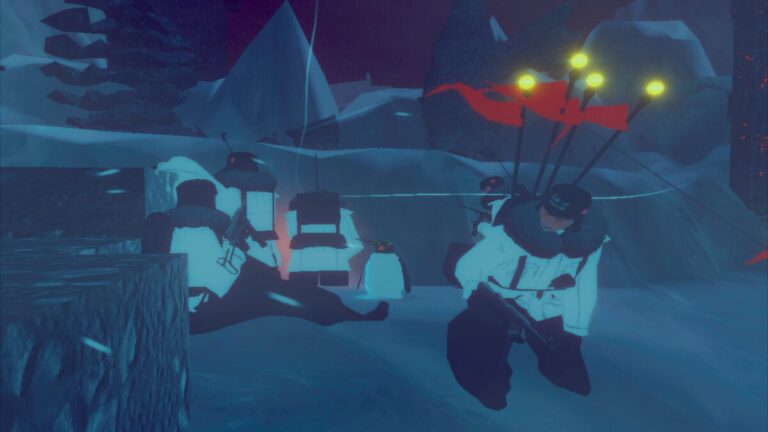
Naphtali Faulkner, creator of the documentary-photography game Umurangi Generation, has tackled Lovecraftian horror with an unexpected solution: adorable penguins. In Penguin Colony, you command a colony of Antarctic birds—emperor penguins, baby chicks, rockhoppers, and chinstraps—each with distinct abilities to navigate both platforming challenges and cosmic horror. Rather than centering human resistance to Lovecraft’s legacy, the game eliminates human importance entirely.
Rethinking Lovecraft’s Contradictions
The Genre’s Ideological Problem
Lovecraftian horror contains a fundamental contradiction. Lovecraft created a universe defined by cosmic insignificance and the limits of human understanding, yet his stories repeatedly centered Western academics whose curiosity triggered civilization-ending catastrophes. These narratives were woven through with race science and imperial conquest, treating fear of the unknown as inseparable from xenophobic panic. Many adaptations have either ignored this legacy entirely or introduced protagonists who explicitly reject Lovecraft’s bigotry. Faulkner chose a different path.
The Penguin Revision
Penguin Colony strips away human agency and arrogance altogether. Penguins are perfectly suited for their Antarctic environment, emotionally unbothered by cosmic horror, physically adapted to landscapes that destroy human explorers, and fundamentally indifferent to the ideological catastrophes unfolding around them. By positioning penguins as observers and inhabitants rather than victims or heroes, Faulkner critiques not just Lovecraft’s politics but the entire narrative framing of the genre itself.
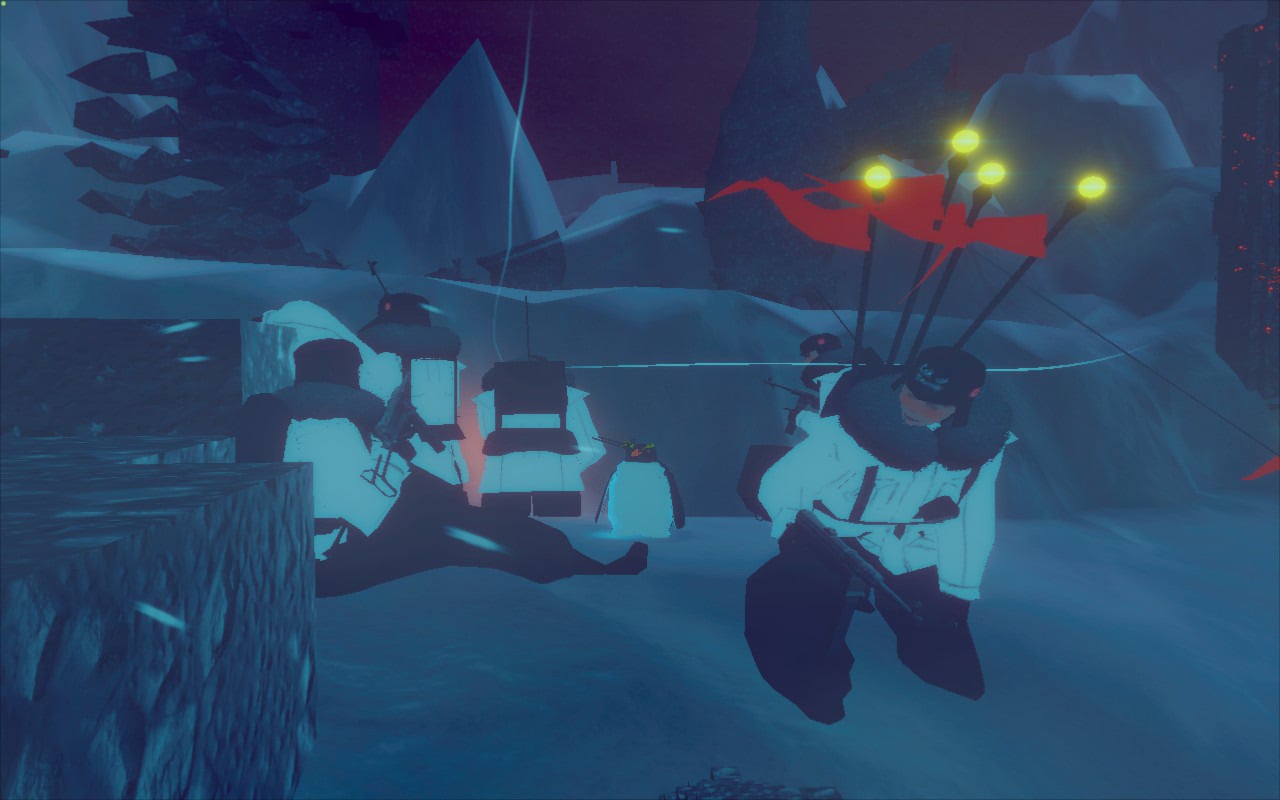
The game retells Lovecraft’s “At The Mountain of Madness,” but recasts the expedition as Nazi researchers seeking proof of racial purity through an ancient god’s appearance. What they discover is a shapeless, mind-bending entity whose form contradicts their entire ideological thesis, unleashing the reality-warping terror Lovecraftian horror prizes. Between chapters, segments feature indigenous caretakers who have spent generations cleaning up after self-inflated travelers. These sequences deliberately mimic other games, as if the player accidentally switched channels. The effect renders visible the labor typically erased from Western narratives of exploration and discovery.
Attacking Fundamentals Rather Than Symptoms
Faulkner’s approach differs from traditional “Nazi-punching” Lovecraftian adaptations like Hellboy. Rather than positioning better-intentioned heroes as the solution, the game attacks the fundamental structure of the genre. In Lovecraft’s stories, Western academics repeatedly cause cosmic-scale consequences through curiosity and arrogance, yet these narratives treat that pattern as inevitable rather than ideological. Penguin Colony reframes the entire premise: the beings best suited to witness and survive this catastrophe are those who have never claimed authority over the world.
Controlling a Colony Through Essence Transfer
Gameplay centers on a consciousness-transfer mechanic. By nuzzling against another penguin, you inhabit its body and gain access to its distinct abilities. Emperor penguins move with different speed than rockhoppers. Some swim with particular grace; others jump with precision. Each species offers a different approach to platforming challenges. The game’s level design accommodates these differences, turning obstacles into puzzles that require selecting the right penguin type for the task. Rockhoppers, for instance, seem to have magnetic feet, allowing them unusual climbing ability across surfaces other penguins cannot traverse.
Hidden throughout the landscape are secrets and environmental sights accessible only to specific penguin types. Reaching these requires understanding both the geography and each species’ physical strengths, transforming exploration into environmental puzzle-solving. A photo mode ability further expands how different penguins can interact with their surroundings. According to Kotaku’s testing, the implementation occasionally produces unintended consequences. The reviewer found themselves stuck in crevices at least three times in ways unrelated to cosmic horror, suggesting the game prioritizes the joy of controlling different penguin species over mechanical polish.
An Expedition Into Frozen Terror
The narrative structure mirrors classical Lovecraftian setup: an expedition ventures into unknown territory seeking confirmation of a hypothesis, only to encounter something that shatters their preconceptions. Here, the seekers are Nazi researchers whose hypothesis is pseudoscientific racism. Their goal is locating an ancient deity matching their ideological expectations. What they discover is a shapeless, reality-warping entity whose form contradicts their entire thesis. The catastrophe that follows is not positioned as a lesson the explorers learn—they are incapable of learning—but as a consequence the penguin colony must inhabit and endure.
Atmosphere and Narration
Lenval Brown’s Role
Lenval Brown provides narration with the same distinctive warmth he brought to Disco Elysium. His voice feels, as Kotaku noted, like honey in the ear. It guides the player through vast, dark, howling landscapes where scale and isolation dominate. Towering ice formations, unseen forces operating beyond comprehension, and the constant presence of something larger than any individual penguin’s understanding fill the environment. The tonal contrast between Brown’s warm narration and the cosmic dread of the settings creates unsettling dissonance—comfort and terror occupying the same space.
The Observer’s Role, Not the Conqueror’s
One of Faulkner’s explicit design principles, shared with Kotaku in a previous interview, was that the game would never force the player to watch a penguin suffer. When a penguin falls into a pit or becomes corrupted by otherworldly influence, the game immediately transfers consciousness to the next available colony member. The player is protected from witnessing individual suffering, even as the broader catastrophe unfolds around them. This approach echoes Umurangi Generation, where you operated as a photographer documenting an apocalyptic war rather than intervening in it. You pace through impossible architecture simply to witness what is happening, not to stop it. The penguins observe the world being upended by outsiders driven by hubris, yet remain untouched by the metaphysical consequences of that hubris. Defying time and space through arrogance, the game suggests, is fundamentally not a penguin’s burden.
Where Adorable Meets Unsettling
The game’s tonal contradiction is deliberate and jarring. Penguin jumps produce precious, anime-like sound effects. Movement animations carry inherent charm and comedic lightness. Yet Nazi soldiers graphically suffer the consequences of encountering forces beyond comprehension—flaying their own faces, pulling intestines out like paper towels. The penguins belly-slide and peck through this carnage, completely unbothered by the human horror surrounding them. Faulkner has created a Lovecraftian horror game that uses the genre’s own framework against its creator’s ideological foundation, proving that cosmic dread can function without centering Western perspectives as history’s protagonists or treating human curiosity as inherently tragic.
Frequently Asked Questions
Who created Penguin Colony?
Naphtali Faulkner created Penguin Colony. He is also the creator of Umurangi Generation, a documentary-photography game about an apocalyptic war.
What is the main story of Penguin Colony?
Penguin Colony retells Lovecraft's 'At The Mountain of Madness,' with Nazi researchers unlocking ice sheets to find an ancient god they believe matches their racial ideology. What they discover is a shapeless, mind-bending entity that contradicts their entire thesis, unleashing cosmic horror while penguins observe the catastrophe.
How does the penguin control system work?
By nuzzling against another penguin, you transfer your consciousness into its body and access its specific abilities. Different penguin types—emperor penguins, rockhoppers, chinstraps, and baby penguins—have distinct speeds, swimming prowess, and jumping capabilities, requiring you to select the right species for each platforming challenge.
